

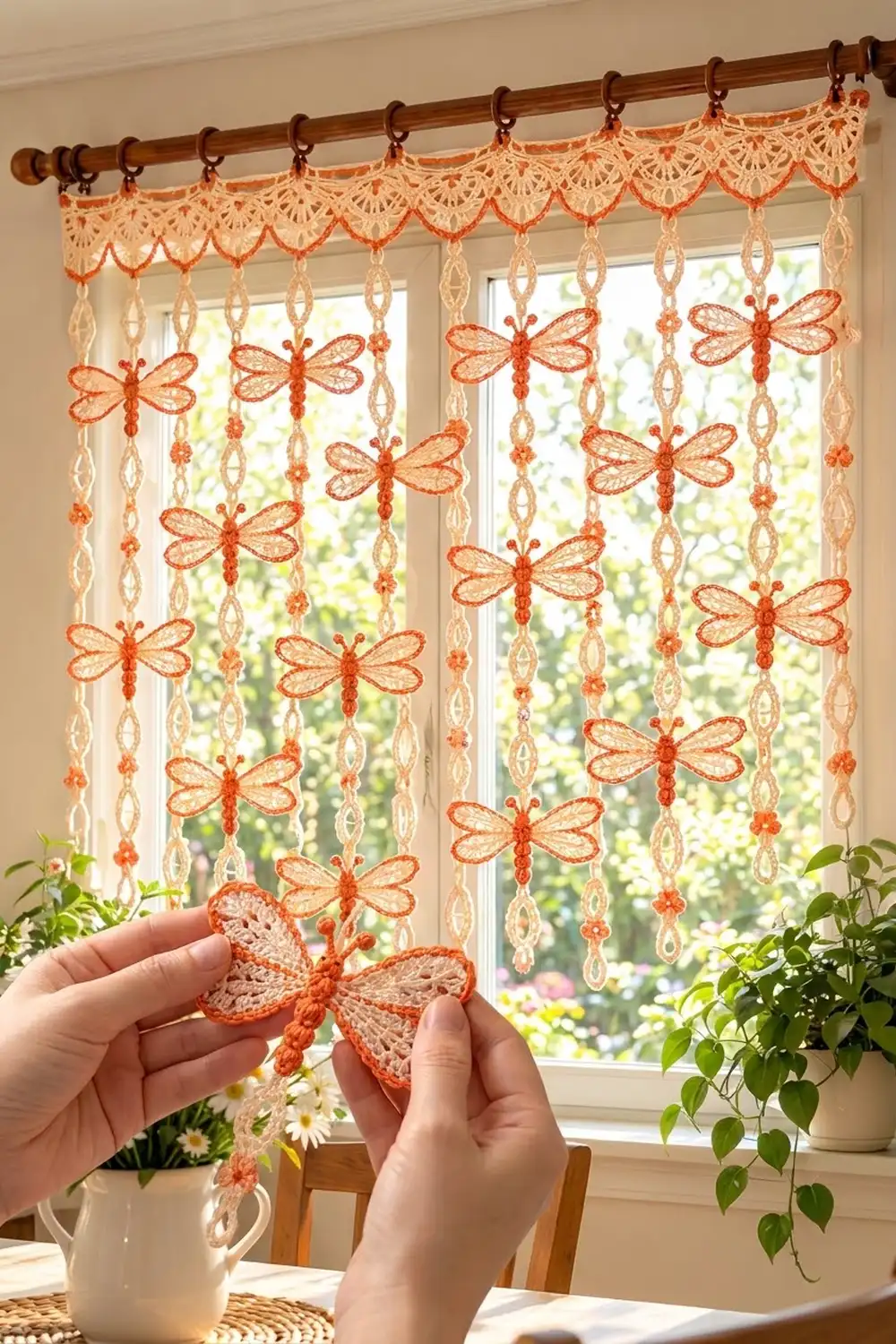
This lace curtain brings a garden feeling indoors. A scalloped cream valance hangs from the rod, and below it eleven airy strands of oval chain links drop toward the sill. Twenty-two dragonflies with beaded orange bodies and lacy cream wings sit in the strands at staggered heights. Tiny orange flowers dot the links between them.
The palette is just two colors: cream for the lace and burnt orange for the outlines, bodies, and flowers. The style is light and boho, and the open lace lets sunlight through.
This pattern uses US crochet terms. The finished curtain measures about 34.4 in (87.4 cm) wide and 36.5 in (92.7 cm) long from the top of the header to the strand tips, not counting the hanging loops.
Construction is modular. You make the dragonflies and flowers first, then work each strand as a chain of links and join the dragonflies in as you go. Next you crochet the header band, add the scalloped border, and join the strand tops into the final orange trim row.
Finished Size and Construction
- Finished size: 34.4 in (87.4 cm) wide x 36.5 in (92.7 cm) long
- Skill level: Intermediate
- Terminology: US terms
- Yarn weight: Fingering cotton (#1 super fine)
- Hook: 2.25 mm (US B-1)
- Number of pieces: 1 header, 11 strands, 22 dragonflies (each with 1 body and 4 wings), 44 flowers
- Layout: 11 strands hanging from the 11 inner valleys between 12 scallops
- Piece sizes: dragonfly 6 in (15.2 cm) across the wings and 2.5 in (6.4 cm) long; one link unit 1.5 in (3.8 cm); strand 33 in (83.8 cm)
- Header size before border: 34.4 x 2 in (87.4 x 5.1 cm)
- Border depth: 1.5 in (3.8 cm) of scallops, so the header is 3.5 in (8.9 cm) deep
Materials
Use a smooth mercerized fingering-weight cotton, about 170 m per 50 g. Mercerized cotton gives crisp lace and keeps the bobbles round. Avoid fuzzy blends because they blur the wing veins.
- Cream: 175 g, about 595 m
- Burnt orange: 90 g, about 306 m
These amounts include a margin of roughly 15% for swatching and sewing tails.
Tools:
– 2.25 mm (US B-1) hook
– Tapestry needle
– Stitch markers
– Rustproof pins and a blocking board
– Spray starch or a fabric stiffener (optional)
– 13 curtain rings or a slim rod
– Measuring tape
Abbreviations (US Terms)
- ch chain
- sl st slip stitch
- sc single crochet
- hdc half double crochet
- dc double crochet
- tr treble crochet
- sp(s) space(s)
- st(s) stitch(es)
- sk skip
- rnd round
- RS / WS right side / wrong side
Special stitches:
– 3-dc, 4-dc, 5-dc bobble: [yo, insert hook in st, pull up a loop, yo, pull through 2 loops] 3 (4, 5) times in the same st, then yo and pull through all loops on hook.
– Popcorn: Work 5 dc in the same st. Drop the loop, insert the hook front to back in the first dc, pick up the dropped loop and pull it through.
– 2-dc cluster: [yo, insert in ring, pull up a loop, yo, pull through 2 loops] twice, then yo and pull through all 3 loops.
Gauge and Checkpoints
Gauge: 28 dc and 12 rows = 4 in (10.2 cm). To swatch, ch 30, then dc in the 4th ch from the hook and in each ch across (28 sts). Work 12 rows.
Before you commit to the full set, make one test dragonfly and a 6-link strand segment. Check these measurements:
- Large wing after Rnd 1: 2.7 in (6.9 cm) long
- Large wing finished: 3 x 1.25 in (7.6 x 3.2 cm)
- Small wing finished: 2.5 x 1 in (6.4 x 2.5 cm)
- Body with antennae: 2.5 in (6.4 cm)
- 6 link units: 9 in (22.9 cm)
- Header after band Row 7: 34.4 x 2 in (87.4 x 5.1 cm)
If your pieces are too big, go down to a 2.0 mm hook. If they are too small, go up to a 2.5 mm hook. Small errors add up quickly: a link that is 0.1 in (0.3 cm) too long makes each strand 1.8 in (4.6 cm) longer.
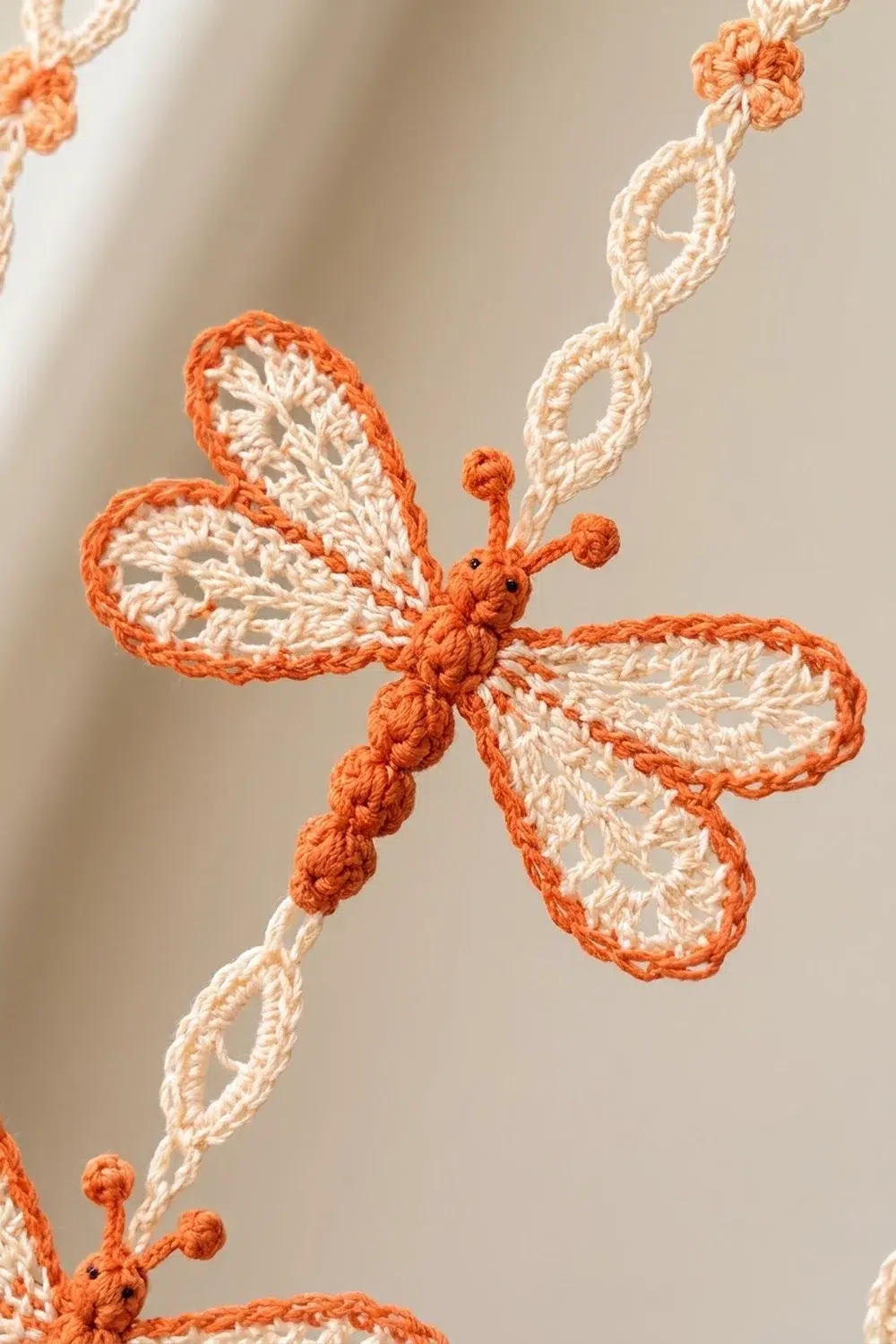
Dragonfly
Large Wing (make 2 per dragonfly)
Rnd 1 (cream): Ch 20. Sc in the 2nd ch from hook (this is the tip) and in the next 17 ch, then 3 sc in the last ch (this is the base). Rotate and work along the other side of the chain: sc in the next 17 ch, 2 sc in the first ch. Join with a sl st to the first sc. (40 sc)
Rnd 2 (cream): Ch 6 (counts as tr + ch 2), sk 1. Then work:
– [tr in next, ch 2, sk 1] 2 times
– [dc in next, ch 2, sk 1] 3 times
– [hdc in next, ch 2, sk 1] 2 times
– [sc in next, ch 2, sk 1] 4 times
– [hdc in next, ch 2, sk 1] 2 times
– [dc in next, ch 2, sk 1] 3 times
– [tr in next, ch 2, sk 1] 3 times
Join with a sl st to the 4th ch of the beginning ch-6. Fasten off. (20 sts: 6 tr, 6 dc, 4 hdc, 4 sc; 20 ch-2 sps)
The tall stitches at the tip and the short ones at the base give the wing its teardrop shape. The ch-2 gaps form the radiating veins.
Rnd 3 (orange): Join orange in any st. Ch 1, then sc in each st and 3 sc in each ch-2 sp around. Join. (20 + 60 = 80 sc) Fasten off, leaving a 10 in (25.4 cm) tail.
Small Wing (make 2 per dragonfly)
Rnd 1 (cream): Ch 16. Sc in the 2nd ch from hook and in the next 13 ch, then 3 sc in the last ch. Sc in the next 13 ch along the other side, then 2 sc in the first ch. Join. (32 sc)
Rnd 2 (cream): Ch 6 (counts as tr + ch 2), sk 1. Then work:
– [tr in next, ch 2, sk 1] 1 time
– [dc in next, ch 2, sk 1] 2 times
– [hdc in next, ch 2, sk 1] 2 times
– [sc in next, ch 2, sk 1] 4 times
– [hdc in next, ch 2, sk 1] 2 times
– [dc in next, ch 2, sk 1] 2 times
– [tr in next, ch 2, sk 1] 2 times
Join to the 4th ch of the beginning ch. Fasten off. (16 sts, 16 ch-2 sps)
Rnd 3 (orange): Sc in each st and 3 sc in each ch-2 sp. Join. (16 + 48 = 64 sc) Fasten off, leaving a 10 in (25.4 cm) tail.
Body (orange, make 1 per dragonfly)
The body is worked from the tail tip up as a stacked bobble column.
- Ch 4, then work a 4-dc bobble in the 4th ch from the hook (abdomen segment 1).
- [Ch 3, 4-dc bobble in the 3rd ch from the hook] 4 times (segments 2-5).
- Ch 3, then work a 5-dc bobble in the 3rd ch from the hook (thorax).
- Ch 3, then work a popcorn in the 3rd ch from the hook (head).
- Antenna: Ch 5, then work a 3-dc bobble in the 3rd ch from the hook for the knob. Sl st in the next 2 ch, then sl st in the top of the head.
- Repeat the antenna once more. Fasten off, leaving a 12 in (30.5 cm) tail.
The finished body has 7 round segments plus 2 knobbed antennae and is 2.5 in (6.4 cm) long.
Assemble the Dragonfly
Sew the base of one large wing to each side of the thorax. Sew one small wing to each side of segment 5. Tuck the wing bases slightly behind the body and spread the antennae into a V. The wingspan should be 6 in (15.2 cm).
Flower (orange, make 44)
Make a magic ring. [Ch 2, 2-dc cluster in the ring, ch 2, sl st in the ring] 5 times. (5 petals) Pull the ring closed and fasten off, leaving an 8 in (20.3 cm) tail. The flower measures 0.6 in (1.5 cm) across.
Strand Links
Link unit (cream): Ch 3 for the neck. Ch 16, then sl st in the 16th ch from the hook to form a ring. Ch 1, work 22 sc into the ring, then sl st to the first sc. Sl st in the next 11 sc to reach the bottom tip of the oval. (22 sc per link)
Each link unit (neck plus oval) measures 1.5 in (3.8 cm). Start each strand with a 12 in (30.5 cm) tail, which you will use to join the strand to the header.
Strand A (strands 1, 3, 5, 7, 9, 11): 3 links, dragonfly, 7 links, dragonfly, 8 links. (18 links)
Strand B (strands 2, 4, 6, 8, 10): 7 links, dragonfly, 7 links, dragonfly, 4 links. (18 links)
Each strand has 18 links x 1.5 in = 27 in, plus 2 dragonfly units of 3 in (7.6 cm) each, for a total of 33 in (83.8 cm).
Header Band (cream)
Row 1 (WS): Ch 242. Sc in the 2nd ch from the hook and in each ch across. (241 sc)
Row 2: Ch 3 (counts as dc), turn. Dc in each st across. (241 sts)
Row 3: Ch 4 (counts as dc + ch 1), turn, sk 1, dc in next. [Ch 1, sk 1, dc in next] across. (121 dc + 120 ch-1 sps = 241 sts)
Row 4: Ch 3, turn. Dc in each dc and in each ch-1 sp across. (241 sts)
Row 5: Repeat Row 3. (241 sts)
Row 6: Repeat Row 4. (241 sts)
Row 7 (WS): Ch 1, turn. Sc in each st across. (241 sc)
Checkpoint: The band should measure 34.4 x 2 in (87.4 x 5.1 cm).
Make All Pieces
Cream:
– 1 header band
– 44 large wings and 44 small wings (Rnds 1-2)
– 11 strands with 198 links in total
Orange:
– 22 bodies
– 88 wing edgings
– 44 flowers
– Header trim (Border Row 4)
Layout grid (depth = distance from the header’s lower edge to the top of each dragonfly; DF = dragonfly, | = links):
Strand:            1  2  3  4  5  6  7  8  9  10 11
Type:              A  B  A  B  A  B  A  B  A  B  A
4.5 in (11.4 cm)   DF |  DF |  DF |  DF |  DF |  DF
10.5 in (26.7 cm)  |  DF |  DF |  DF |  DF |  DF |
18 in (45.7 cm)    DF |  DF |  DF |  DF |  DF |  DF
24 in (61.0 cm)    |  DF |  DF |  DF |  DF |  DF |
Flower positions:
– Strand A: sew a flower on the neck above links 6, 9, 14, and 17.
– Strand B: sew a flower on the neck above links 3, 5, 11, and 17.
That gives 4 flowers per strand.
Joining
Dragonflies into strands: Work the links down to the first dragonfly position. After the sl sts to the bottom tip of the last link, ch 3 and sl st into the top of the dragonfly’s head, between the antennae. Fasten off.
Rejoin cream with a sl st in the foundation ch at the dragonfly’s tail tip. Ch 3, then continue with the next link. The 3-ch necks above and below each dragonfly are part of its 3 in (7.6 cm) unit.
Flowers: Center each flower over its neck and sew it on with 3-4 stitches through the petal base. Keep these stitches loose so the neck still hangs straight.
Tension: Keep the necks relaxed. A tight neck pulls the links into a zigzag.
Checkpoint: Hang each strand from its tail. Each one should measure 33 in (83.8 cm), and all 11 strands should match within 0.5 in (1.3 cm).
Border
Border gauge: One 20-st scallop repeat is 2.9 in (7.4 cm) wide. Rows 1-4 add 1.5 in (3.8 cm) of depth.
Row 1 (RS, cream): Ch 1, turn, sc in the first st. Ch 4, sk 4, sc in next, ch 7, sk 9, sc in next, ch 4, sk 4, sc in next; repeat from * 12 times. (37 sc, 36 loops)
Row 2 (WS, cream): Ch 1, turn, sc in the first sc. Ch 3, sk the ch-4 sp and the next sc, ([dc, ch 1] 8 times, dc) in the ch-7 sp, ch 3, sk the next sc and ch-4 sp, sc in the next sc; repeat from * 12 times. (12 fans = 108 dc; 13 valley sc)
Row 3 (RS, cream): Ch 1, turn, sc in the first sc. Ch 3, dc in the next dc, [ch 2, dc in the next dc] 8 times, ch 3, sc in the next sc; repeat from * 12 times. (108 dc, 96 ch-2 sps, 13 sc) Fasten off.
Top edge (cream): With RS facing, work along the foundation chain. (Sc, ch 10, sc) in the first ch. Sc in the next 19 ch, (sc, ch 10, sc) in the next ch; repeat from * 12 times. (254 sc, 13 hanging loops)
Side edges (cream): Along each short side of the band, work 1 sc per sc row and 2 sc per dc row. (12 sc per side)
Row 4 (RS, orange): Join orange in the first sc of Row 3. Ch 1, sc in the same st. 3 sc in the ch-3 sp, sc in the next dc, [2 sc in the ch-2 sp, sc in the next dc] 8 times, 3 sc in the ch-3 sp, sc in the next sc; repeat from * 12 times. (385 sc)
At the end of repeats 1-11, join a strand into that valley sc:
1. Insert the hook through the valley sc and through the strand’s first chain, then complete the sc.
2. Join Strand A to the odd valleys and Strand B to the even valleys.
3. Weave each strand’s tail into the header.
Why the math works: 241 = 12 repeats x 20 sts + 1 edge st. Each scallop’s trim has 3 + 1 + 24 + 3 = 31 sc, so 12 x 31 + 13 valley sc = 385. The 13 hanging loops sit at sts 1, 21, 41, … 241, every 20 sts, which matches the scallop repeat.
Final Blocking
- Wet the header and dragonflies, then roll them in a towel to remove extra water.
- Pin the header to 34.4 x 3.5 in (87.4 x 8.9 cm), with a pin at each scallop point.
- Pin each wing flat with the veins radiating outward. Spray with starch.
- Pin the antennae into a V.
- Hang the strands while they are damp, and gently tug each link into an oval.
- Let everything dry completely before hanging the curtain on the rod.
Final Quality-Control Checklist
- The header measures 34.4 in (87.4 cm) wide and has 12 even scallops.
- There are 13 hanging loops, 20 sts apart.
- There are 11 strands, each 33 in (83.8 cm) long with 18 links.
- There are 22 dragonflies, each with 7 body segments and 4 wings.
- There are 44 flowers, 4 per strand.
- All tails are woven in, and the dragonflies hang face forward.
Troubleshooting
- The header ruffles: The fans are too full. Change ch 7 to ch 6 in Row 1.
- The wings cup: Block them flat with starch, or work Rnd 3 more loosely.
- The strands are uneven: Recount the links and keep each neck at exactly 3 ch.
- The dragonflies twist: Add one tack stitch from the wing base to the neck behind it.
- The bobbles look flat: Pull each bobble’s final loop snug before you chain.
Care
Hand wash in cool water with mild soap. Lay the curtain flat to dry and reshape it before hanging.
Final Notes
Here is the full measurement chain:
– A gauge of 28 dc = 4 in (10.2 cm) gives a 241-st band that is 34.4 in (87.4 cm) wide.
– Twelve 2.9 in (7.4 cm) scallops add 1.5 in (3.8 cm) of depth.
– Eighteen 1.5 in (3.8 cm) links plus two 3 in (7.6 cm) dragonfly units make each strand 33 in (83.8 cm).
– The total drop is 36.5 in (92.7 cm).
If every measurement in that chain matches, the curtain will hang straight.
Happy crocheting!