
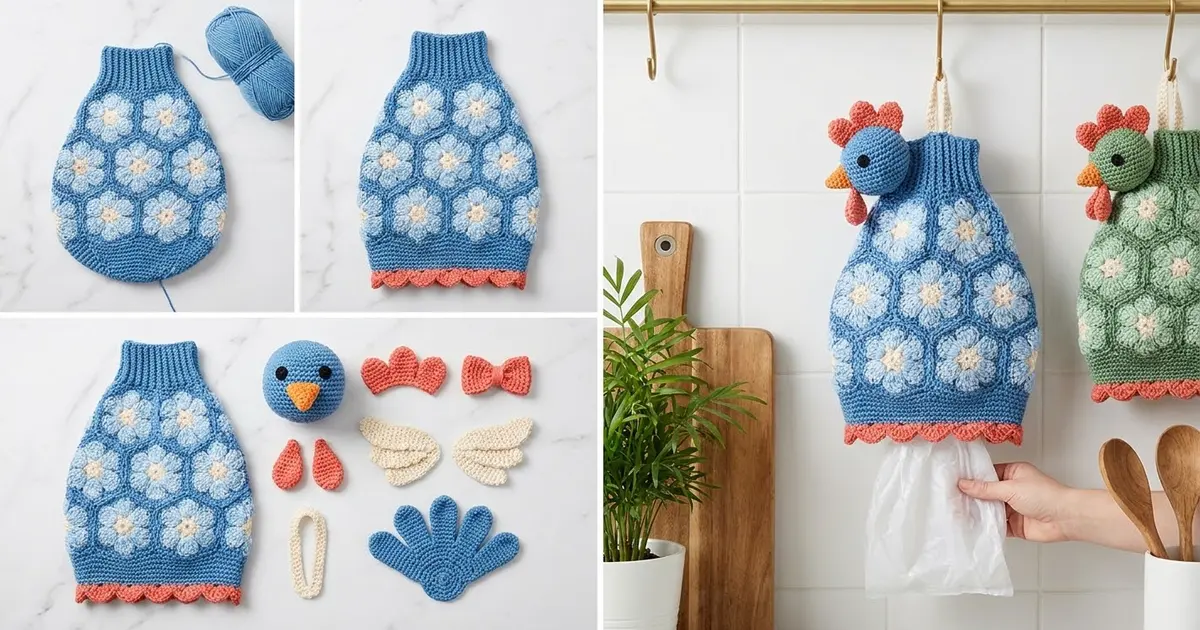
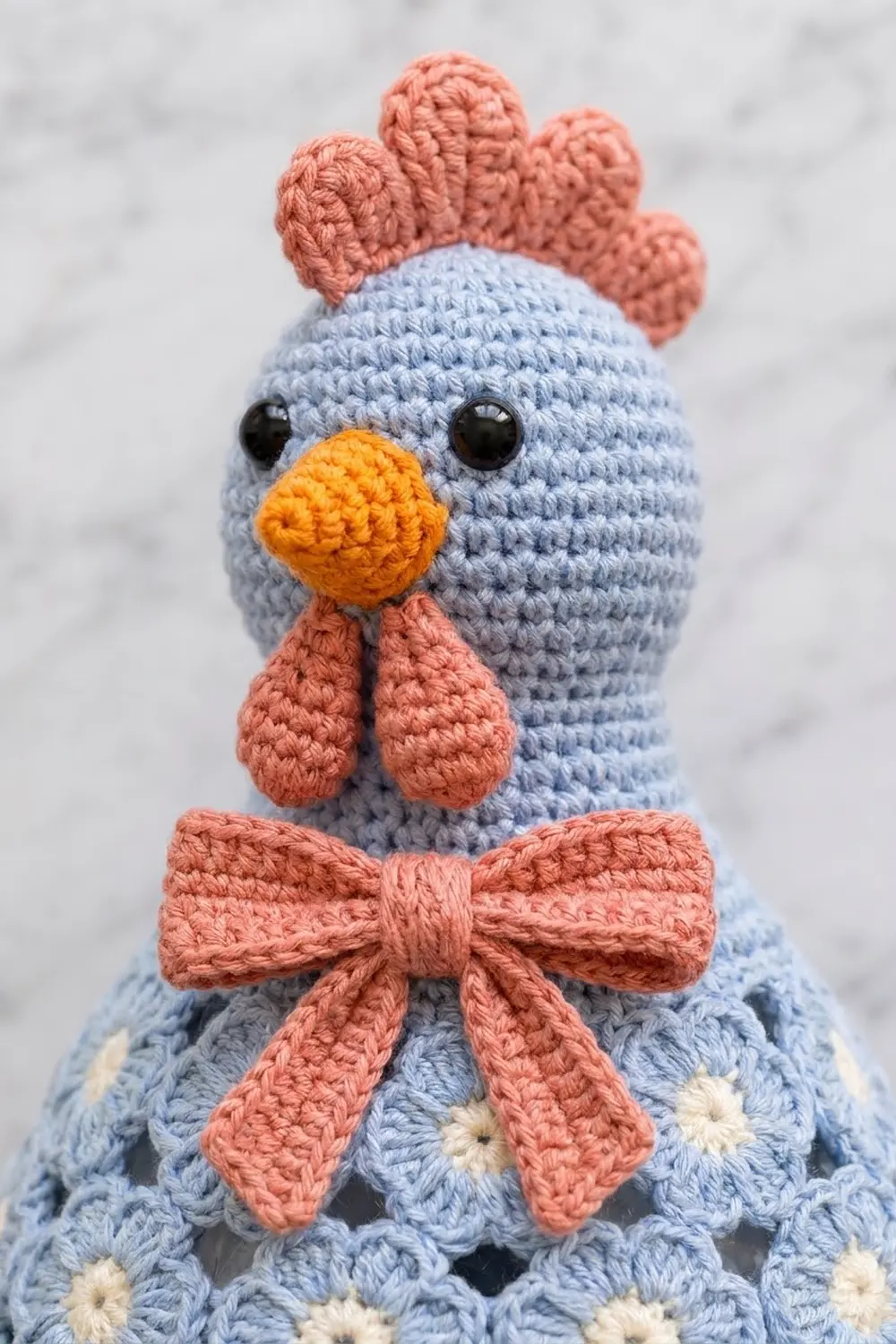
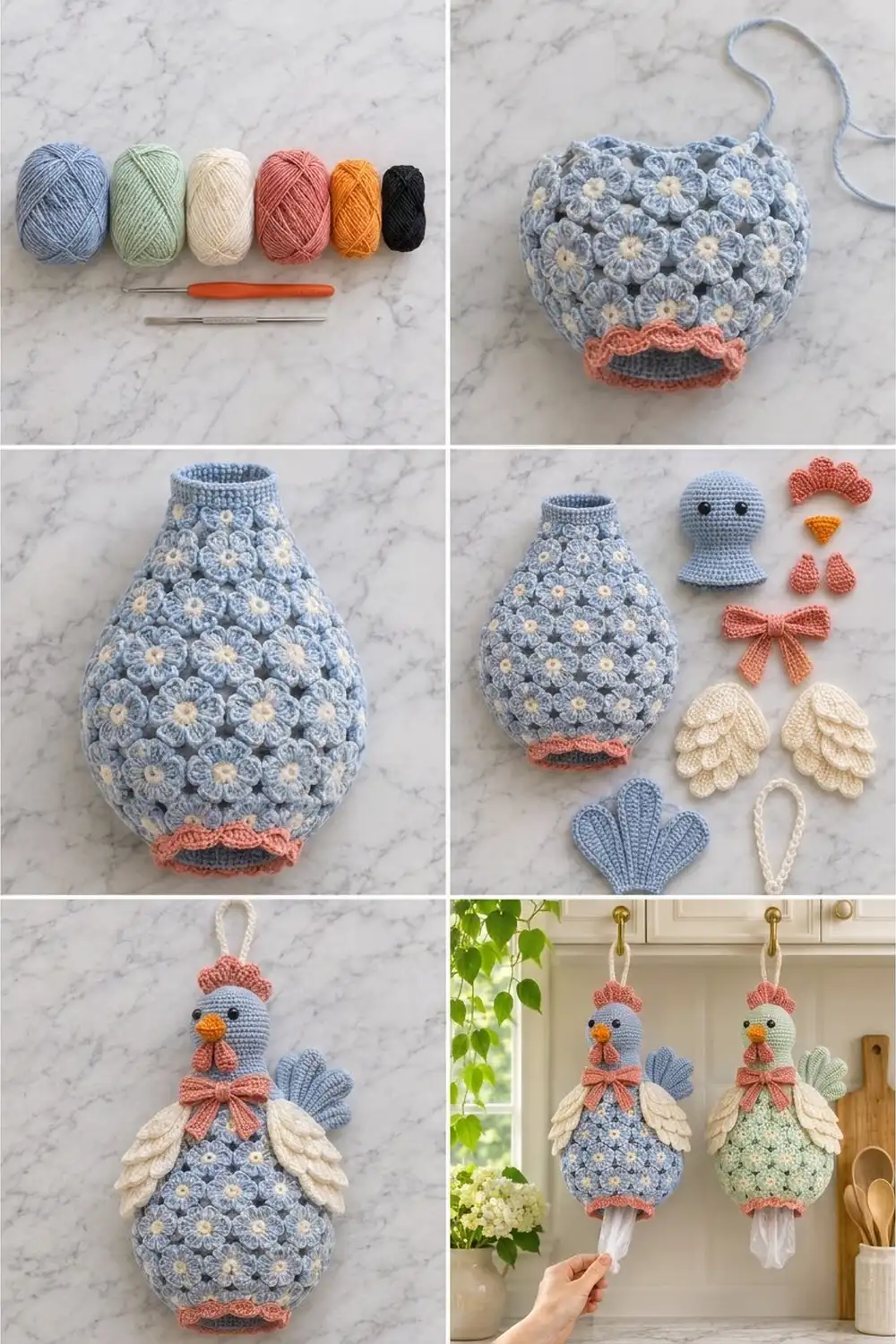
The Bluebell Hen is a hanging plastic bag holder in the shape of a plump chicken. Her teardrop body is a lacy shell of small blue flowers with cream centers. The flowers join petal tip to petal tip, so small open windows show between them. A coral scalloped ruffle trims the bottom opening, and a coral comb, wattles, and bow add warm accents against the soft blue.
The rest of the hen uses simple amigurumi-style shaping:
– a round blue head with black safety eyes and an orange triangle beak
– layered cream wings with rounded feather lobes
– a blue fan tail
– a cream chain loop for hanging
You load bags through the bottom opening and pull them out one at a time from below.
This pattern uses US crochet terms. The finished holder measures about 10.5 in (26.7 cm) wide across the body. It’s about 19.75 in (50.2 cm) tall from the top of the comb to the bottom edge, not counting the hanging loop.
Construction overview:
1. Make 82 flower motifs, joining them as you go into 8 rings that form the body.
2. Work a blue band at the neck and another at the bottom.
3. Add the coral scallop trim.
4. Make the head, comb, beak, wattles, bow, wings, tail, and loop, then sew them on.
Finished Size and Construction
- Finished size: about 10.5 in (26.7 cm) wide x 19.75 in (50.2 cm) tall
- Skill level: Intermediate
- Terminology: US
- Yarn weight: Worsted (#4) cotton or cotton blend
- Hook: 4 mm (G-6)
- Number of pieces: 82 flowers (joined into one body), plus head, comb, beak, 2 wattles, bow (3 parts), 2 wings (3 tiers each), tail, and loop
- Layout: 8 rings of flowers, from bottom to top: 10, 12, 12, 12, 12, 10, 8, 6
- Piece size: one flower measures 1.75 in (4.4 cm) from petal tip to petal tip
- Size before border: the body is 15 in (38.1 cm) tall from the neck edge to the bottom edge, including both bands
- Border depth: the scallop trim is 0.75 in (1.9 cm) deep and lies over the bottom band, so it adds no height
Materials
Choose a smooth worsted cotton, either mercerized or matte. Cotton keeps the flower shapes crisp and won’t stretch out under the weight of the bags. The amounts below assume about 1.6 m per gram.
- Blue: 250 g / 400 m (flowers, bands, head, tail)
- Cream: 80 g / 128 m (flower centers, wings, loop)
- Coral: 50 g / 80 m (trim, comb, wattles, bow)
- Orange: 10 g / 16 m (beak)
All quantities include a margin of about 15–20%.
Tools:
– 4 mm (G-6) hook
– One pair of 10 mm black safety eyes
– About 20 g polyester fiberfill
– Tapestry needle
– Stitch markers
– Rustproof pins and a blocking mat
– Scissors
To make a green hen, use green in place of blue in the same amounts.
Abbreviations (US Terms)
- ch – chain
- sl st – slip stitch
- sc – single crochet
- hdc – half double crochet
- dc – double crochet
- inc – 2 sc in the same stitch
- dec – sc2tog (single crochet 2 together)
- sc3tog – single crochet 3 together
- BLO / FLO – back loop only / front loop only
- mr – magic ring
- st(s) – stitch(es); sp – space; rnd – round
Special stitch – Tip Join: When you reach the ch-1 at a petal tip, don’t chain 1. Instead, sl st into the ch-1 tip of the neighboring flower, then finish the petal as written. A joined tip still counts as that petal’s tip.
Gauge and Checkpoints
Gauge: 16 sc and 16 rnds = 4 in (10.2 cm), worked in sc in the round.
Make one test flower before you start the body:
– After Rnd 1, the center should measure 0.75 in (1.9 cm) across.
– After Rnd 2, the flower should measure 1.75 in (4.4 cm) from tip to tip.
If the flower is too big, go down 0.5 mm in hook size. If it’s too small, go up 0.5 mm. A difference of just 0.125 in (0.3 cm) per flower adds up to 1.5 in (3.8 cm) around a 12-flower ring.
Checkpoints:
– Ring 1, laid flat: 8.75 in (22.2 cm) wide
– Ring 2, laid flat: 10.5 in (26.7 cm) wide
– All 8 rings finished: 12.25 in (31.1 cm) tall
– Neck band, laid flat: 4.5 in (11.4 cm) wide
– Bottom band, laid flat: 6 in (15.2 cm) wide
Flower Motif
Rnd 1 (cream): Make a mr, ch 1, and work 12 sc into the ring. Sl st to the first sc. (12) Fasten off.
Rnd 2 (blue): Join blue in any sc. Sc in that st, then (hdc, dc, ch 1, dc, hdc) in the next st. Repeat from * to * 6 times in total. Sl st to the first sc. (6 sc + 24 petal sts = 30 sts, plus 6 ch-1 tips) Fasten off.
This gives you 6 rounded petals, each with a ch-1 tip.
Naming the tips: For joining, lay the flower with one tip pointing right. Moving counterclockwise from there, the tips are:
– T1 – right
– T2 – upper right
– T3 – upper left
– T4 – left
– T5 – lower left
– T6 – lower right
Make All Pieces
Flowers: Make 82 in total. Finish the first flower completely. Join every flower after that during its own Rnd 2 (see Joining).
The body layout, with the number of flowers in each ring:
Ring 8:  6   (top, under neck)
Ring 7:  8
Ring 6:  10
Ring 5:  12
Ring 4:  12
Ring 3:  12
Ring 2:  12
Ring 1:  10  (bottom)
Total:   82
That’s 82 cream centers and 82 blue petal rounds in total.
Head (blue, continuous spiral):
– Rnd 1: 6 sc in a mr. (6)
– Rnd 2: Inc in each st. (12)
– Rnd 3: Sc, inc 6 times. (18)
– Rnd 4: Sc 2, inc 6 times. (24)
– Rnd 5: Sc 3, inc 6 times. (30) The head should now measure 7.5 in (19.1 cm) around.
– Rnds 6–11: Sc around. (30)
– Rnd 12: Sc 3, dec 6 times. (24)
– Rnd 13: Sc 2, dec 6 times. (18)
Insert the safety eyes between Rnds 8 and 9, 7 sts apart. Stuff the head firmly.
- Rnds 14–18: Sc around. (18) This is the neck. Stuff it lightly.
- Rnd 19: Sc 2, inc 6 times. (24)
- Rnd 20: Sc 3, inc 6 times. (30)
- Rnd 21: Sc 4, inc 6 times. (36) Fasten off with a long tail. Don’t stuff the flare.
Comb (coral): Ch 13.
– Row 1: Sc in the 2nd ch from the hook and in each ch across. (12)
– Row 2: Sl st in the first st. 5 dc in the next st, sl st in the next st. Repeat from * to * 5 times. Sl st in the last st. (5 scallops; uses all 12 sts)
The comb is 3 in (7.6 cm) long.
Beak (orange): Ch 6.
– Row 1: Sc in the 2nd ch from the hook and in each ch across. (5)
– Row 2: Ch 1, dec, sc, dec. (3)
– Row 3: Ch 1, sc3tog. (1)
The beak is 1.25 in (3.2 cm) wide.
Wattles (coral, make 2): In a mr, work ch 2, 6 dc, ch 2, then sl st into the ring. Pull the ring tight to form a teardrop.
Bow (coral):
– Loops piece: Ch 21. Hdc in the 3rd ch from the hook and in each ch across. (19) For the next 4 rows, ch 2 (doesn’t count as a st) and hdc across. (19) The piece is 4.75 in (12.1 cm) wide. Fold both ends to the center and tack them in place.
– Tails (make 2): Ch 10. Sc in the 2nd ch from the hook and in each ch across. (9) Work 1 more row of sc. (9)
– Center wrap: Ch 9. Work 2 rows of sc. (8) Wrap it around the middle of the loops piece and the tops of the tails. Sew it closed at the back.
Wings (cream, make 2): Each wing is made of 3 tiers. In every tier, the base row has (number of lobes x 4) + 1 sc.
- Tier A (4 lobes): Ch 18.
- Row 1: Sc in the 2nd ch from the hook and in each ch across. (17)
- Row 2: Sc in the first st. Skip 1, 7 dc in the next st, skip 1, sc in the next st. Repeat from * to * 4 times. (1 + 16 = 17 base sts used)
- Tier A is 4.25 in (10.8 cm) wide.
- Tier B (3 lobes): Ch 14. Work Rows 1–2 as for Tier A. (13 sc; 3 lobes)
- Tier C (2 lobes): Ch 10. Work Rows 1–2 as for Tier A. (9 sc; 2 lobes)
Stack the tiers so the outer edges line up:
1. Tier A goes on the bottom.
2. Tier B goes on top, with its lobes overlapping the upper half of Tier A’s lobes.
3. Tier C goes on top of Tier B.
Sew the tiers together along their Row 1 bases.
Tail (blue): Ch 2.
– Row 1: 6 sc in the 2nd ch from the hook. (6)
– Row 2: Ch 1, turn, 2 sc in each st. (12)
– Row 3: Sl st in the first st. Ch 9. Working back along the chain: sc in the 2nd ch, hdc in the next ch, dc in the next 5 ch, hdc in the last ch. Skip 1 sc, sl st in the next sc. Repeat from * to * 5 times. Sl st in the last st. (5 feathers; uses all 12 sts)
– Row 4: Sc evenly around each feather, working 3 sc at each tip to round it.
The tail is about 4 in (10.2 cm) wide.
Loop (cream): Ch 41. Sl st in the 2nd ch from the hook and in each ch across. (40) The strip is 9 in (22.9 cm) long and forms a 4.5 in (11.4 cm) loop.
Joining
Method: Join as you go, using the Tip Join during each flower’s Rnd 2.
Ring 1 (10 flowers):
– Join each new flower’s T4 to the T1 of the flower before it.
– On flower 10, also join its T1 to flower 1’s T4. This closes the ring.
– Check that the ring isn’t twisted and measures 8.75 in (22.2 cm) wide when laid flat.
Ring 2 and up: Join each new flower at three tips:
– T5 to T2 of the flower below and to the left
– T6 to T3 of the flower below and to the right
– T4 to the T1 of the previous flower in the same ring
Close each ring the same way as Ring 1.
Changing the number of flowers: Keep all increases and decreases at the two side folds, directly opposite each other.
– Ring 2 (10 to 12 flowers): The two flowers that sit at the folds join only at their sides, leaving their T5 and T6 free. The other 10 flowers use all 20 upper tips of Ring 1.
– Rings 3–5 (12 flowers over 12): All 24 upper tips of the ring below are joined.
– Rings 6, 7, and 8 (down to 10, 8, and 6 flowers): In the ring below, the two flowers at the folds leave their T2 and T3 free. That leaves exactly 2 x (new flower count) tips for the new ring to join.
Tension: Make the sl st joins the same tension as your chains. Tight joins pucker the lace, and loose joins let it sag.
Size checkpoint: After Ring 8, the body should be 12.25 in (31.1 cm) tall. Laid flat, it should be 10.5 in (26.7 cm) wide across Rings 2–5.
Neck band (blue), worked into the 12 free tips of Ring 8:
– Rnd 1: Sc in the tip, ch 3. Repeat around. (12 sc + 12 ch-3 sps)
– Rnd 2: Sc in each sc and 2 sc in each ch-3 sp. (12 + 24 = 36)
– Rnds 3–5: Sc around. (36)
The neck band is 1.25 in (3.2 cm) tall and 4.5 in (11.4 cm) wide when laid flat.
Bottom band (blue), worked into the 20 free lower tips of Ring 1:
– Rnd 1: Sc in the tip, ch 3. Repeat around. (20 sc + 20 ch-3 sps)
– Rnd 2: Sc in each sc and 2 sc in each ch-3 sp. (20 + 40 = 60)
– Rnd 3 (BLO): Sc 3, dec. Repeat 12 times. (48)
– Rnds 4–5: Sc around. (48)
The bottom band is 1.5 in (3.8 cm) tall. The opening is 12 in (30.5 cm) around, or 6 in (15.2 cm) wide when laid flat.
Assembly:
1. Head: Whipstitch Rnd 21 of the head flare (36 sts) to Rnd 5 of the neck band (36 sts), one stitch to one stitch.
2. Comb: Sew it along the top of the head, front to back.
3. Beak and wattles: Center the beak over Rnds 10–11. Sew the wattles just below it.
4. Bow: Sew it over the front of the seam where the head meets the neck.
5. Wings: Sew one wing to each side fold over Rings 3–6, with the lobes pointing down.
6. Tail: Sew it to the back right, at Rings 6–7.
7. Loop: Fold the loop and sew both ends behind the comb.
Border
Border gauge: 4 sts = 1 in (2.5 cm), the same as the body.
You’ll work the coral trim into the front loops of bottom band Rnd 2. These loops were left free when you worked Rnd 3 in the BLO. Flatten the body so each side has 30 of these loops.
- Rnd 1: Join coral at one fold. Sc in each front loop around. (60 sts; 30 per side) Sl st to the first sc.
- Rnd 2: Sc in the next st, skip 2, 7 dc in the next st, skip 2. Repeat from * to * 10 times. Sl st to the first sc. (10 sc + 70 dc = 80 sts; 5 shells and 40 sts per side)
Why the math works: Each shell repeat uses 6 base sts. 60 ÷ 6 = 10 shells in total, and 30 ÷ 6 = 5 shells per side, so no stitches are left over. Because you started at a fold, an sc lands on each fold and the scallops are centered on the front and back. The shells hang 0.75 in (1.9 cm) and lie over Rnds 3–5 of the bottom band.
Final Blocking
- Lightly mist the body or dip it in cool water, then roll it in a towel to remove extra water.
- Fill the body with plastic bags or a towel until it reaches a 10.5 in (26.7 cm) teardrop shape.
- Use your fingertips to open the petals so the gaps between flowers are even.
- Pin the wings and tail flat with their lobes separated.
- Pin the scallops so they fan out evenly.
- Let everything dry completely before you remove the filling.
Final Quality-Control Checklist
- All 82 flowers measure 1.75 in (4.4 cm).
- The rings aren’t twisted, and all increases and decreases sit at the side folds.
- The neck band and head flare each have 36 sts and are sewn one to one.
- The opening is 6 in (15.2 cm) wide when laid flat.
- There are 5 scallops on each side.
- The safety eyes are locked securely, and all yarn ends are woven in twice.
Troubleshooting
- Body leans or spirals: Check that each flower joins the ring below at T5/T6, not at T4/T5.
- Rings ruffle: The joins are too loose. Redo them a little tighter.
- Neck is too wide for the head: Rework neck band Rnd 2 with a hook one size smaller.
- Scallops are off-center: Restart the trim exactly at a fold.
- Bags fall out: Add one round of sc 4, dec to the bottom band (40 sts).
Care
Hand wash in cool water. Reshape the body around a towel and let it dry flat. Don’t tumble dry.
Final Notes
Every size in this pattern builds on the one before it:
– The 1.75 in (4.4 cm) flower sets the size of each ring.
– Twelve flowers make the 10.5 in (26.7 cm) wide body.
– Eight rings make the body 12.25 in (31.1 cm) tall.
– The neck band turns 12 tips into 36 sts, which match the 36-st head flare.
– The bottom band turns 20 tips into 60 sts for an even 10-shell trim, then narrows to a 48-st opening.
Check your gauge first and the rest follows. Happy crocheting!