

These lace curtains have deep teal dragonflies set in rows on an airy cream mesh. Each dragonfly has a beaded bobble tail, four lattice-filled wings and two short antennae. Small five-petal flower nodes hold the mesh in place, and the light comes through between them.
The palette is two colors: a rich teal for the dragonflies and a soft cream for the mesh, frames and border. The style is vintage lace with a garden feel. It suits a sunny living room, a bedroom or French doors.
This pattern uses US crochet terms. Each finished panel measures 32 x 92 in (81.3 x 233.7 cm), and the pattern makes two panels.
Construction is modular. You make the dragonfly body and four wings in teal, then sew them together. Next, you work four cream rounds around the dragonfly to turn it into a rectangular block with a solid single crochet frame. You join the blocks into a 3 x 10 grid and finish each panel with a three-round picot border.
Finished Size and Construction
- Finished panel size: 32 x 92 in (81.3 x 233.7 cm), make 2
- Skill level: Intermediate
- Terminology: US
- Yarn weight: DK (#3) mercerized cotton
- Hooks: 3.5 mm (E-4) for the dragonflies, 4.0 mm (G-6) for the cream mesh
- Number of pieces: 30 blocks per panel, 60 blocks total
- Layout: 3 blocks across x 10 blocks down per panel
- Block size: 10 x 9 in (25.4 x 22.9 cm)
- Panel size before border: 30 x 90 in (76.2 x 228.6 cm)
- Border depth: 1 in (2.5 cm) on every side
Materials
Choose a smooth mercerized cotton or a cotton blend. It shows the stitch detail clearly, holds its shape when hanging, and handles sunlight better than acrylic.
- Teal (Color A): 400 g, about 960 m
- Cream (Color B): 800 g, about 1920 m
These quantities assume about 120 m per 50 g and include a margin of roughly 15%.
Tools:
– 3.5 mm (E-4) and 4.0 mm (G-6) crochet hooks
– Tapestry needle
– Stitch markers
– Rust-proof pins and blocking mats
– Tape measure
– Spray bottle
– 22 curtain clip rings (11 per panel)
Abbreviations (US Terms)
- ch = chain
- sl st = slip stitch
- sc = single crochet
- hdc = half double crochet
- dc = double crochet
- sk = skip
- sp = space
- st(s) = stitch(es)
- RS = right side
Special stitches:
- Bobble: [Yarn over, insert hook in st, pull up a loop, yarn over, draw through 2 loops] 3 times in the same st. Yarn over and draw through all 4 loops.
- Popcorn: Work 5 dc in the same st. Drop the loop from the hook, insert the hook front to back in the first dc, pick up the dropped loop and pull it through.
- Flower node (FN): [Ch 3, sl st in 3rd ch from hook] 5 times, then sl st in the ch at the base of the first petal. This makes a tiny five-petal flower. The 3rd petal is the tip petal.
- Picot: Ch 3, sl st in 3rd ch from hook.
Gauge and Checkpoints
Frame gauge: 4 sc = 1 in (2.5 cm) on the 4.0 mm hook, measured along Rnd 4 of a block.
Make and block one full block before starting production. Every later measurement depends on it.
Checkpoints:
– Upper wing: 3.75 in (9.5 cm) long, 1.5 in (3.8 cm) wide.
– Lower wing: 3.25 in (8.3 cm) long, 1.25 in (3.2 cm) wide.
– Body without antennae: 5 in (12.7 cm).
– Assembled dragonfly wingspan: about 8.25 in (21.0 cm).
– Block after Rnd 3, lightly stretched: about 9.5 x 8.5 in (24.1 x 21.6 cm).
– Block after Rnd 4: 10 x 9 in (25.4 x 22.9 cm).
If the block is too big, go down 0.5 mm on the cream hook. If it is too small, go up 0.5 mm. Don’t change any stitch counts. The joining and border math depend on exactly 40 sts on the top and bottom edges and 36 sts on each side.
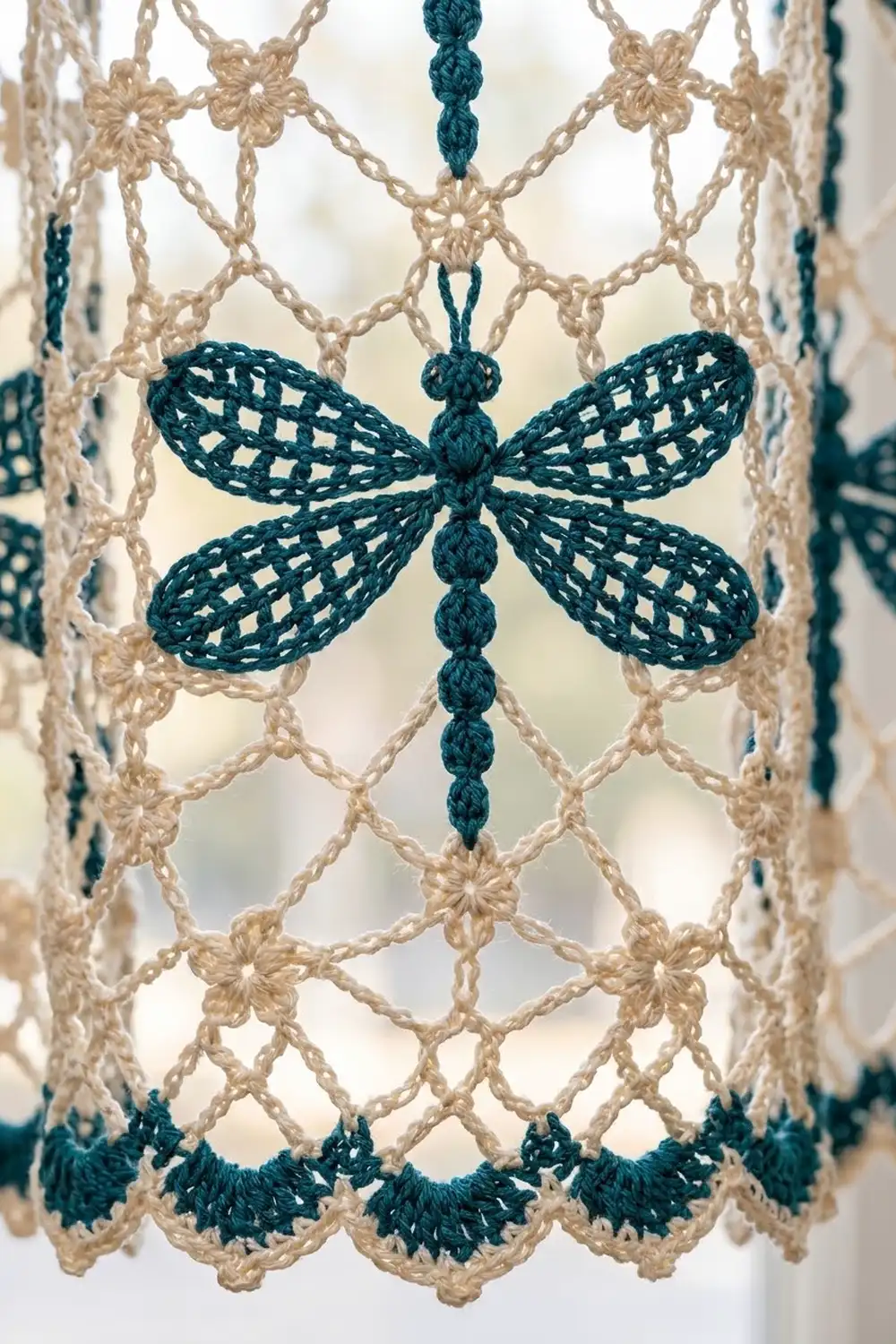
Dragonfly (Teal, 3.5 mm Hook)
Body
The body starts at the tail tip and is worked along a chain.
Tail: Ch 15. Bobble in the 4th ch from hook, sl st in next ch, *bobble in next ch, sl st in next ch; rep from * 4 more times. (6 bobbles, 6 sl sts. The last sl st is in the first ch you made.)
Thorax: Ch 3, popcorn in the same ch as the last sl st. Ch 3, popcorn in the top of the previous popcorn. (2 popcorns)
Head: Ch 2, work 4 hdc in the top of the last popcorn. Drop the loop and pull it through the first hdc, as for a popcorn. (1 small head cluster)
Antennae: *Ch 5, sl st in 2nd ch from hook and in each of the next 3 ch, sl st in the top of the head; rep from * once more. Fasten off, leaving a 6 in (15.2 cm) tail.
Upper Wing (Make 2)
Foundation: Ch 18.
Rnd 1: Sc in 2nd ch from hook, hdc in next ch, [ch 1, sk 1 ch, dc in next ch] 6 times, ch 1, sk 1 ch, hdc in next ch, 5 sc in last ch for the wing tip.
Now work along the other side of the foundation chain: hdc in next ch, [ch 1, sk 1 ch, dc in next ch] 6 times, ch 1, sk 1 ch, hdc in next ch, 3 sc in last ch. Sl st in the first sc to join.
Count: 9 sts on each side + 5 tip sc + 2 extra base sc = 25 sts, plus 14 ch-1 sps. The ch-1 sps make the open lattice.
Rnd 2: Ch 1. Sc in each st and in each ch-1 sp around, working 2 sc in each of the 3 center tip sc. Join. That is 25 sts + 14 sps + 3 extra = 42 sc. Fasten off, leaving a long tail for sewing.
Lower Wing (Make 2)
Foundation: Ch 16.
Rnd 1: Sc in 2nd ch from hook, hdc in next ch, [ch 1, sk 1 ch, dc in next ch] 5 times, ch 1, sk 1 ch, hdc in next ch, 5 sc in last ch.
Along the other side: hdc in next ch, [ch 1, sk 1 ch, dc in next ch] 5 times, ch 1, sk 1 ch, hdc in next ch, 3 sc in last ch. Join.
Count: 8 + 8 + 5 + 2 = 23 sts, plus 12 ch-1 sps.
Rnd 2: Ch 1. Sc in each st and in each ch-1 sp, with 2 sc in each of the 3 center tip sc. Join. That is 23 + 12 + 3 = 38 sc. Fasten off, leaving a long tail.
Assembly
Sew the base of each upper wing to one side of the top popcorn, angled slightly upward. Sew each lower wing to one side of the second popcorn, angled slightly downward. The wing tips should sit about 0.75 in (1.9 cm) apart at the outer edges. Weave in all ends.
Cream Mesh Frame (4.0 mm Hook)
Lay the dragonfly RS up with the head at the top. The cream rounds below make the mesh and flower nodes and finish with a rectangular single crochet frame.
Anchor points:
– A = top of head
– B = right upper wing tip
– C = right lower wing tip
– D = tail-tip bobble
– E = left lower wing tip
– F = left upper wing tip
At each wing tip, use the center sc of the tip.
Rnd 1 (anchor ring): Join cream with sc at A. Then work: ch 10, sc in B, ch 8, sc in C, ch 12, sc in D, ch 12, sc in E, ch 8, sc in F, ch 10. Sl st in the first sc to join.
Total: 6 sc and 6 loops (60 ch).
Rnd 2 (flower nodes): Sl st in the A–B loop.
– (Sc, ch 5, FN, ch 5, sc) in the A–B loop. This is the top-right corner node, TR.
– (Sc, ch 5, FN, ch 5, sc) in the B–C loop for the right-middle node, RM.
– (Sc, ch 5, FN, ch 5, sc) in the C–D loop for the bottom-right corner node, BR.
– Ch 5, FN, ch 5, skipping over D. This is the bottom-middle node, BM.
– (Sc, ch 5, FN, ch 5, sc) in the D–E loop for the bottom-left corner node, BL.
– (Sc, ch 5, FN, ch 5, sc) in the E–F loop for the left-middle node, LM.
– (Sc, ch 5, FN, ch 5, sc) in the F–A loop for the top-left corner node, TL.
– Ch 5, FN, ch 5, skipping over A. This is the top-middle node, TM.
Sl st in the first sc to join.
Total: 8 FN, 12 sc, 80 ch.
Rnd 3 (rectangle chains): Sl st up the next chain to the tip petal of TR. Work only into tip petals:
- (Sc, ch 3, sc) in TR
- ch 15, sc in RM, ch 16
- (sc, ch 3, sc) in BR
- ch 17, sc in BM, ch 18
- (sc, ch 3, sc) in BL
- ch 15, sc in LM, ch 16
- (sc, ch 3, sc) in TL
- ch 17, sc in TM, ch 18
Sl st in the first sc to join.
Total: 12 sc + 132 ch, plus 4 corner ch-3 sps. The chains pull the nodes into a rectangle.
Rnd 4 (sc frame, conversion round): Ch 1. Work 1 sc in each sc and each ch of Rnd 3, and (sc, ch 2, sc) in each corner ch-3 sp. Join.
Count: 144 sts worked 1-per-st + 8 corner sc = 152 sc, plus 4 corner ch-2 sps.
Per side, including that side’s 2 corner sc:
– Top: 1 + 17 + 1 + 18 + 1 = 38, plus 2 corner sc = 40 sc
– Right: 1 + 15 + 1 + 16 + 1 = 34, plus 2 corner sc = 36 sc
– Bottom: 40 sc
– Left: 36 sc
Check: 40 + 36 + 40 + 36 = 152.
At 4 sc per inch, the block measures 10 x 9 in (25.4 x 22.9 cm). Fasten off and weave in the ends.
Make All Pieces
For both panels (60 blocks):
- Teal: 60 bodies, 120 upper wings and 120 lower wings, assembled into 60 dragonflies
- Cream: 60 four-round mesh frames
Layout per panel (D = dragonfly block, head up):
Row 1:   D | D | D
Row 2:   D | D | D
Row 3:   D | D | D
Row 4:   D | D | D
Row 5:   D | D | D
Row 6:   D | D | D
Row 7:   D | D | D
Row 8:   D | D | D
Row 9:   D | D | D
Row 10:  D | D | D
Every block points the same way, with all heads toward the rod.
Joining
Method: Join with cream sl sts through the back loops only, with the blocks held wrong sides together. This leaves a neat raised line on the RS, which echoes the cream grid in the mesh.
Step 1, vertical seams: Join the blocks into 10 horizontal strips of 3. Match the 36 side sc of one block to the 36 side sc of the next, stitch for stitch, including the corner sc. Pin the corner ch-2 sps together, but don’t work stitches into them.
Step 2, horizontal seams: Join the strips together. Each seam runs 3 x 40 = 120 sts to 120 sts. Where four corners meet, pass straight from the last sc of one block to the first sc of the next. Don’t add stitches.
Tension: The seam should match the gauge of the sc frame. If it puckers, use the next hook size up for joining only.
Checkpoint: The joined panel measures 30 x 90 in (76.2 x 228.6 cm). The width is 3 x 10 in and the height is 10 x 9 in.
Border (Cream, 4.0 mm Hook)
Border gauge: 4 sc = 1 in (2.5 cm), the same as the block frames.
Starting counts:
– Top and bottom: 3 blocks x 40 sts = 120 sts each
– Sides: 10 blocks x 36 sts = 360 sts each
The corner ch-2 sps at seams are skipped and add nothing. Only the 4 outer corner ch-2 sps are worked.
Rnd 1 (trim round): Join with sc in any st. Work 1 sc in each st around. At each outer corner ch-2 sp, work 3 sc. Skip the joined ch-2 sps at the seams. Join.
Count: 960 sts worked 1-per-st (120 + 360 + 120 + 360) + 12 corner sc = 972 sc. Mark the center sc of each corner group.
Rnd 2 (mesh loops): Sl st to the first marked corner sc. *(Sc, ch 5, sc) in the corner sc, [ch 3, sk 2 sts, sc in next st] across, ending with the sc in the next marked corner sc. That sc is the first sc of the next corner. Rep from * around. Join.
Why the math works:
– Top and bottom: after one corner center there are 1 + 120 + 1 = 122 sts, plus the next corner center, for 123 sts. 123 ÷ 3 = 41 ch-3 loops.
– Sides: 1 + 360 + 1 + 1 = 363 sts. 363 ÷ 3 = 121 ch-3 loops.
Total: 41 + 121 + 41 + 121 = 324 ch-3 loops + 4 ch-5 corner loops, 328 sc.
Rnd 3 (picot scallops): Sl st into the next loop.
– In each ch-3 loop: (2 sc, picot, 2 sc).
– In each ch-5 corner loop: (3 sc, picot, 3 sc).
Join and fasten off. Count: 324 x 4 + 4 x 6 = 1320 sc and 328 picots.
Depth: Rnd 1 adds 0.25 in (0.6 cm), Rnd 2 adds 0.5 in (1.3 cm) and Rnd 3 adds 0.25 in (0.6 cm), for 1 in (2.5 cm) total. The finished panel measures 30 + 2 = 32 in by 90 + 2 = 92 in (81.3 x 233.7 cm).
Final Blocking
- Weave in any remaining ends, following the cream chains so they don’t show through the mesh.
- Lay the panel RS up on blocking mats. Work in sections if your floor space is limited.
- Mist the panel evenly until it is damp, but not soaked.
- Pin the outer corners first to 32 x 92 in (81.3 x 233.7 cm).
- Pin along every seam line to keep the grid square. Each block should measure 10 x 9 in (25.4 x 22.9 cm).
- Pin each wing tip outward and open the lattice gaps with your fingertips.
- Pin out every picot on the border.
- Let the panel dry completely before you unpin it. Repeat for the second panel.
Final Quality-Control Checklist
- Every block has 40 sc on the top and bottom and 36 sc on each side.
- All dragonfly heads point toward the top edge.
- Wings are sewn on securely and at matching angles.
- All 8 flower nodes on each block are anchored in Rnd 3.
- Seams are flat with no puckering.
- Border Rnd 2 has 41 loops on the top and bottom and 121 loops on each side.
- Both panels measure 32 x 92 in (81.3 x 233.7 cm).
- For hanging, place 11 clip rings on each panel’s top border, one in every 4th ch-3 loop (loops 1, 5, 9 and so on through 41).
Troubleshooting
- The block is wavy: The Rnd 3 chains are too loose. Go down a hook size for Rnd 3 only.
- The block cups: The chains are too tight. Go up a hook size for Rnd 3.
- The dragonfly is distorted: The Rnd 1 anchors are pulling too hard. Check the chain counts and keep your tension relaxed.
- The wing lattice is closed up: Block more firmly and pin the wing tips outward.
- The border loops don’t come out even: Recount Border Rnd 1. Each side must be exactly 120 or 360 between the corner groups.
- The panel sags when hanging: Use more clip rings, or re-block and dry the panel flat.
Care
Hand wash in cool water with a mild detergent, gently squeeze out the water and dry flat. Re-pin to size if needed. Avoid long periods of strong direct sun to protect the teal from fading.
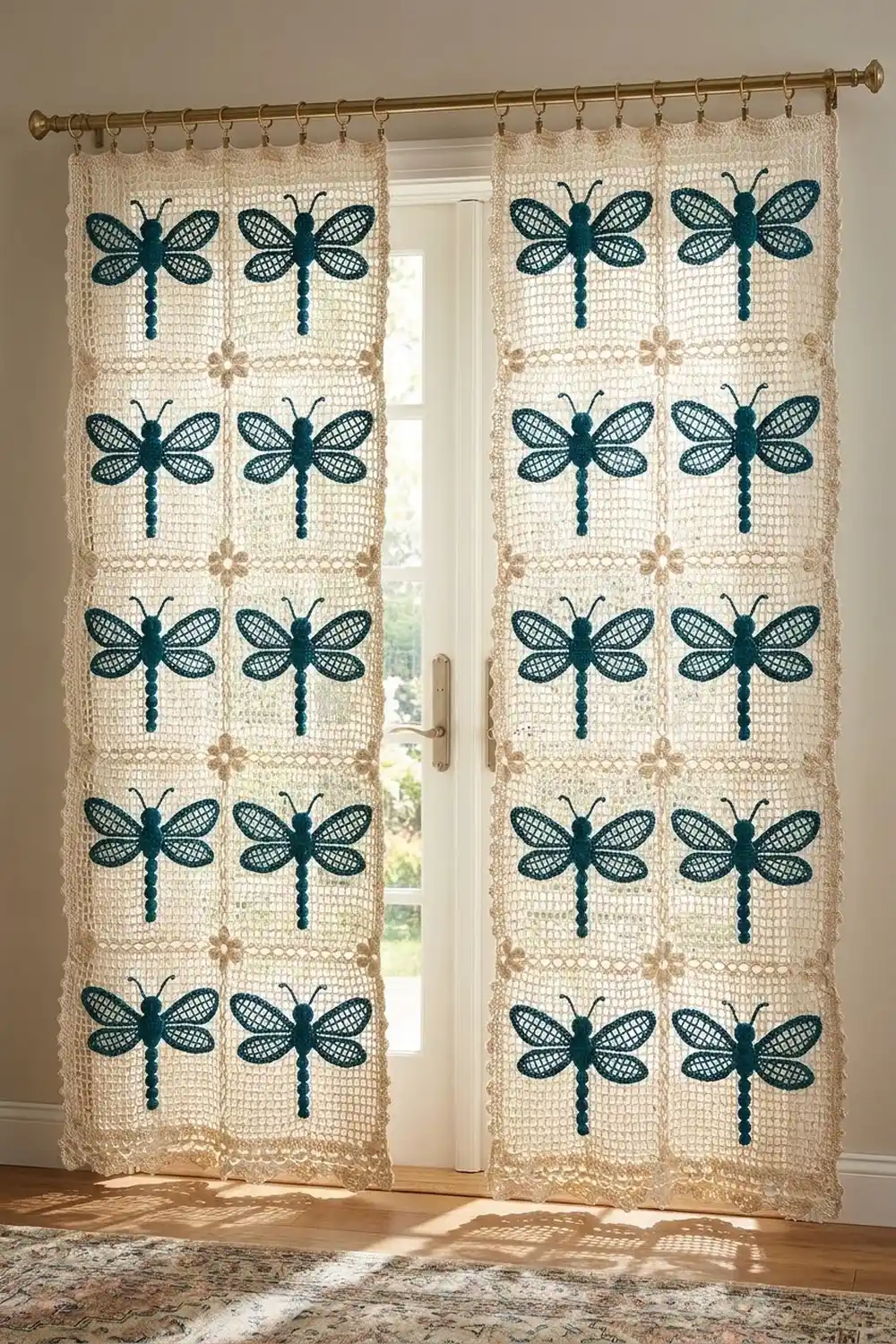
Final Notes
The measurement chain is simple:
– Each dragonfly fits inside a 10 x 9 in (25.4 x 22.9 cm) block with 40 x 36 frame sts.
– 3 x 10 blocks make a 30 x 90 in (76.2 x 228.6 cm) panel with 120 and 360 edge sts.
– A 1 in (2.5 cm) border brings each panel to 32 x 92 in (81.3 x 233.7 cm).
If your test block measures correctly, the rest will follow. Happy crocheting!