

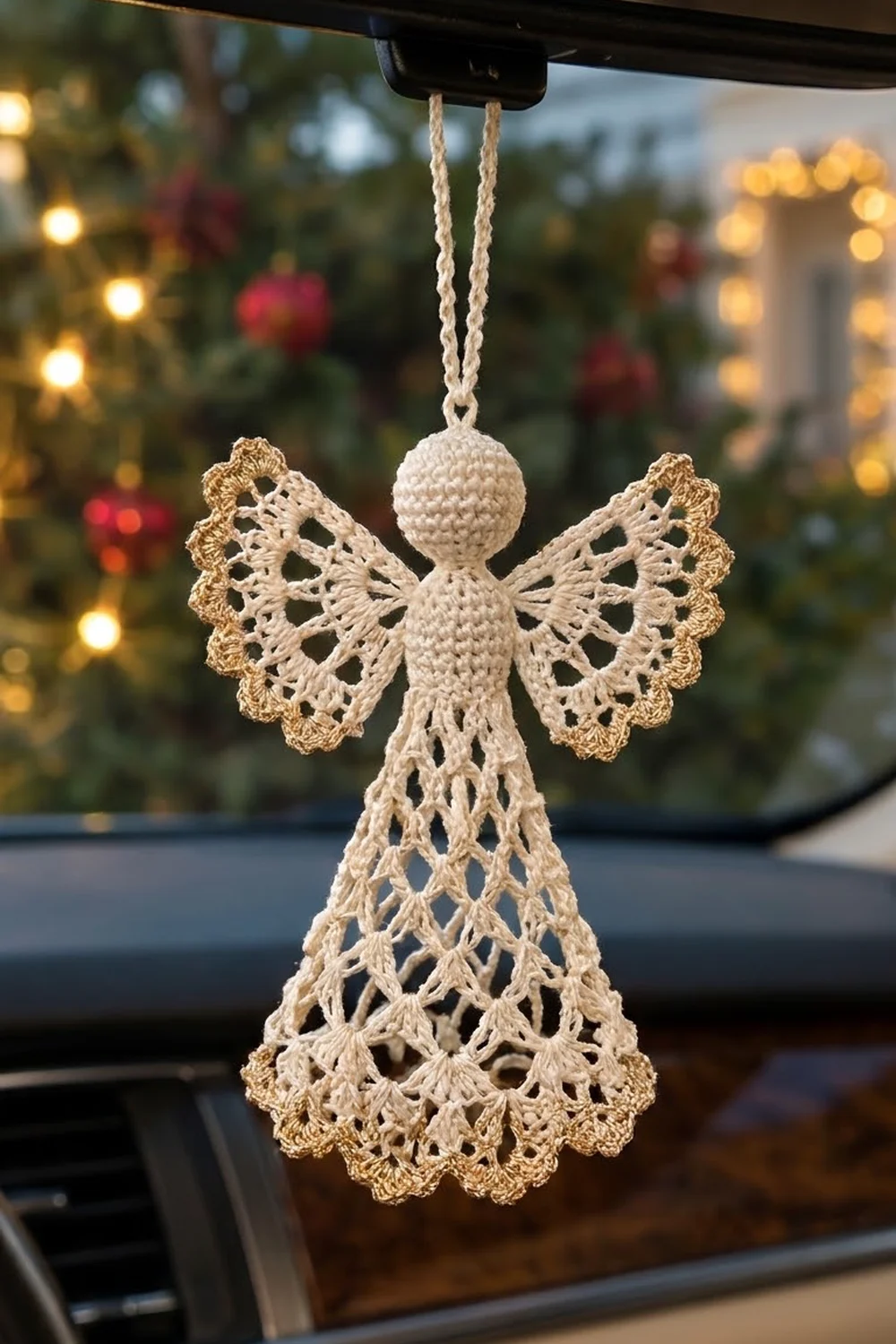
This little angel is worked in ivory cotton thread with a fine gold metallic edge. She has a smooth round head, a small solid bodice, two fan-shaped lace wings, and a bell-shaped mesh skirt finished with scalloped fans. The gold catches the light on the wings and hem, so she looks lovely hanging from a rearview mirror or a tree branch.
This is one ornament in classic thread lace, made from four small parts (head, body with skirt, and two wings) sewn into a single figure. The pattern uses US crochet terms.
The finished angel is 4.25 in (10.8 cm) tall from head to hem, not counting the hanging loop. The wingspan is 3.75 in (9.5 cm), and the blocked hem is 3 in (7.6 cm) across.
The head is a stuffed sphere in spiral single crochet. You work the bodice from the neck down and close it at the waist, and the skirt grows from its leftover front loops. The wings are worked in rows from a small ring, and the gold edging goes on last.
Finished Size and Construction
- Finished height: 4.25 in (10.8 cm), hanging loop not included
- Wingspan: 3.75 in (9.5 cm)
- Hem width (blocked): 3 in (7.6 cm)
- Skill level: Intermediate
- Terminology: US crochet terms
- Yarn weight: Size 10 cotton crochet thread (lace, category 0)
- Hook: 1.5 mm steel hook
- Number of pieces: 4 crocheted parts (head, body with skirt, 2 wings) plus a hanging cord, put together into one ornament
- Layout: head on top, bodice below, wings sewn to the back of the bodice, skirt hanging from the waist
- Head: 0.75 in (1.9 cm) diameter
- Bodice: 0.75 in (1.9 cm) tall and 0.75 in (1.9 cm) across
- Size before gold edging: skirt 2.6 in (6.6 cm) long; each wing 1.35 in (3.4 cm) from point to edge
- Gold edging depth: 0.15 in (0.4 cm)
Materials
Use mercerized size 10 cotton thread. It has a crisp twist, takes starch well, and keeps lace spokes sharp. For the edging, choose a size 10 metallic gold thread that is firm enough to hold a picot.
- Ivory size 10 cotton thread: about 10 g / 28 m
- Gold metallic size 10 thread: about 3 g / 10 m
These amounts include a safety margin. The angel itself uses roughly 16 m of ivory and 5 m of gold.
Tools:
- 1.5 mm steel crochet hook
- Fine tapestry needle
- Small pinch of fiberfill
- Stitch marker
- Small scissors
- Fabric stiffener or starch
- Blocking board and rustproof pins
- Paper cone 3 in (7.6 cm) across the base, covered in plastic wrap
Abbreviations (US Terms)
- ch – chain
- sl st – slip stitch
- sc – single crochet
- hdc – half double crochet
- dc – double crochet
- inc – 2 sc in the same stitch
- sc2tog – single crochet 2 together
- BLO – back loop only
- sp(s) – space(s)
- MR – magic ring
- st(s) – stitch(es)
- RS – right side
Picot: ch 3, sl st into the front loop and left vertical strand of the sc just made. A picot adds height, not width, and is not counted as a stitch.
Gauge and Checkpoints
Gauge: 10 sc and 11 rounds = 1 in (2.5 cm) in spiral sc.
Make the head first. It is your gauge test, and every other part is sized to match it.
Checkpoints:
- Head after Round 4: flat circle 0.75 in (1.9 cm) across
- Finished head: 0.75 in (1.9 cm) diameter
- Bodice: 0.75 in (1.9 cm) tall
- Skirt after Round 5: 1.25 in (3.2 cm) from the waist
- Skirt after Round 9: 2.25 in (5.7 cm)
- Skirt after Round 10: 2.6 in (6.6 cm)
- Wing after Row 6: 1.35 in (3.4 cm) from ring to edge
Too big? Go down to a 1.25 mm hook and keep the mesh chains snug.
Too small? Go up to a 1.75 mm hook. A tight head also stuffs unevenly.
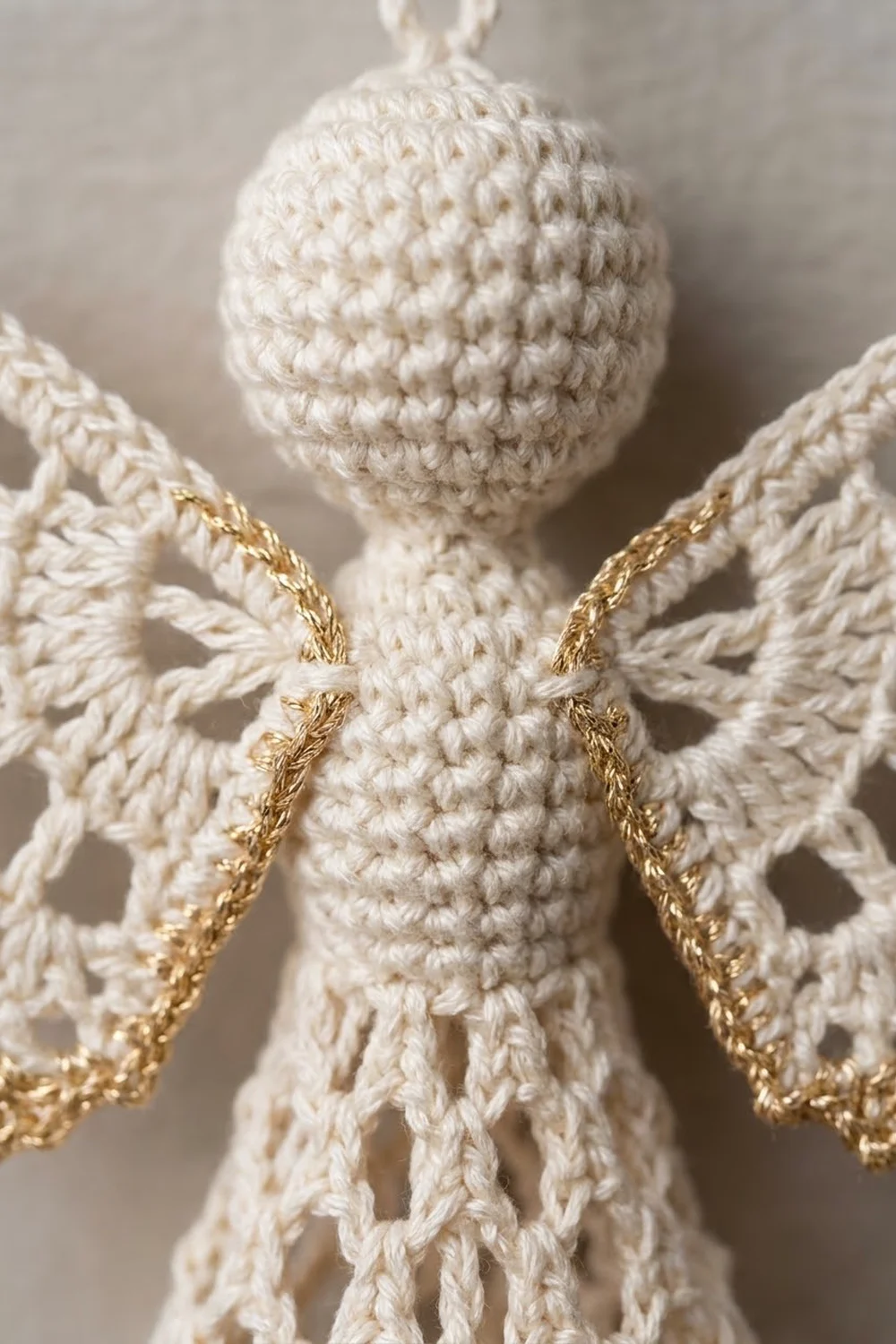
Head
Work in a continuous spiral without joining. Mark the first stitch of each round.
Round 1: 6 sc in MR. (6 sts)
Round 2: inc in each st around. (12 sts)
Round 3: sc in next st, inc 6 times. (18 sts)
Round 4: sc in next 2 sts, inc 6 times. (24 sts)
Rounds 5–9: sc in each st around. (24 sts each round)
Round 10: sc in next 2 sts, sc2tog 6 times. (18 sts)
Round 11: sc in next st, sc2tog 6 times. (12 sts)
Stuff firmly and shape into an even ball.
Round 12: sc2tog 6 times. (6 sts)
Fasten off with a 10 in (25.4 cm) tail. Weave it through the front loops of the last 6 sts and pull closed. Keep the tail for sewing.
Body: Bodice
The bodice is worked from the neck down in joined rounds and closed at the waist in back loops. The unused front loops become the base of the skirt.
Foundation: ch 12, sl st to first ch to form a ring, without twisting.
Round 1: ch 1, sc in each ch around, sl st to first sc. (12 sts)
Round 2: ch 1, sc in next st, inc 6 times, sl st to first sc. (18 sts)
Rounds 3–6: ch 1, sc in each st around, sl st to first sc. (18 sts each round)
Round 7: ch 1, sc in next 2 sts, inc 6 times, sl st to first sc. (24 sts)
Round 8 (waist): ch 1, sc in each st around, sl st to first sc. (24 sts)
Round 9: ch 1, working in BLO, sc in next 2 sts, sc2tog 6 times, sl st to first sc. (18 sts)
Round 10: ch 1, working in BLO, sc in next st, sc2tog 6 times, sl st to first sc. (12 sts)
Stuff lightly through the open neck.
Round 11: ch 1, sc2tog 6 times, sl st to first st. (6 sts)
Fasten off, pull the last 6 sts closed from the inside, and weave in the end.
Check: 0.75 in (1.9 cm) tall, with 24 free front loops around the waist.
Body: Skirt
The skirt is worked in joined rounds into the free front loops of bodice Round 8, with the neck held up. From Round 2 on, start each round by slip stitching to the center of the first loop, then ch 1. The first repeat goes into that same loop.
Round 1: join ivory with a sl st in any free front loop at center back. Ch 1, sc in same loop, ch 4, skip next front loop, sc in next front loop 11 times, ch 4, skip last loop, sl st to first sc. (12 sc, 12 ch-4 loops)
Round 2: (sc, ch 5) in next loop 12 times, sl st to first sc. (12 ch-5 loops)
Round 3 (growth): (sc, ch 5) in next loop, (sc, ch 5, sc, ch 5) in next loop 6 times, sl st to first sc. (18 ch-5 loops)
Round 4: (sc, ch 5) in next loop 18 times, sl st to first sc. (18 ch-5 loops)
Round 5 (growth): (sc, ch 5) in each of next 2 loops, (sc, ch 5, sc, ch 5) in next loop 6 times, sl st to first sc. (24 ch-5 loops)
Check: skirt measures 1.25 in (3.2 cm) from the waist.
Rounds 6–9: (sc, ch 6) in next loop 24 times, sl st to first sc. (24 ch-6 loops each round)
The longer loops flare the lower skirt into a bell without adding loops.
Check: skirt measures 2.25 in (5.7 cm).
Round 10 (fans): sc in next loop, 7 dc in next loop 12 times, sl st to first sc. (12 sc + 84 dc = 96 sts; 12 fans)
Fasten off. Check: skirt measures 2.6 in (6.6 cm).
Wings (Make 2)
Each wing is worked in turned rows from a small ring. The ring becomes the point that sits against the bodice.
Row 1 (RS): ch 4, sl st to first ch to form a ring. Ch 3 (counts as dc), 6 dc in ring. Turn. (7 dc)
Row 2: ch 4 (counts as dc + ch 1), dc in next dc, ch 1 5 times, dc in top of turning ch. Turn. (7 dc, 6 ch-1 sps)
Row 3: ch 5 (counts as dc + ch 2), dc in next dc, ch 2 5 times, dc in 3rd ch of turning ch. Turn. (7 dc, 6 ch-2 sps)
Row 4: ch 6 (counts as dc + ch 3), dc in next dc, ch 3 5 times, dc in 3rd ch of turning ch. Turn. (7 dc, 6 ch-3 sps)
The 7 dc are the radiating spokes. The growing spaces open the wing into a fan.
Row 5: ch 1, sc in first dc, ch 5, sc in next dc 6 times, with the last sc in the 3rd ch of turning ch. Turn. (7 sc, 6 ch-5 loops)
Row 6: ch 1, (sc, hdc, 3 dc, hdc, sc) in next ch-5 loop 6 times. (6 scallops, 42 sts)
Fasten off. Check: 1.35 in (3.4 cm) from ring to edge.
Hanging Cord
With ivory, ch 72, about 6 in (15.2 cm). Sl st in the back bump of the 2nd ch from hook and in each ch across. (71 sl sts) Fasten off, leaving 6 in (15.2 cm) tails.
Gold Edging (Border)
Only the skirt hem and the curved outer wing edges get gold. The straight wing sides stay ivory.
Border gauge: gold sc are worked 1 per stitch at the same gauge. They add 0.15 in (0.4 cm) of depth and no width.
Skirt hem (Round 11, trim round): with RS facing, join gold with a sl st in any sc of Round 10. Ch 1, sc in same sc, sc in next dc, [picot, sc in next dc] 6 times, sc in next sc, sc in next dc, [picot, sc in next dc] 6 times 11 times, sl st to first sc. Fasten off.
Count: 96 sc (1 per existing stitch) + 72 picots added, which is 8 sc and 6 picots per fan.
Wings (Row 7, trim row, each wing): with RS facing, join gold with a sl st in the first sc of Row 6. Ch 1, sc in next 2 sts, sc in next dc, [picot, sc in next dc] 2 times, sc in next 2 sts 6 times. Fasten off.
Count: 42 sc (1 per existing stitch) + 12 picots added, which is 7 sc and 2 picots per scallop.
Why the math works: every existing stitch gets exactly 1 gold sc, so the hem stays at 96 sts and each wing edge stays at 42 sts. The edge gets no longer, so it can’t ruffle or cup. Picots only add height. On the skirt, the 6 picots sit between the 7 dc of each fan, and the plain sc between fans forms a valley. On the wings, the 2 picots sit between the 3 center dc, which keeps each scallop symmetrical.
Check: the skirt with edging is 2.75 in (7.0 cm). Each wing is 1.5 in (3.8 cm) from point to edge and 1.75 in (4.4 cm) along its outer curve.
Assembly
- Head: center the closed bottom of the head on the bodice neck ring. Whipstitch around the 12-st ring with the head tail, catching Round 11 of the head.
- Wings: place the wings on the back of the bodice, RS out. The ring points meet at center back just below the neck, with the scallops angled up and out. Sew each ring plus the first 0.25 in (0.6 cm) of each straight side.
- Cord: fold in half and sew both ends to the top center of the head. The loop hangs 3 in (7.6 cm) above the head.
- Weave all ends into the solid sc parts, not the lace.
Check: total height is 0.75 in (1.9 cm) head + 0.75 in (1.9 cm) bodice + 2.75 in (7.0 cm) skirt = 4.25 in (10.8 cm). The wingspan is 3.75 in (9.5 cm).
Final Blocking
- Prepare the stiffener according to its label.
- Dip only the skirt and wings. Keep the head and bodice as dry as possible.
- Squeeze out the excess and clear any film from the mesh with a pin.
- Slide the skirt over the wrapped cone. Ease the hem down to 3 in (7.6 cm) across and space the 12 fans evenly.
- Lay the cone on its side. Pin each wing open into a fan with the spokes evenly spaced and the picots pinned outward.
- Let it dry completely, usually overnight.
- Unpin, lift off the cone, and re-check the height and wingspan.
Final Quality-Control Checklist
- Head is round, firm, and 0.75 in (1.9 cm) across.
- Bodice sits straight under the head.
- Skirt has 24 even loops in Rounds 5–9 and 12 fans at the hem.
- Hem edging has 96 sc and 72 picots.
- Each wing has 7 spokes, 6 scallops, 42 gold sc, and 12 picots.
- Wings match and sit at the same angle.
- Height is 4.25 in (10.8 cm); wingspan is 3.75 in (9.5 cm).
- The angel hangs straight from a centered loop.
- No visible ends or stiffener film.
Troubleshooting
Lumpy head: stuff in small pinches and roll the ball between your palms before closing.
Skirt pulls in like a tube: loosen your ch-5 and ch-6 loops, or go up a hook size for the skirt only.
Skirt ruffles before blocking: this is normal for lace mesh. The cone sets it into a bell.
Uneven mesh: start every round at the center of the first loop and keep the chains the same length.
Wing leans to one side: check that the last dc of each row goes into the turning chain. You need 7 dc in Rows 1–4.
Angel hangs tilted: recenter the cord ends on top of the head.
Care
Spot clean with cool water and mild soap, then reshape and re-starch if needed. Don’t leave her in heat or direct sun in the car for long, so the thread doesn’t yellow.
Final Notes
Each measurement builds on the one before. A 0.75 in (1.9 cm) head sets the gauge. The 0.75 in (1.9 cm) bodice leaves 24 front loops at the waist. These become 12, then 18, then 24 mesh loops, growing to a 2.6 in (6.6 cm) skirt with 96 stitches. The gold edging keeps those 96 stitches and adds 0.15 in (0.4 cm), giving a 2.75 in (7.0 cm) skirt and a 4.25 in (10.8 cm) angel. Each 42-stitch wing edge gets 42 gold sc and blocks to 1.5 in (3.8 cm), for a 3.75 in (9.5 cm) wingspan.
Happy crocheting!