

This coaster looks like a freshly iced gingerbread cookie. It has a warm brown hexagon center, a wavy cream icing line, little cream “sugar dots,” and a bobbly cream edge like piped frosting.
The palette is just two colors: gingerbread brown and soft cream. That keeps the style cozy and classic, and it suits holiday tables, cocoa nights, and gift baskets.
The pattern uses US crochet terms. The finished coaster measures about 5 in (12.7 cm) from point to point and 4.5 in (11.4 cm) from flat side to flat side.
You’ll work the brown center in joined single-crochet rounds. It starts as a circle and becomes a hexagon through stacked increases. Next come a cream single-crochet round and a bobble-picot round. Last, you add the icing line in surface slip stitch and stitch the dots with French knots.
Finished Size and Construction
- Finished size: about 5 in (12.7 cm) point to point and 4.5 in (11.4 cm) flat side to flat side
- Skill level: Easy to Intermediate
- Terminology: US crochet terms
- Yarn weight: DK / light worsted (CYC 3), cotton or cotton blend
- Hook: 3.5 mm (E-4)
- Number of pieces: 1 (single coaster)
- Layout: one standalone hexagon, no joining
- Piece size before border: 4 in (10.2 cm) point to point and 3.5 in (8.9 cm) flat to flat
- Border depth: about 0.5 in (1.3 cm) all around (2 rounds)
Materials
Yarn: Use a smooth DK cotton or cotton blend. Cotton soaks up drips, holds its shape under a mug, and shows stitch definition clearly. Avoid fuzzy acrylic, because it blurs the icing line.
- Color A – Gingerbread Brown: 12 g, about 28 m (31 yd)
- Color B – Cream: 6 g, about 14 m (15 yd), for the border, icing line, and dots
Both quantities include a small margin for your gauge swatch and tails.
Tools:
- 3.5 mm (E-4) crochet hook
- Tapestry needle with a large eye
- 2 stitch markers
- Scissors
- Measuring tape or ruler
- Blocking mat and rust-proof pins
- Spray bottle with water
Abbreviations (US Terms)
- ch – chain
- sl st – slip stitch
- sc – single crochet
- dc – double crochet
- st(s) – stitch(es)
- MR – magic ring
- rep – repeat
- kp – knot picot (see below)
Special stitch – Knot Picot (kp): Ch 3. In the 3rd ch from the hook, work 3 dc, leaving the last loop of each dc on the hook. Yarn over and pull through all 4 loops on the hook. This makes a small round bobble that sits on the edge.
Surface slip stitch: Hold the yarn behind the work. Insert the hook from front to back through the fabric, pull up a loop, and draw it through the loop on the hook.
Gauge and Checkpoints
Gauge: 20 sc and 23 rounds = 4 in (10.2 cm) in sc worked in the round, using a 3.5 mm hook.
Because the coaster is small, the coaster itself is your test piece. Measure it at each checkpoint below before you go on.
- After Round 5: circle diameter is 1.75 in (4.4 cm).
- After Round 10: hexagon is 4 in (10.2 cm) point to point and 3.5 in (8.9 cm) flat to flat.
- After Round 11: about 3.9 in (9.9 cm) flat to flat.
- After Round 12: 4.5 in (11.4 cm) flat to flat and about 5 in (12.7 cm) point to point.
If it’s too big: Go down to a 3.25 mm hook, or tighten your sc by pulling each loop snug before you finish the stitch.
If it’s too small: Go up to a 3.75 mm hook.
If the center ruffles: Your stitches are too short for the number of increases, so go up half a hook size. If it cups: Go down half a size.
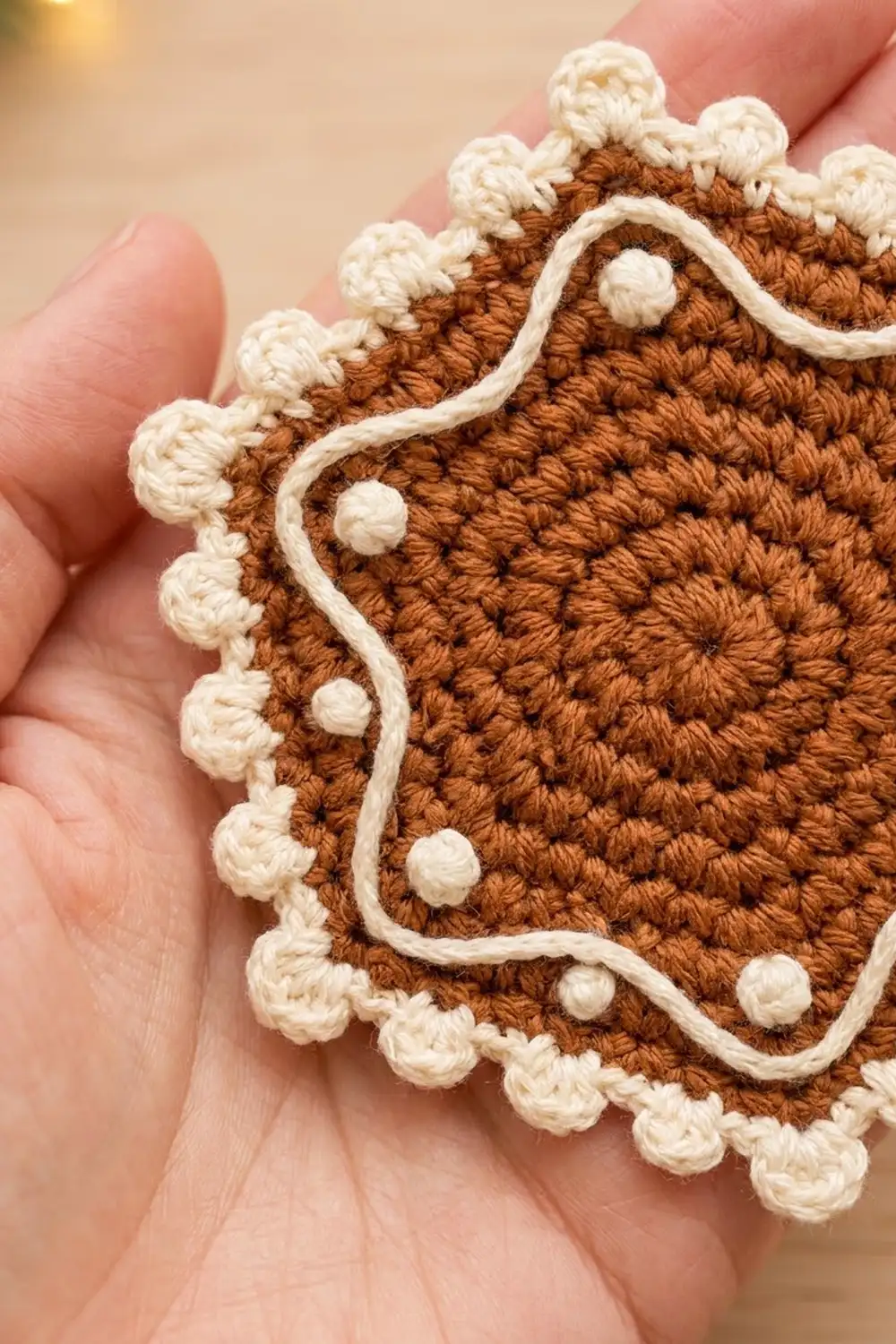
Brown Center (Color A)
Work in joined rounds. At the end of every round, sl st into the first sc. Begin every round with ch 1, which does not count as a stitch, and work the first sc in the same st as the join.
Round 1: In an MR, work 6 sc. Join. (6 sts)
Round 2: 2 sc in each st around. Join. (12 sts)
Round 3: Sc in next st, 2 sc in next st; rep from * 5 more times. Join. (18 sts)
Round 4: Sc in next st, 2 sc in next st, sc in next st; rep from * 5 more times. Join. (24 sts)
Round 4 staggers the increases so the center stays round.
Round 5: Sc in next 3 sts, 2 sc in next st; rep from * 5 more times. Join. (30 sts)
Checkpoint: The piece is a flat circle about 1.75 in (4.4 cm) across.
From here on, the increases stack directly on top of each other. Always work the 2 sc into the second sc of the previous round’s increase. Stacking six increases per round is what turns the circle into a hexagon.
Round 6: Sc in next 4 sts, 2 sc in next st; rep from * 5 more times. Join. (36 sts)
Round 7: Sc in next 5 sts, 2 sc in next st; rep from * 5 more times. Join. (42 sts)
Round 8: Sc in next 6 sts, 2 sc in next st; rep from * 5 more times. Join. (48 sts)
Round 9: Sc in next 7 sts, 2 sc in next st; rep from * 5 more times. Join. (54 sts)
Round 10: Sc in next 8 sts, 2 sc in next st; rep from * 5 more times. Join. (60 sts)
Fasten off Color A and weave in the tail.
Each of the six segments now has 10 sts: 8 plain sc plus the 2-sc increase. The second sc of each increase is the corner st.
Checkpoint: The hexagon is 4 in (10.2 cm) point to point and 3.5 in (8.9 cm) flat to flat, with six visible corners. If one corner looks blunt, check that the increases stacked correctly in that segment.
Border (Color B)
Border gauge: The cream sc round matches the brown gauge of 20 sc = 4 in (10.2 cm). Together, the two border rounds add about 0.5 in (1.3 cm) all around.
Round 11 (trim round): Join Color B with a sl st in the first st of any segment, which is the st right after a corner st.
Ch 1. Sc in next 9 sts, 3 sc in the next st (the corner st); rep from * 5 more times. Join.
- Count: 60 sts worked one per existing st, plus 12 extra sts (2 extra in each of the 6 corners) = 72 sts
- Per segment: 12 sts, made of 9 side sc plus the 3-sc corner group. The middle sc of each 3-sc group is the new corner st.
Each segment count of 12 already includes its corner group, so don’t add corner stitches again. 6 segments × 12 sts = 72 sts.
In this round, the 9 side sc cover the 8 plain sts and the first sc of the brown increase. The 3 sc go into the brown corner st.
Checkpoint: About 3.9 in (9.9 cm) flat to flat, and lying flat.
Round 12 (picot round): Ch 1. Sc in the first st. (Sc, kp) in next st, sc in next 2 sts; rep from * 22 more times. (Sc, kp) in next st, sc in last st. Join with a sl st to the first sc and fasten off.
- Count: 72 sc + 24 kp
- Per segment: 4 kp on the 2nd, 5th, 8th, and 11th sts. The 11th st is the corner st, so one picot sits exactly on each corner and three sit evenly along each side.
Why the math works:
- Six increases per round matches the natural growth of flat sc, so the hexagon stays flat.
- The 3-sc corners in Round 11 sharpen each point for the picots.
- 72 divides evenly by 3. That gives 24 picots spaced every 3 sts, so the corner picots land on the corner sts every time with no fudging.
Lay the coaster flat before you add the icing. The surface line should follow the blocked shape, so if needed, pin it to size and spray it lightly first.
Icing Line (Color B)
The icing line is a wavy, six-pointed star. Each point reaches Round 9 at a corner, and each valley dips to Round 7 at the middle of a side.
- Cut a 60 in (152.4 cm) length of Color B. Holding the yarn behind the work, pull up a loop from back to front at the Round 9 corner st of any segment. This is Point 1.
- Work 1 surface sl st into Round 8, moving about 2 sts along toward the next corner.
- Work 1 surface sl st into Round 7, again moving about 2 sts along.
- Work 3 surface sl sts along Round 7, centered on the middle of the side. This is the valley.
- Work 1 surface sl st up into Round 8, moving about 2 sts along.
- Work 1 surface sl st up into the next Round 9 corner st. That makes the next point.
- Repeat steps 2–6 around. That’s 7 surface sl sts per segment and 42 sl sts in total.
- To close, cut the yarn, pull the tail up through the last loop, and use the needle to take it down through the first sl st so the line looks unbroken. Weave the tail in on the back.
Tension tip: Keep each surface sl st about one round tall. If the fabric puckers, loosen up, or go up to a 4 mm hook for the surface stitching only.
Sugar Dots (Color B)
Thread an 18 in (45.7 cm) length of Color B onto the tapestry needle. Make 12 French knots, wrapping the yarn twice around the needle for each one:
- 6 point dots: one just inside each star point, on Round 8 at the corner
- 6 valley dots: one in the outer valley of each side, on Round 9 at the middle of the side
Run the yarn across the back between knots, keeping it loose. Weave the end in under the brown sts on the back.
Final Blocking
- Weave in all remaining tails along matching colors on the back.
- Lay the coaster right side up on a blocking mat.
- Pin each of the six corner picots so the piece measures 5 in (12.7 cm) point to point.
- Check that each flat side measures 4.5 in (11.4 cm) to the opposite side, all three ways.
- Open each side picot gently with your fingertips so it sits round.
- Mist with water until damp but not soaked.
- Let it dry completely, usually 4 to 6 hours, before you unpin it.
Final Quality-Control Checklist
- [ ] Rounds 1–10 total 60 sts, with 10 sts per segment
- [ ] Six clear corners line up in straight lines from the center
- [ ] Round 11 has 72 sts, with 12 per segment
- [ ] Round 12 has 24 picots, 4 per side, with one on each corner
- [ ] The icing line has 42 surface sl sts, 6 points, and 6 valleys
- [ ] There are 12 French knots: 6 at the points and 6 in the valleys
- [ ] Size is 5 in (12.7 cm) point to point and 4.5 in (11.4 cm) flat to flat
- [ ] The coaster lies flat with no cupping or ruffling
- [ ] All tails are woven in on the back
Troubleshooting
The hexagon looks round. The increases aren’t stacking. Always put the 2 sc into the second st of the previous increase, and mark it if that helps.
The edges ruffle. Your stitches are too short for six increases per round. Go up half a hook size.
The piece cups. Your stitches are too tall or loose. Go down half a hook size.
The picots flop or splay. Pull the final yarn-over snug, and make sure all three dc go into the same ch.
The picots miss the corners. Recount Round 11. Each segment must have exactly 12 sts.
The icing line puckers. Your surface sl sts are too tight. Redo them with a larger hook.
The French knots pull through. Wrap three times instead of twice, or catch a brown strand on the back before you tighten.
Care
Hand wash in cool water with a mild detergent. Reshape the coaster and dry it flat, and don’t machine dry it, because that can shrink the cotton and distort the picots.
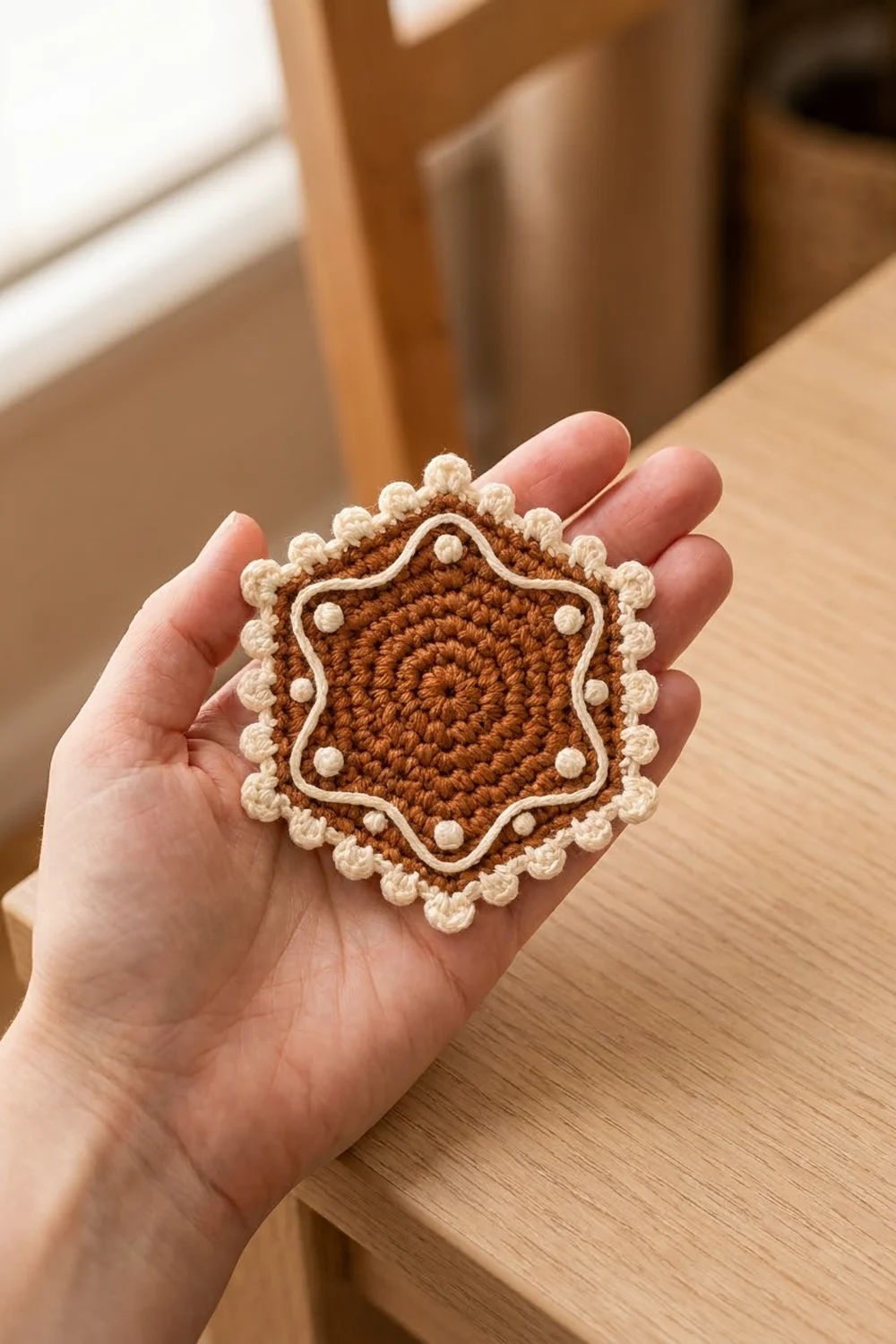
Final Notes
The size of this coaster comes down to a simple chain of measurements:
- A 1.75 in (4.4 cm) circle after Round 5
- A 4 in (10.2 cm) point-to-point hexagon after Round 10
- About 3.9 in (9.9 cm) flat to flat after the cream trim round
- 5 in (12.7 cm) point to point and 4.5 in (11.4 cm) flat to flat after the picot round and blocking
Check each link as you go and your coaster will match. Make one for yourself, or a stack of them as gifts.
Happy crocheting!