

This runner is a long, airy strip of lace diamonds in soft ivory cotton. Two columns of flower motifs run down the table, each motif turned on its point, with open gaps between them so the tabletop shows through. A full cream tassel hangs from each of the four end points.
Every motif has an open center ring, eight rounded petal arches, and a squared outer round with crisp points and gently scalloped sides. The single neutral color works for Christmas tables, winter weddings, or year-round use.
This pattern uses US crochet terms. The finished runner measures 14 in (35.6 cm) wide by 70 in (177.8 cm) long, or about 78 in (198.1 cm) including tassels.
You’ll make 20 identical motifs. They’re joined as you go at their corner points during the last round, in a grid 2 motifs wide and 10 motifs long. Four tassels finish the ends. No separate border is added, because the scalloped final round of each motif is the finished edge.
Finished Size and Construction
- Finished size: 14 in x 70 in (35.6 cm x 177.8 cm); about 78 in (198.1 cm) long with tassels
- Skill level: Easy-intermediate
- Terminology: US crochet terms
- Yarn weight: Worsted (#4) cotton
- Hook: 4.5 mm (US 7)
- Number of pieces: 20 motifs + 4 tassels
- Layout: 2 motifs wide x 10 motifs long, each set on point (diamond)
- Piece size: 5 in (12.7 cm) per side; 7 in (17.8 cm) from point to point
- Size before border: 14 in x 70 in (35.6 cm x 177.8 cm)
- Border depth: 0 in (0 cm). The motif edges are the border.
Materials
Yarn: Use a smooth, matte, worsted-weight cotton or cotton blend in ivory or cream. Mercerized cotton gives crisper stitches. Soft unmercerized cotton gives the cushy, rope-like look shown. Avoid fuzzy yarns, because the open arches need clean definition.
- Ivory (only color): about 400 g / 700 m total
- Motifs: about 13 g / 23 m each, so 260 g / 460 m for 20
- Tassels: about 8 g / 13 m each, so 32 g / 52 m for 4
These quantities include a margin of roughly 35% for gauge differences, swatching, and tassel trimming.
Tools:
- 4.5 mm (US 7) crochet hook
- Tapestry needle
- Scissors
- Stiff card, 4 in (10.2 cm) tall, for the tassels
- Rust-proof pins and a blocking mat
- Spray bottle
- Measuring tape
Abbreviations (US Terms)
- ch – chain
- sl st – slip stitch
- sc – single crochet
- dc – double crochet
- tr – treble crochet (yo twice, insert hook, yo and pull up a loop, [yo, pull through 2 loops] 3 times)
- sp – space
- st(s) – stitch(es)
- rep – repeat
Special stitch: joining corner. Work 2 sc in the corner ch-3 sp, then ch 1. Remove nothing, but insert the hook from the front into the matching corner ch-3 sp of the finished neighbor motif and sl st. Ch 1, then work 2 sc back in the corner sp of the current motif. This replaces the corner’s ch 3 with ch 1, sl st, ch 1, so the stitch count stays the same.
Gauge and Checkpoints
Make one complete motif before starting the runner, and block it lightly. Gauge here means motif size, not a stitch swatch.
- After Round 1: the ring is 1.75 in (4.4 cm) across
- After Round 3: the petal flower is 4 in (10.2 cm) across
- After Round 5: the motif is 5 in (12.7 cm) per side and 7 in (17.8 cm) from point to point
If your motif is too big, change to a 4 mm (US G/6) hook. If it’s too small, change to a 5 mm (US H/8) hook. A difference of only 0.25 in (0.6 cm) per motif adds up to 2.5 in (6.4 cm) over the runner’s 10-motif length, so check before going further.
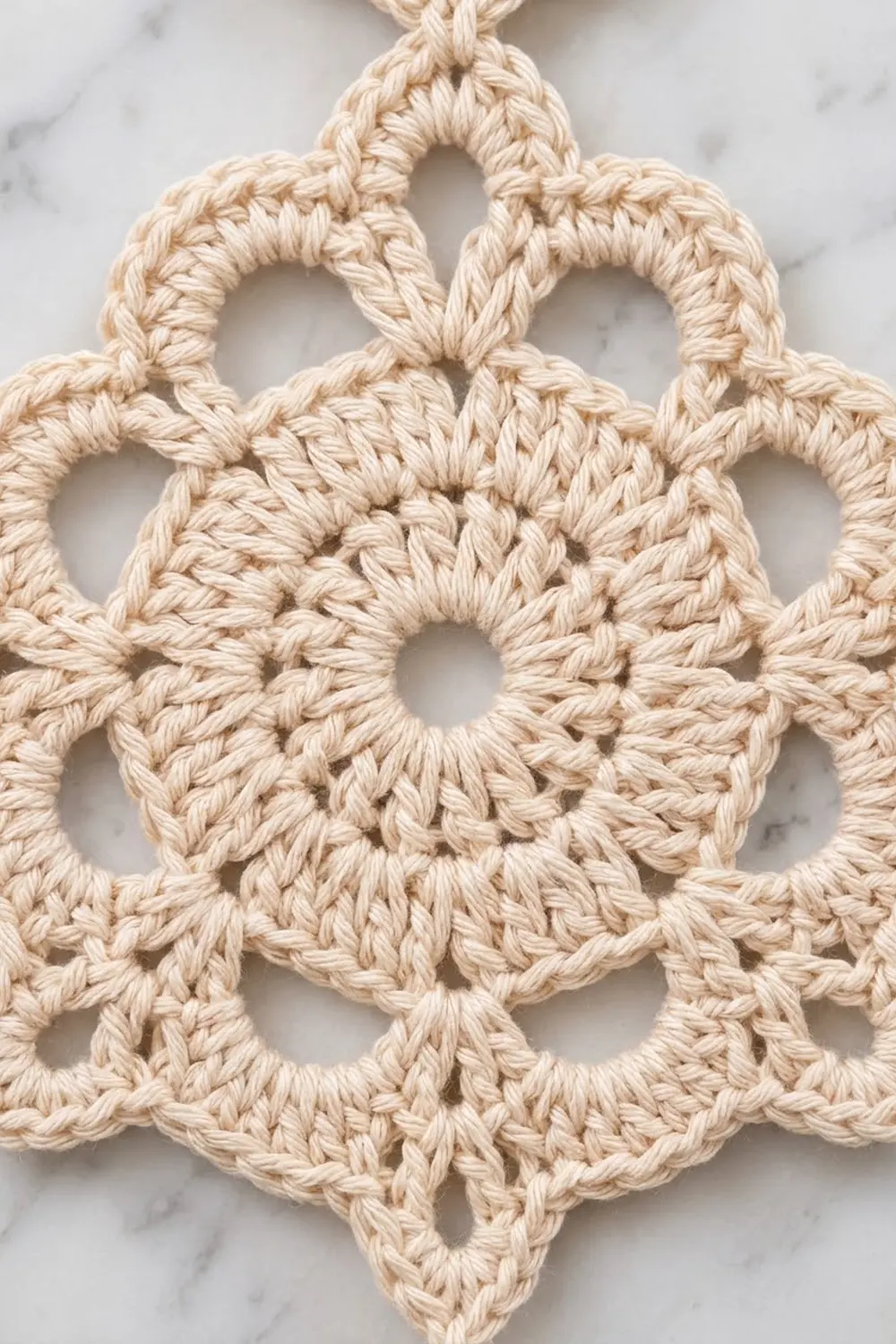
Motif (Make 20)
Work in rounds with the right side facing throughout. Don’t turn.
Round 1: Ch 6 and sl st to the first ch to form a ring. Ch 3 (counts as dc), then work 23 dc into the ring. Sl st to the top of the beginning ch-3. (24 dc)
Don’t tighten the ring. The open center hole is part of the design.
Round 2: Ch 1, sc in the same st as the join. Ch 5, skip 2 dc, sc in the next dc. Rep from * 6 more times. Ch 5, skip the last 2 dc, and sl st to the first sc. (8 sc, 8 ch-5 sps)
Round 3 (petals): Sl st into the first ch-5 sp. Ch 1, then work 7 sc into each ch-5 sp around. Sl st to the first sc. (56 sc: 8 petals of 7 sc)
This is a conversion round: it is 0 sts worked into existing stitches + 56 sts worked into the ch-5 spaces. Pack the 7 sc snugly over each chain so the arch stays round and the opening underneath stays open. Those openings are the petal “windows.”
Round 4 (squaring frame): Sl st in each of the next 3 sc so you’re on the 4th sc, the center of the first petal.
- Ch 4 (counts as tr), ch 3, tr in the same st to make the first corner.
- Ch 5, sc in the center (4th) sc of the next petal, ch 5.
- (Tr, ch 3, tr) in the center sc of the next petal to make the next corner.
- Rep from * to ** 2 more times, then rep from * to * once.
- Sl st to the top of the beginning ch-4.
(8 tr, 4 sc, 4 corner ch-3 sps, 8 ch-5 sps)
The tr pairs push the 4 corners out into points, while the sc at the side petals sits lower. This is what turns the round flower into a square.
Round 5 (edge): Sl st into the first corner ch-3 sp. Ch 1 and work (2 sc, ch 3, 2 sc) in the same sp.
- Sc in the next tr, 6 sc in the next ch-5 sp, sc in the next sc, 6 sc in the next ch-5 sp, sc in the next tr.
- (2 sc, ch 3, 2 sc) in the next corner ch-3 sp.
- Rep from * to ** 2 more times, then rep from * to * once.
- Sl st to the first sc and fasten off.
(76 sc + 4 corner ch-3 loops)
Stitches per side: 2 + 1 + 6 + 1 + 6 + 1 + 2 = 19 sc. That count includes the 2 sc on each side of both corner loops. Four sides x 19 = 76 sc, which matches the round total. Each corner ch-3 loop sits between two sides and isn’t counted in either side.
For the first motif, work Round 5 exactly as written. For every later motif, use the joining corner wherever a corner touches a finished motif. See Joining below.
Weave in ends on the wrong side, following the sc path so they don’t show through the open arches.
Make All Pieces
- Ivory motifs: 20 (Motif 1 made separately, Motifs 2–20 joined as you go)
- Ivory tassels: 4
Layout grid (all motifs set on point; numbers show working order):
Row 1:   [ 1] [ 2]
Row 2:   [ 3] [ 4]
Row 3:   [ 5] [ 6]
Row 4:   [ 7] [ 8]
Row 5:   [ 9] [10]
Row 6:   [11] [12]
Row 7:   [13] [14]
Row 8:   [15] [16]
Row 9:   [17] [18]
Row 10:  [19] [20]
Tassels hang from the outer bottom point of Motifs 19 and 20, and from the outer top point of Motifs 1 and 2.
Joining
Method: Join as you go at the corner points only, during Round 5.
Orientation: Each motif sits as a diamond with points at the top, bottom, left and right. The top point of a motif joins the bottom point of the motif above it. The right point of a left-column motif joins the left point of the right-column motif beside it. Each corner touches at most one neighbor, so you never have a 3- or 4-way join.
Joining order:
- Motif 2: Join its left point to Motif 1’s right point.
- Motif 3: Join its top point to Motif 1’s bottom point.
- Motif 4: Join its top point to Motif 2’s bottom point, and its left point to Motif 3’s right point.
- Motifs 5–20: Follow the Motif 3/Motif 4 pattern row by row.
Stitch-to-stitch logic: Each join replaces one corner’s ch 3 with ch 1, sl st, ch 1. The sl st sits in the neighbor’s existing ch-3 loop. No sc are added or removed, so every motif keeps 19 sc per side and 76 sc total.
Tension advice: Keep the ch 1 on either side of the join sl st the same size as your usual chains. If they’re too tight, the points pucker and pull. If they’re too loose, the diamonds drift apart and the runner grows longer. Lay the work flat after every row to make sure each joined point lies flat with no twist.
Size checkpoint: After Row 2 (4 motifs), the piece should be 14 in (35.6 cm) wide and 14 in (35.6 cm) long, measured point to point. After Row 5, it should be 35 in (88.9 cm) long.
Border
This runner has no added border. That matches the finished piece, where the scalloped motif edges and open gaps form the outline. The border is built into Round 5 of each motif.
Border gauge: 19 sc per 5 in (12.7 cm) side, or 3.8 sc per inch (1.5 sc per cm), measured along the scalloped edge after blocking.
Edge counts:
- Each long side: 10 motifs, each showing 2 outer sides, so 10 x 2 x 19 = 380 sc. There are also 9 outer corner loops, each joined to nothing.
- Each short end: 2 motifs, each showing 2 outer sides, so 2 x 2 x 19 = 76 sc. There are 3 free corner points along each end; the center one is the join between the two motifs’ upper sides. The outer top/bottom points of the 2 end motifs carry the tassels.
Why the math works: No stitches are added at the joins. Each side is the motif’s own 19 sc, so the edge count is always (motifs along the side) x (sides showing) x 19. Every motif is identical, so the zigzag edge stays even, and the runner’s dimensions follow directly from the motif size:
- Width: 2 x 7 in = 14 in (35.6 cm)
- Length: 10 x 7 in = 70 in (177.8 cm)
Tassels (Make 4)
- Wrap yarn 60 times around a 4 in (10.2 cm) card.
- Slide a 10 in (25.4 cm) strand under the wraps at the top edge and tie it tightly. Keep both tails long.
- Cut through all the loops at the bottom edge.
- Fold the tassel so the tie sits at the top. About 0.5 in (1.3 cm) below the top, wrap a separate 20 in (50.8 cm) strand tightly 8–10 times to form the rounded head. Knot it, then thread the ends down into the skirt with the needle.
- Trim the skirt evenly to 4 in (10.2 cm) from the top of the head.
- Use the long top tails to tie the tassel through the free corner ch-3 loop of an end motif. Knot securely and bury the tails inside the head.
Final Blocking
- Weave in all remaining ends.
- Lay the runner flat on blocking mats, right side up.
- Spray it evenly until damp but not dripping.
- Pin each motif’s 4 points first, so every diamond measures 7 in (17.8 cm) from point to point.
- Check the overall runner: 14 in (35.6 cm) wide and 70 in (177.8 cm) long.
- Pin the center of each sc-covered arch to round out the scallops. Use your fingertip to open each petal window.
- Let it dry completely, at least 12 hours.
- Unpin. Steam the tassels lightly and comb the strands straight with your fingers.
Final Quality-Control Checklist
- [ ] 20 motifs, each with 24 / 8 / 56 / 8 tr + 4 sc / 76 sc counts
- [ ] Every side has 19 sc
- [ ] All 4 corners of each motif are sharp points with chain loops
- [ ] Center rings are open, not cinched shut
- [ ] All 8 petal windows are open on every motif
- [ ] Joins lie flat, with no twists or puckers
- [ ] Runner measures 14 in x 70 in (35.6 cm x 177.8 cm)
- [ ] 4 tassels, each 4 in (10.2 cm) long, securely tied
- [ ] Ends are invisible from the right side
Troubleshooting
Motif cups into a bowl: Your Round 4 chains are too tight. Loosen them, or go up a hook size for Round 4 only.
Motif ruffles: You’re packing too many sc into the arches. Recount 7 sc per petal in Round 3 and 6 sc per ch-5 sp in Round 5.
Corners look round, not pointed: Check that you worked tr (not dc) at the corners in Round 4, and that you made a ch-3 loop at each Round 5 corner.
Runner is twisted: One motif was joined with its wrong side up. Undo that motif’s joining corner and rejoin it with the right side facing.
Runner is too long: Your join chains are loose. Rework them with ch 1 kept snug.
Tassels are lopsided: Re-trim them on a flat surface with a ruler laid across the skirt.
Care
Hand wash cold with mild detergent and roll the runner in a towel to remove water. Lay it flat to dry and re-pin the points if needed. Don’t hang it while wet.

Final Notes
Everything in this runner comes back to one measurement chain:
- Round 1 = 1.75 in (4.4 cm)
- Round 3 = 4 in (10.2 cm)
- Round 5 = 5 in (12.7 cm) per side and 7 in (17.8 cm) point to point, with 19 sc per side
- 2 motifs across = 14 in (35.6 cm)
- 10 motifs long = 70 in (177.8 cm)
- Plus two 4 in (10.2 cm) tassels = about 78 in (198.1 cm) overall
Get the first motif right and the rest of the runner follows. Happy crocheting!