

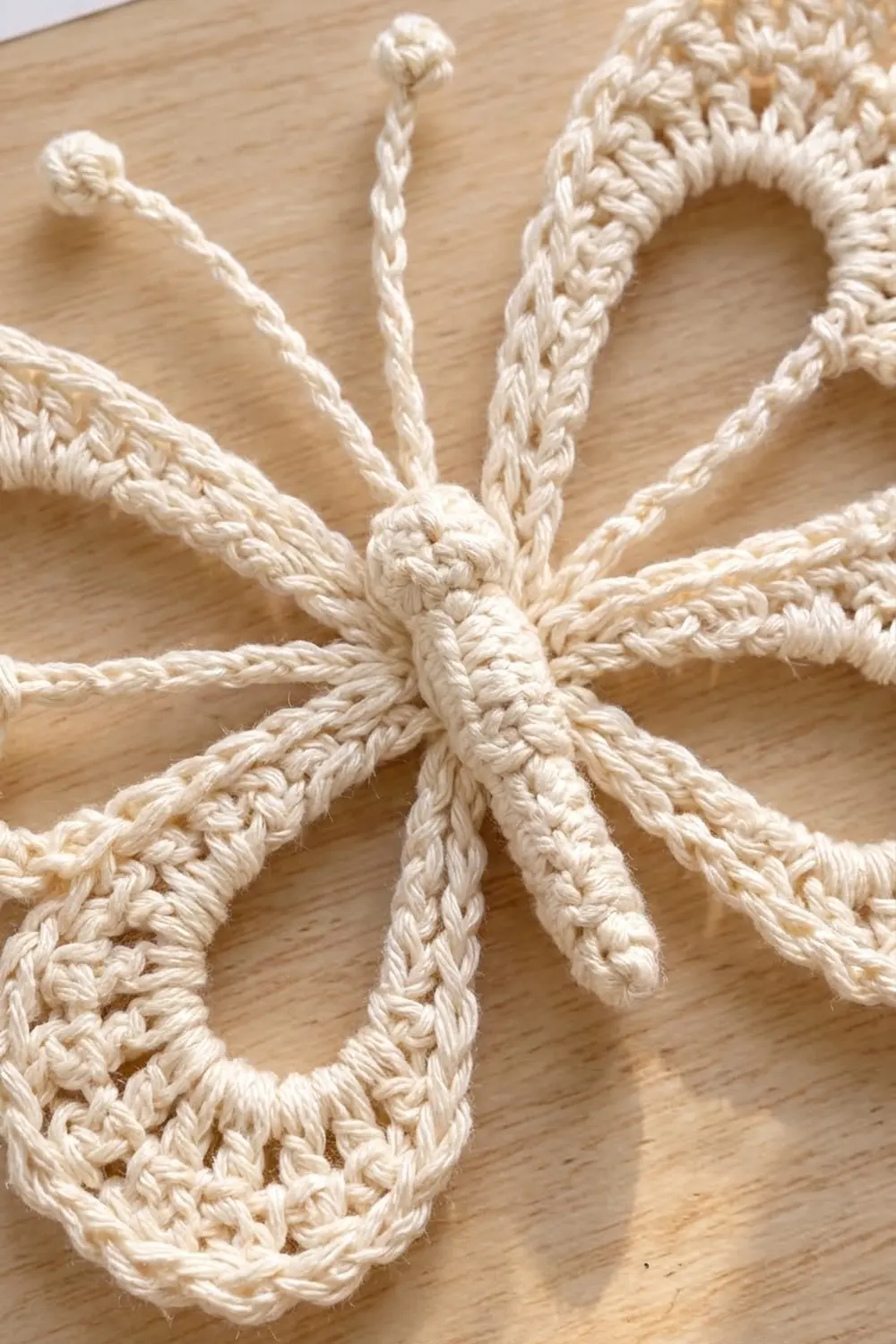
This butterfly is a light, airy appliqué made in a single shade of ivory cotton. Each of its four wings has an open teardrop “window” in the middle, framed by a thin inner line on one side and a solid band of stitches on the outer curve. A twisted rope edge outlines every wing, and a raised, ridged body with two bobble-tipped antennae sits down the center.
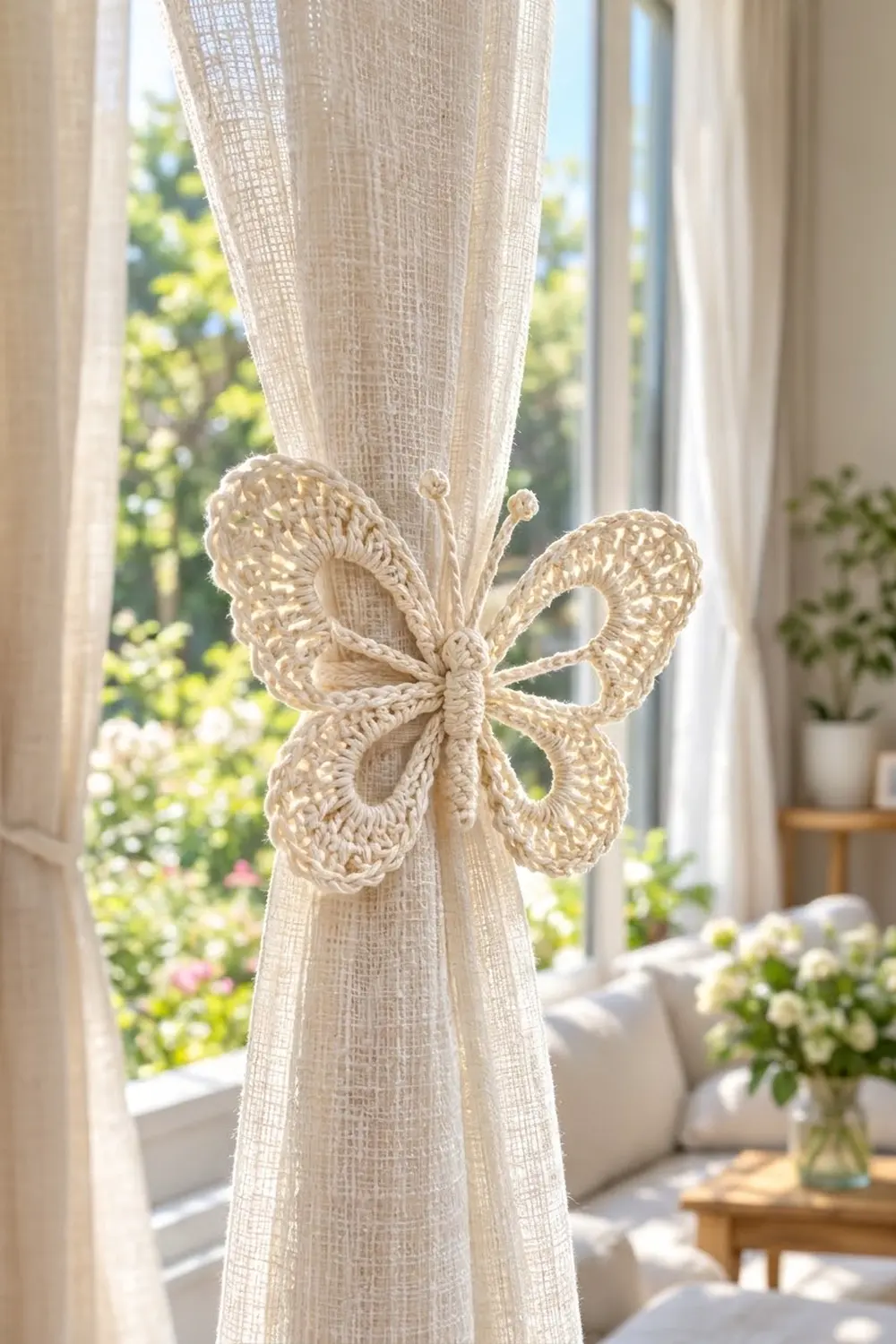
The look is calm, natural and a little vintage. It looks good pinned to a sheer curtain, stitched onto a tote bag, or tucked into a gift wrap. Because it’s one color, the texture does all the work: open windows, dense fans and a corded edge.
The pattern uses US crochet terms. The finished butterfly is 6.25 in (15.9 cm) wide and 5 in (12.7 cm) tall, with a body about 2.25 in (5.7 cm) long.
Construction is simple. You make all four wings in one piece, working each one out from a small center ring as a chain loop with two short rows and then the next wing. A single reverse single crochet border then runs around the whole outline. Last, you make the body and antennae separately and sew them over the center ring.
Finished Size and Construction
- Finished size: 6.25 in x 5 in (15.9 cm x 12.7 cm)
- Skill level: Intermediate (chain loops, short rows, reverse single crochet)
- Terminology: US terms
- Yarn weight: DK (#3) cotton
- Hook: 3.0 mm
- Number of pieces: 1 finished motif (1 wing unit + 1 body + 2 antennae, sewn together)
- Layout: four wings around a center ring, with the body laid vertically on top
- Upper wing reach (ring to edge, before border): 2.75 in (7.0 cm)
- Lower wing reach (ring to edge, before border): 2.25 in (5.7 cm)
- Size before border: 6 in x 4.75 in (15.2 cm x 12.1 cm)
- Border depth: 0.125 in (0.3 cm) per edge, adding 0.25 in (0.6 cm) to each overall dimension
Materials
Yarn: Choose a smooth, tightly plied DK cotton or cotton blend. Mercerized cotton gives the crispest windows and the clearest rope edge. Matte cotton gives a softer, more rustic look. Avoid fuzzy or very splitty yarns, because the open loops need clean stitch definition.
- Ivory/cream: 15 g, about 35 m (38 yd)
That amount covers the wing unit (about 8 g), body (about 2 g), antennae (about 1 g) and sewing tails. The quantities include a margin of about 30% for your gauge swatch wing and any rework.
Tools:
- 3.0 mm crochet hook
- Tapestry needle
- 2 stitch markers
- Scissors
- A pinch of fiberfill or matching yarn scraps for the body
- Rust-proof pins, a blocking mat and a spray bottle
- Optional: fabric stiffener or starch spray
Abbreviations (US Terms)
- ch – chain
- sl st – slip stitch
- sc – single crochet
- hdc – half double crochet
- dc – double crochet
- rev sc – reverse single crochet (crab stitch)
- sc2tog – single crochet 2 together
- MR – magic ring
- BLO – back loop only
- st(s) – stitch(es)
- [ ] – repeat the bracketed steps as many times as stated
Special stitches:
Reverse single crochet (rev sc): Work from left to right (right to left if you crochet left-handed). Insert the hook into the next stitch to the right, yarn over, pull up a loop, yarn over and pull through both loops. This makes the twisted rope edge.
4-dc bobble: [Yarn over, insert the hook in the stitch, pull up a loop, yarn over, pull through 2 loops] 4 times, all in the same stitch (5 loops on the hook). Yarn over and pull through all 5 loops.
Gauge and Checkpoints
Gauge: 20 dc and 10 rows = 4 in (10.2 cm) with a 3.0 mm hook. One dc row is about 0.4 in (1.0 cm) tall.
Test one piece first. Before you commit, work the ring and one upper wing (Rows 1 and 2) as your swatch. Then check it:
- After the ch-24 loop and Row 1: the loop reaches about 2 in (5.1 cm) from the ring to the tip, measured along the center of the loop.
- After Row 2: the upper wing reaches 2.75 in (7.0 cm) from the ring to the outer edge.
- Lower wing after Row 2: 2.25 in (5.7 cm) from the ring to the outer edge.
- Wing unit before border: 6 in x 4.75 in (15.2 cm x 12.1 cm) when laid flat.
- After border: 6.25 in x 5 in (15.9 cm x 12.7 cm).
If your wing is too big, go down to a 2.75 mm hook. If it is too small, go up to a 3.25 mm hook. Don’t change the chain counts, because the stitch math depends on them. If the window closes up or the band ruffles, check that you are working into the chain’s back bumps and not around the chain as a space.
Wing Unit
You make all four wings in one piece, in this order: upper right, lower right, lower left, upper left. Each wing starts and ends at the center ring. Work each loop’s Row 1 into the back bumps of the chains.
Center Ring
Ch 8, sl st in the first ch to form a ring. Don’t work any stitches into the ring yet. It’s only the anchor, and the body will cover it later.
Upper Right Wing
Loop: Ch 24, sl st in the ring.
Row 1 (outer stitches around the loop): Don’t turn. Working into the back bump of each ch of the loop, starting with the ch closest to the ring:
sc in the next 3 ch, hdc in the next 2 ch, dc in the next 2 ch, [2 dc in the next ch, dc in the next ch] 5 times, dc in the next 2 ch, hdc in the next 2 ch, sc in the last 3 ch. Sl st in the ring.
Chains used: 3 + 2 + 2 + 10 + 2 + 2 + 3 = 24.
Stitch count: 29 sts (3 sc, 2 hdc, 19 dc, 2 hdc, 3 sc).
Because the stitches stand outward from the chain, the middle of the loop stays open as the window. The sc stretches near the ring form the thin vein lines.
Row 2 (widening the band): Ch 1, turn. Sl st in each of the first 3 sc. Sc in each of the next 2 hdc. Across the 19 dc: hdc in the first dc, [2 dc in the next dc, dc in the next dc] 8 times, dc in the next dc, hdc in the last dc. Sc in each of the next 2 hdc, sl st in each of the last 3 sc.
Stitches worked across the 19 dc: 1 + 16 + 1 + 1 = 19.
Band count: 1 hdc + 25 dc + 1 hdc = 27 band sts.
Row 2 total: 3 sl st + 2 sc + 27 + 2 sc + 3 sl st = 37 sts, including 31 working sts (2 sc + 27 + 2 sc) for the border.
Sl st in the ring.
Checkpoint: The wing reaches 2.75 in (7.0 cm) from the ring. The band is widest at the tip and narrows to the thin sc vein near the center.
Lower Right Wing
Loop: Ch 18, sl st in the ring.
Row 1: Don’t turn. Working into the back bumps, starting with the ch closest to the ring:
sc in the next 2 ch, hdc in the next ch, dc in the next 2 ch, [2 dc in the next ch, dc in the next ch] 4 times, dc in the next 2 ch, hdc in the next ch, sc in the last 2 ch. Sl st in the ring.
Chains used: 2 + 1 + 2 + 8 + 2 + 1 + 2 = 18.
Stitch count: 22 sts (2 sc, 1 hdc, 16 dc, 1 hdc, 2 sc).
Row 2: Ch 1, turn. Sl st in each of the first 2 sc, sc in the next hdc. Across the 16 dc: hdc in the first dc, [2 dc in the next dc, dc in the next dc] 7 times, hdc in the last dc. Sc in the next hdc, sl st in each of the last 2 sc.
Stitches worked across the 16 dc: 1 + 14 + 1 = 16.
Band count: 1 hdc + 21 dc + 1 hdc = 23 band sts.
Row 2 total: 2 sl st + 1 sc + 23 + 1 sc + 2 sl st = 29 sts, including 25 working sts (1 sc + 23 + 1 sc) for the border.
Sl st in the ring.
Checkpoint: The wing reaches 2.25 in (5.7 cm) from the ring.
Lower Left Wing
Repeat the Lower Right Wing exactly: ch-18 loop, Row 1 (22 sts), Row 2 (23 band sts, 25 working sts). Sl st in the ring.
Upper Left Wing
Repeat the Upper Right Wing exactly: ch-24 loop, Row 1 (29 sts), Row 2 (27 band sts, 31 working sts). Sl st in the ring.
Fasten off and weave in the tail at the ring.
Checkpoint: Lay the unit flat and nudge the upper wings up and out and the lower wings down and out. It should measure 6 in x 4.75 in (15.2 cm x 12.1 cm).
Body
The body is worked in continuous rounds. Don’t join the rounds. Mark the first st of each round with a stitch marker.
- Rnd 1: 6 sc in a MR. (6)
- Rnd 2: [sc in the next st, 2 sc in the next st] 3 times. (9)
- Rnds 3–4: sc in each st. (9)
- Rnd 5 (neck): [sc in the next st, sc2tog] 3 times. (6)
- Rnd 6: [sc in the next st, 2 sc in the next st] 3 times. (9)
- Rnd 7: sc in BLO of each st. (9)
- Rnd 8: sc in each st. (9)
- Rnd 9: sc in BLO of each st. (9)
- Rnd 10: sc in each st. (9)
- Rnd 11: sc in BLO of each st. (9)
- Rnd 12: sc in each st. (9)
Lightly stuff the head and abdomen. Keep the body softly rounded, not firm.
- Rnd 13: [sc in the next st, sc2tog] 3 times. (6)
- Rnd 14: sc in each st. (6)
- Rnd 15: sc2tog 3 times. (3)
Fasten off, leaving a 12 in (30.5 cm) tail. Thread the tail through the last 3 sts and pull it closed.
The unused front loops from Rnds 7, 9 and 11 form the horizontal ridges on the abdomen. Checkpoint: The body is about 2.25 in (5.7 cm) long, and the head is about 0.6 in (1.5 cm) wide.
Antennae (Make 2)
Ch 11. Work a 4-dc bobble in the 4th ch from the hook. Sl st in each of the remaining 7 ch.
Chain math: 3 skipped ch + 1 bobble ch + 7 sl st = 11.
Fasten off, leaving a 6 in (15.2 cm) tail. Each antenna is about 1.5 in (3.8 cm) long, with a small round knob at the tip. The slip-stitch spine keeps it stiff enough to stand up.
Assembly
- Lay the wing unit right side up. Center the body vertically over the ring, with the head between the two upper wings and the tail end between the two lower wings.
- Whipstitch the body down along both sides with its long tail, catching only the back of the body so the stitches stay hidden. Keep the lower third of the abdomen tacked flat. Leave the head slightly raised.
- Sew the base of each antenna to the top of the head, about 0.2 in (0.5 cm) apart, and angle them outward in a V.
- Weave in all the ends through the body.
Border
The border is a single round of reverse single crochet around the outer edge of all four wings. It gives the twisted rope edge.
Border gauge: 1 rev sc per stitch of Row 2. The round adds about 0.125 in (0.3 cm) per edge.
Border round: With the right side facing, join the yarn in the ring between the upper left and upper right wings. Ch 1. On each wing, skip that wing’s Row 2 slip stitches and work only into its working stitches:
- Upper right wing: rev sc in each of the 31 working sts (2 sc + 27 band + 2 sc). 31 + 0 = 31 rev sc. Sl st in the ring.
- Lower right wing: rev sc in each of the 25 working sts (1 sc + 23 band + 1 sc). 25 + 0 = 25 rev sc. Sl st in the ring.
- Lower left wing: rev sc in each of the 25 working sts. 25 + 0 = 25 rev sc. Sl st in the ring.
- Upper left wing: rev sc in each of the 31 working sts. 31 + 0 = 31 rev sc. Sl st in the ring.
Border total: 31 + 25 + 25 + 31 = 112 rev sc, plus 4 sl st in the ring.
Fasten off and weave in the end under the body.
Why the math works: The fan increases in Rows 1 and 2 already make each outer curve long enough to lie flat. That’s why the border works exactly 1 rev sc per stitch with no extra increases. Reverse single crochet also draws the edge in slightly, which firms up the curve and stops the band from flaring. The 4 sl sts at the ring fall under the body, so they never show. Checkpoint: 6.25 in x 5 in (15.9 cm x 12.7 cm).
Final Blocking
- Lightly mist the butterfly with water until it is damp but not soaked.
- Lay it right side up on the blocking mat. Shape the upper wings into teardrops angled up and out, and the lower wings into rounded lobes angled down and out.
- Pin each wingtip first, then pin around the rope edge every 0.5 in (1.3 cm).
- Push a pin through the center of each window and gently open it into a clear teardrop.
- Check the overall size: 6.25 in (15.9 cm) wide and 5 in (12.7 cm) tall. Make sure the left and right wings mirror each other.
- Optional: brush or spray a light coat of fabric stiffener on the wings only, not the body.
- Let it dry completely, then unpin. Straighten the antennae by rolling them between your fingers.
Final Quality-Control Checklist
- Upper wing loops are ch 24, and lower wing loops are ch 18.
- Row 1 counts: 29 sts on each upper wing and 22 sts on each lower wing.
- Row 2 band counts: 27 on each upper wing and 23 on each lower wing.
- Border: 31 + 25 + 25 + 31 = 112 rev sc.
- All four windows are open and clearly teardrop-shaped.
- The rope edge is even and doesn’t ruffle or cup.
- The body is centered, with the ridges facing out and the head between the upper wings.
- The antennae are matched in length and their bobble tips are round.
- Finished size is 6.25 in x 5 in (15.9 cm x 12.7 cm).
- All ends are woven in under the body.
Troubleshooting
The windows close up or look small. You may be working into the loop as a space. Work into each chain’s back bump, or try a slightly looser foundation chain.
The wing band ruffles. Your dc tension may be loose. Go down a hook size, or check that you repeated the increase exactly the stated number of times.
The wing cups upward. Your border may be too tight. Work the rev sc a little looser, or block it more firmly.
The left and right wings don’t match. Count the Row 2 band stitches on each wing. They must be 27 (upper) or 23 (lower).
The ring shows around the body. Pull the starting tail to snug the ring closed before sewing on the body.
The antennae flop. Work the slip stitches a little tighter, or add a touch of stiffener.
The body looks lumpy. Use less stuffing and roll the body between your palms before closing it.
Care
Hand wash in cool water with mild soap, press out the water in a towel, and reshape it flat to dry. If you used stiffener, re-stiffen after washing.
Final Notes
Here is the measurement chain in short:
- Gauge is 20 dc and 10 rows = 4 in (10.2 cm).
- The ch-24 upper loops reach 2.75 in (7.0 cm) after Row 2, and the ch-18 lower loops reach 2.25 in (5.7 cm).
- The wing unit measures 6 in x 4.75 in (15.2 cm x 12.1 cm) before the border.
- The 112-stitch rev sc border adds 0.125 in (0.3 cm) per edge, for a finished butterfly of 6.25 in x 5 in (15.9 cm x 12.7 cm).
- The 15-round body is 2.25 in (5.7 cm) long, and the slip-stitch antennae are 1.5 in (3.8 cm) long.
If you check your numbers at each stage, the wings will mirror cleanly and the windows will stay open.
Happy crocheting!