

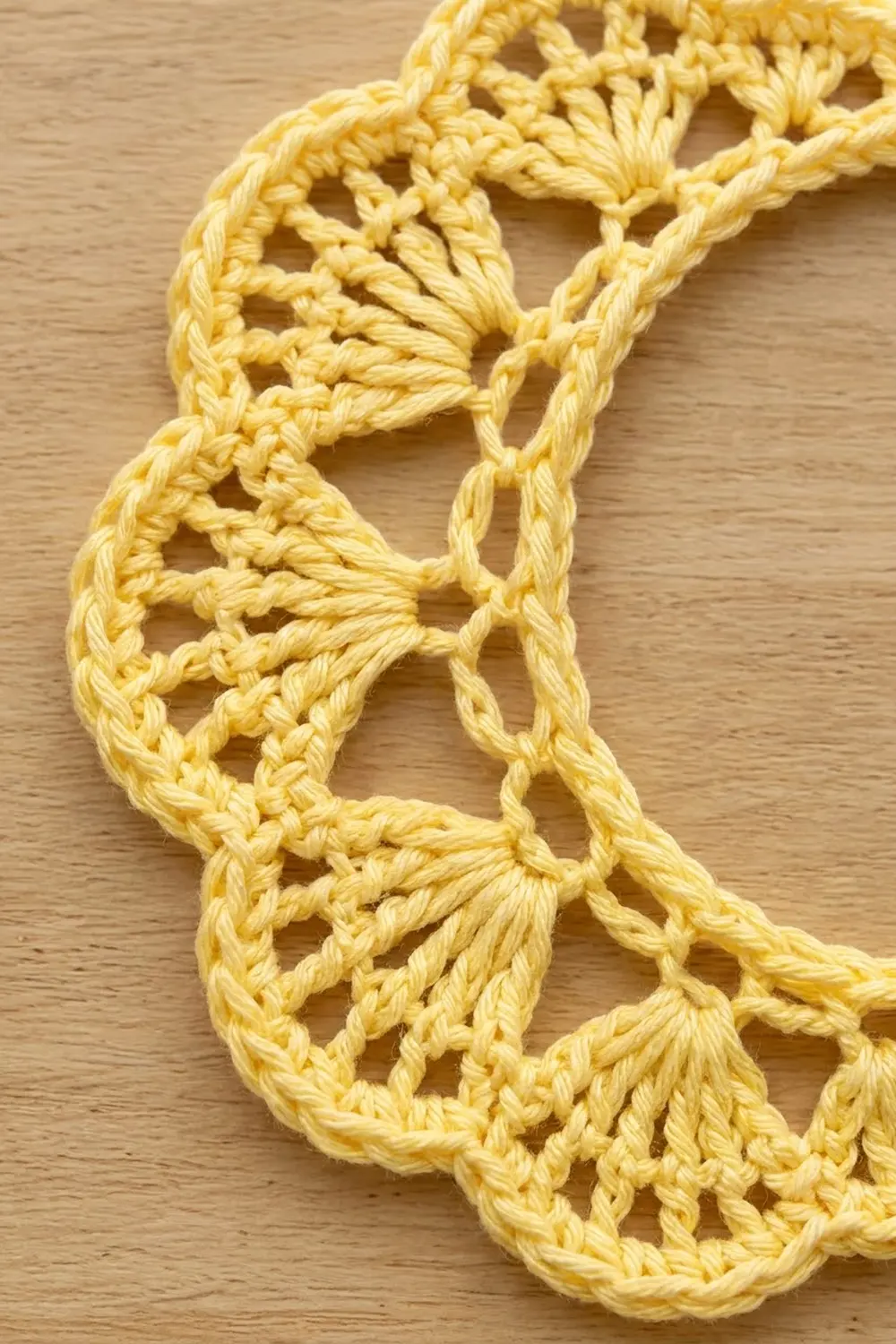
The Lunette Lace Crescent Moon is a small, airy motif in the shape of a classic crescent. It has a smooth inner curve, a band of tiny eyelets and five fanned scallops that flare out along the outer edge. Both ends taper to clean points, so it looks like a moon even from across the room.
This sample is worked in a single soft butter-yellow cotton thread. The pale color keeps the lace looking light and shows off the fans. The motif looks just as good in white, ivory, silver-gray or pale gold. The style is vintage doily lace on a modern ornament scale.
This pattern uses US crochet terms throughout. The finished moon is about 4.75 in (12.1 cm) from tip to tip, about 3 in (7.6 cm) across at its widest point, and the lace band is about 1 in (2.5 cm) deep.
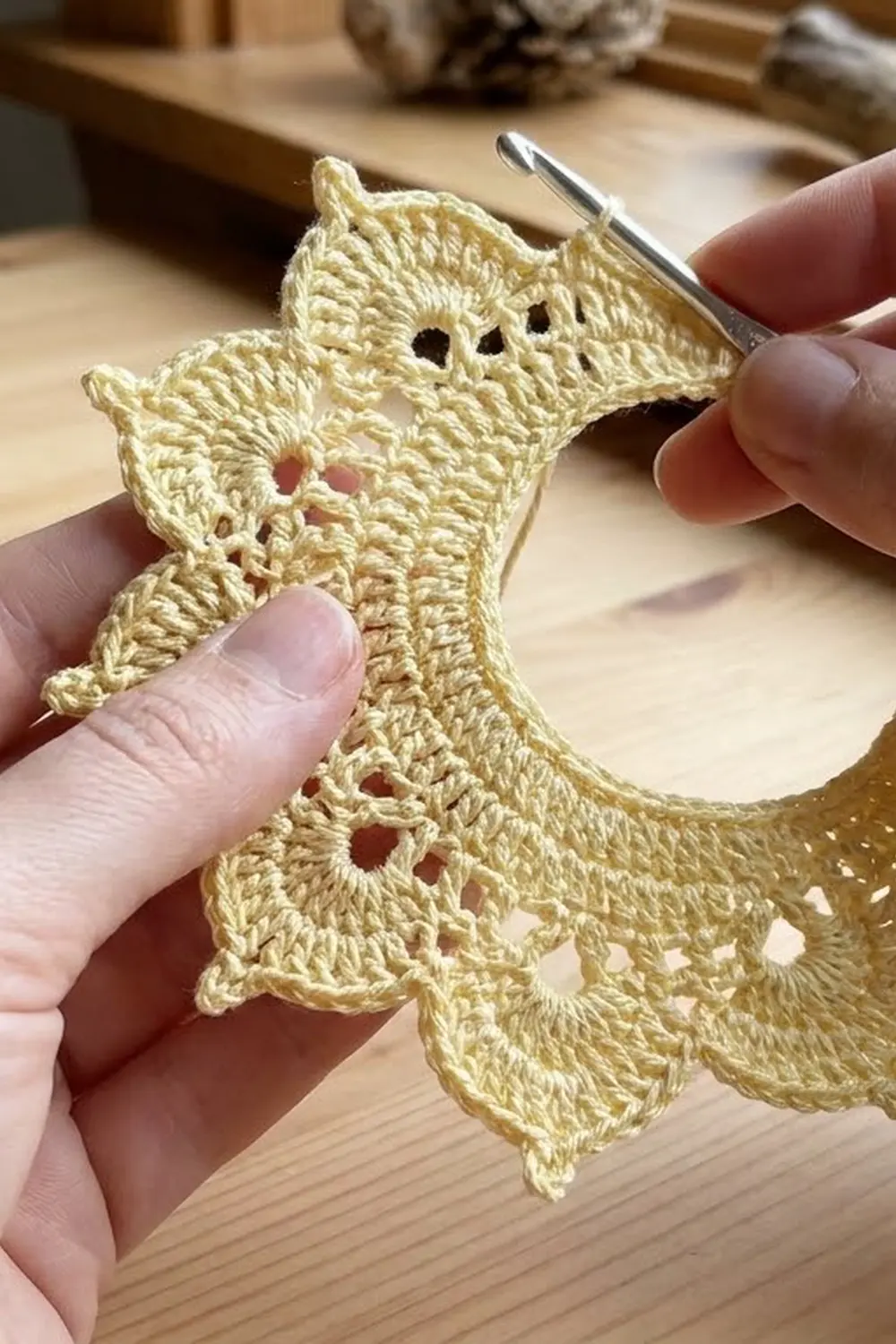
Construction is simple. You chain a foundation and work one row of single crochet along it to form the inner spine. Next comes one eyelet row and one fan row, all worked flat in turned rows. One continuous edging round then finishes the scallops, the tips and the inner curve. The moon gets its curve from the fans being much wider than the spine, and a short pinned blocking sets the shape.
Finished Size and Construction
- Finished size: 4.75 in (12.1 cm) tip to tip × 3 in (7.6 cm) at widest
- Skill level: Easy-intermediate (treble crochet fans and working into a chain’s bottom loops)
- Terminology: US crochet terms
- Yarn weight: Size 3 crochet cotton thread (fine, about #1 weight)
- Hook: 2.25 mm (US B-1)
- Number of pieces: 1 single motif
- Layout: One crescent, worked flat in rows and finished with one edging round
- Piece size: Lace band 1 in (2.5 cm) deep after the edging
- Size before border: About 4.5 in (11.4 cm) tip to tip, band 0.875 in (2.2 cm) deep
- Border depth: About 0.125 in (0.3 cm)
Materials
Yarn advice: Use a smooth, tightly plied mercerized cotton thread. Mercerized cotton holds crisp stitch definition and blocks well, and it keeps the fans sharp. Avoid fuzzy or very soft acrylics, because the scallops will blur and the tips will not hold a point.
- Color A – Butter Yellow: 6 g (about 10 m / 11 yd) of size 3 cotton thread
These quantities include a margin of roughly 30–40% for your gauge swatch, weaving in ends and the optional hanging loop.
Tools:
– 2.25 mm (US B-1) crochet hook
– Small sharp scissors
– Fine tapestry needle for weaving in ends
– Rustproof pins
– Foam blocking mat or folded towel
– Spray bottle with water (optional: light spray starch)
– Ruler or tape measure
Abbreviations (US Terms)
- ch – chain
- sl st – slip stitch
- sc – single crochet
- hdc – half double crochet
- dc – double crochet
- tr – treble crochet
- sp(s) – space(s)
- st(s) – stitch(es)
- RS / WS – right side / wrong side
Special stitch – Fan: Work 7 tr into the same ch-1 sp. The fan counts as 7 sts.
Treble crochet (tr) reminder: Yarn over twice, insert the hook, yarn over and pull up a loop (4 loops on the hook). Then [yarn over and draw through 2 loops] 3 times.
Gauge and Checkpoints
Gauge: 14 sc = 2 in (5.1 cm) worked flat with a 2.25 mm hook.
Gauge matters for the motif’s final size, so make one moon as your test piece. Measure it at each checkpoint below before you commit to a batch.
Checkpoint 1 (after Row 1): The 39-sc spine measures about 5.5 in (14.0 cm) when laid straight.
Checkpoint 2 (after Row 2): Rows 1 and 2 together measure about 0.375 in (1.0 cm) deep. The eyelets should be clearly open but not stretched.
Checkpoint 3 (after Row 3): The band is about 0.875 in (2.2 cm) deep at the top of each fan. The piece should already curl on its own into a rough crescent about 4.5 in (11.4 cm) from tip to tip.
Checkpoint 4 (after the edging and blocking): 4.75 in (12.1 cm) tip to tip, 3 in (7.6 cm) at widest, band 1 in (2.5 cm) deep.
If your moon is too big: Go down to a 2.0 mm hook, or tighten the foundation chain. A loose foundation is the most common cause of an oversized, floppy crescent.
If your moon is too small: Go up to a 2.5 mm hook. If the fans look cramped but the spine is the right length, loosen up only while working the tr stitches.
Pattern
Row 1 – Inner Spine (WS)
Ch 40.
Sc in the 2nd ch from the hook and in each ch across. Turn. (39 sc)
The skipped chain does not count as a stitch. Keep this row smooth and even, because it becomes the inner curve of the moon. Leave a 6 in (15.2 cm) starting tail and weave it in later.
Row 2 – Eyelet Row (RS)
Ch 1 (does not count as a st).
Sc in the first 2 sc, hdc in the next sc. Ch 1, skip the next sc, dc in the next sc. Repeat from * to * 15 more times (16 times in total). Ch 1, skip the next sc, hdc in the next sc, sc in the last 2 sc. Turn.
Stitch count: 20 sts (2 sc + 1 hdc at each end, plus 16 dc) and 17 ch-1 sps.
Check your coverage: the 2 sc + 1 hdc use spine sts 1–3. The 16 repeats use sts 4–35. The final ch-1, hdc and 2 sc use sts 36–39. That adds up to all 39 sts.
For reference in Row 3, number the ch-1 sps from 1 to 17 and the dc from 1 to 16 in the order you meet them. Dc 1 sits between sp 1 and sp 2, dc 2 sits between sp 2 and sp 3, and so on.
Row 3 – Fan Row (WS)
This row builds the five scallops and tapers both tips.
Ch 1 (does not count as a st).
First tip: Sc in each of the first 2 sc, hdc in the hdc, hdc in sp 1, dc in dc 1, dc in sp 2.
Fan 1: Skip dc 2, Fan in sp 3, skip dc 3.
Valley: Sc in sp 4, ch 1, skip dc 4, sc in sp 5, skip dc 5.
Fan 2: Fan in sp 6, skip dc 6.
Valley: Sc in sp 7, ch 1, skip dc 7, sc in sp 8, skip dc 8.
Fan 3 (center): Fan in sp 9, skip dc 9.
Valley: Sc in sp 10, ch 1, skip dc 10, sc in sp 11, skip dc 11.
Fan 4: Fan in sp 12, skip dc 12.
Valley: Sc in sp 13, ch 1, skip dc 13, sc in sp 14, skip dc 14.
Fan 5: Fan in sp 15, skip dc 15.
Second tip: Dc in sp 16, dc in dc 16, hdc in sp 17, hdc in the hdc, sc in each of the last 2 sc. Turn.
Stitch count: 55 sts and 4 ch-1 sps.
– Tips: 6 sts each (2 sc, 2 hdc, 2 dc) = 12
– Fans: 5 × 7 tr = 35
– Valleys: 4 × 2 sc = 8, plus 4 ch-1 sps
– Total: 12 + 35 + 8 = 55 sts
The center fan sits in sp 9, the exact middle of 17 spaces, so the moon is symmetrical. Fans 1 and 5 (sps 3 and 15) mirror each other, and so do fans 2 and 4 (sps 6 and 12).
At this stage the motif cups and curls. This is correct. The fans are far wider than the 39-st spine, and that difference is what makes the crescent.
Border
The border is one continuous edging round. It is dense over the scallops, dips with a slip stitch at each valley, wraps the tips and then runs snug along the inner curve.
Border gauge: Work the edging at the same 14 sc = 2 in (5.1 cm) gauge. On the inner curve, aim for one firm sc per foundation chain, with no extra stitches.
Border Round (RS)
Ch 1 (does not count as a st).
Outer edge, first tip: Sl st in the first sc. Sc in each of the next 5 sts (sc, hdc, hdc, dc, dc).
Over each fan: Sc in the first tr, 2 sc in each of the next 5 tr, sc in the last tr. (12 sc per fan)
At each valley (between fans): Skip the sc, sl st in the ch-1 sp, skip the next sc.
Repeat the fan and valley sequence across: Fan, valley, Fan, valley, Fan, valley, Fan, valley, Fan.
Outer edge, second tip: Sc in each of the next 5 sts (dc, dc, hdc, hdc, sc), sl st in the last sc.
Outer edge count: 76 sts. This is a conversion round, so here is how the count breaks down:
– Worked 1 per existing st: 12 (tips) + 35 (tr) = 47
– Extra sts added: 5 per fan × 5 fans = 25
– Sl sts into the valley ch-1 sps: 4
– Total: 47 + 25 + 4 = 76
– The 8 valley sc are skipped and get no new sts.
Tip edge (first side): Do not turn. Rotate the piece and work down the row ends: 1 sc in the end of each of Rows 3, 2 and 1. (3 sc)
Inner edge: Work 1 sc into the bottom loop of each foundation ch that holds a Row 1 sc. (39 sc)
Tip edge (second side): Work up the row ends: 1 sc in the end of each of Rows 1, 2 and 3. (3 sc)
Join with a sl st to the first sl st of the round. Fasten off, leaving a 6 in (15.2 cm) tail.
Border total: 76 + 3 + 39 + 3 = 121 sts.
Why the math works:
– Inner edge: Placing exactly 39 sc into 39 foundation loops keeps the inner curve exactly the length of the spine, so it stays firm and holds the crescent shape.
– Fans: Each fan gets 5 extra sts at its outer curve. That gives the scallop edge room to lie flat instead of ruffling or cupping.
– Valleys: The sl st pulls each valley inward, which makes each scallop look distinct.
– Tips: The sl st at each end of the outer edge, plus a single sc per row end, keeps the tips narrow and pointed.
Optional hanging loop: Before fastening off, ch 12 and sl st into the same st to make a loop about 1.5 in (3.8 cm) long. Then fasten off.
Final Blocking
- Weave in both tails along the inner spine, where they hide best. Do not trim them yet.
- Wet the moon in cool water, gently squeeze out the excess and roll it in a towel.
- Lay it on the blocking mat RS up and shape the inner curve into a smooth arc.
- Pin each tip to a point so that the tips are 4.75 in (12.1 cm) apart.
- Pin the top of each of the five scallops outward until the band measures 1 in (2.5 cm) deep. Pin the center fan first, then fans 2 and 4, then fans 1 and 5.
- Use your fingertip or a pin to open each eyelet in Row 2.
- Check the width: 3 in (7.6 cm) at the widest point.
- If you want a stiffer ornament, mist lightly with spray starch.
- Let it dry completely, then unpin it and trim the tails close.
Final Quality-Control Checklist
- Row 1 has 39 sc.
- Row 2 has 20 sts and 17 ch-1 sps.
- Row 3 has 55 sts and 4 ch-1 sps, with five 7-tr fans.
- The fans sit in sps 3, 6, 9, 12 and 15, and the moon is symmetrical.
- The border has 121 sts: 76 on the outer edge, 3 at each tip and 39 on the inner edge.
- Each scallop has 12 sc, with a sl st dip at each of the 4 valleys.
- Both tips are pointed and match each other.
- The blocked size is 4.75 in (12.1 cm) tip to tip, 3 in (7.6 cm) wide, with a 1 in (2.5 cm) band.
- The tails are woven in invisibly along the spine.
Troubleshooting
The crescent won’t curve and lies almost straight. Your foundation chain was probably worked loosely. Redo it a hook size smaller, or crochet the inner border sc more firmly.
The fans ruffle or flip. Your tr stitches are too tall or too loose. Shorten your yarn-overs, or drop half a hook size for Row 3 only.
The scallops cup upward. The edging is too tight. Make sure each fan has 2 sc in each of its 5 center tr.
The tips are blunt. Check that you used one sc per row end, not two, and that the outer edge starts and ends with a sl st.
The moon is lopsided. Count the Row 2 spaces again. If the center fan is not in sp 9, the moon will lean to one side.
The eyelets close up. Block again and open each ch-1 sp with a pin while the piece is damp.
Care
Hand wash in cool water with a mild soap, press out the water in a towel and dry flat. Re-pin the tips and scallops while damp if they need refreshing, and re-starch if you like a firm finish.
Final Notes
The whole moon comes from one short chain of measurements. A 39-sc spine of 5.5 in (14.0 cm) carries 17 eyelet spaces. Five fans of 7 tr sit on those spaces and turn the piece into a curving 4.5 in (11.4 cm) crescent with a 0.875 in (2.2 cm) band. A 121-st edging round adds 0.125 in (0.3 cm). After blocking, the finished moon is 4.75 in (12.1 cm) tip to tip and 3 in (7.6 cm) wide.
If your test moon hits each checkpoint, every moon after it will match. Hang it with a loop, tie it onto a gift or keep it as a small piece of lace on its own.
Happy crocheting!