

The Morning Vine strand is a long hanging vine in soft sage green and cream. A thin chain spine runs down from a hanging loop at the top. Pointed openwork leaves branch off it on alternating sides, a narrow ribbon twists down around it, and small five-petal cream flowers sit over the spine every 6 in (15.2 cm).
The look is light, botanical and a little vintage. It works well against window light because the open leaf windows and the twisting ribbon throw soft shadows. You can hang one strand alone or hang a row of separate strands on a rod.
This pattern uses US crochet terms. The finished strand is about 75 in (190.5 cm) long including the hanging loop and about 3 in (7.6 cm) wide at the leaves.
Construction is simple. You crochet the spine and all 24 leaves in one continuous piece, then make one long ribbon strip and 12 flowers. Next you work a slip-stitch border up the spine. Last, you twist the ribbon around the spine, tack it at each leaf base and sew a flower over every second tack.
Finished Size and Construction
- Finished size: 75 in (190.5 cm) long including the loop; 3 in (7.6 cm) wide at the leaves
- Skill level: Easy to intermediate
- Terminology: US crochet terms
- Yarn weight: DK / light worsted (#3), cotton or cotton blend
- Hook: 3.5 mm (E-4)
- Number of pieces: 14 per strand (1 spine with leaves, 1 ribbon, 12 flowers)
- Layout: 1 vertical strand made of 12 repeats of 6 in (15.2 cm), plus a 1 in (2.5 cm) tail
- Piece size: leaf 2.75 x 1.25 in (7.0 x 3.2 cm); flower 2 in (5.1 cm) across; ribbon 0.4 in (1.0 cm) wide
- Size before border: spine chain 73 in (185.4 cm) below the loop
- Border depth: 0 in (0 cm). The border is a slip-stitch row worked back up the spine. It firms the spine but adds no width.
Materials
Use a smooth mercerized or matte cotton in DK weight. Cotton holds the leaf points and petal shapes well and stretches very little when it hangs. Avoid fuzzy yarns, because they blur the leaf windows.
- Sage green: 60 g, about 132 m (144 yd), for the spine, leaves, ribbon and flower centers
- Cream: 20 g, about 44 m (48 yd), for the flower petals
These amounts assume yarn of about 110 m per 50 g and include a margin of about 25%.
Tools:
– 3.5 mm (E-4) crochet hook
– Tapestry needle
– Stitch markers (about 6)
– Scissors
– Measuring tape
– Blocking mat and rust-proof pins
– Spray bottle
Abbreviations (US Terms)
- ch – chain
- sl st – slip stitch
- sc – single crochet
- hdc – half double crochet
- dc – double crochet
- BLO – back loop only
- sk – skip
- sp – space
- st(s) – stitch(es)
- MR – magic ring
Special technique – surface slip stitch: Hold the working yarn behind the leaf. Insert the hook from the front between two strands of the center vein, pull up a loop, and draw it through the loop on your hook. Move about 0.2 in (0.5 cm) along the vein and repeat. This makes a raised chain line on the front of the leaf.
Gauge and Checkpoints
Gauge matters more for length than for fit, because any small error repeats 12 times down the strand.
Test piece first: Ch 30, then work one leaf and one flower before you start the full strand.
- Chain gauge: 5 ch = 1 in (2.5 cm), so 30 ch = 6 in (15.2 cm).
- Single crochet gauge: 5 sc = 1 in (2.5 cm); 2 rows of sc = 0.4 in (1.0 cm).
- Leaf checkpoint: 2.75 x 1.25 in (7.0 x 3.2 cm) after Rnd 2.
- Flower checkpoints: 0.5 in (1.3 cm) across after Rnd 1, 1 in (2.5 cm) after Rnd 2, 1.25 in (3.2 cm) after Rnd 3, and 2 in (5.1 cm) after Rnd 4.
If your pieces are too big, go down to a 3.25 mm (D-3) hook. If they are too small, go up to a 3.75 mm (F-5). Chain gauge is the most important number. If only your chains are off, change hooks for the spine and ribbon only.
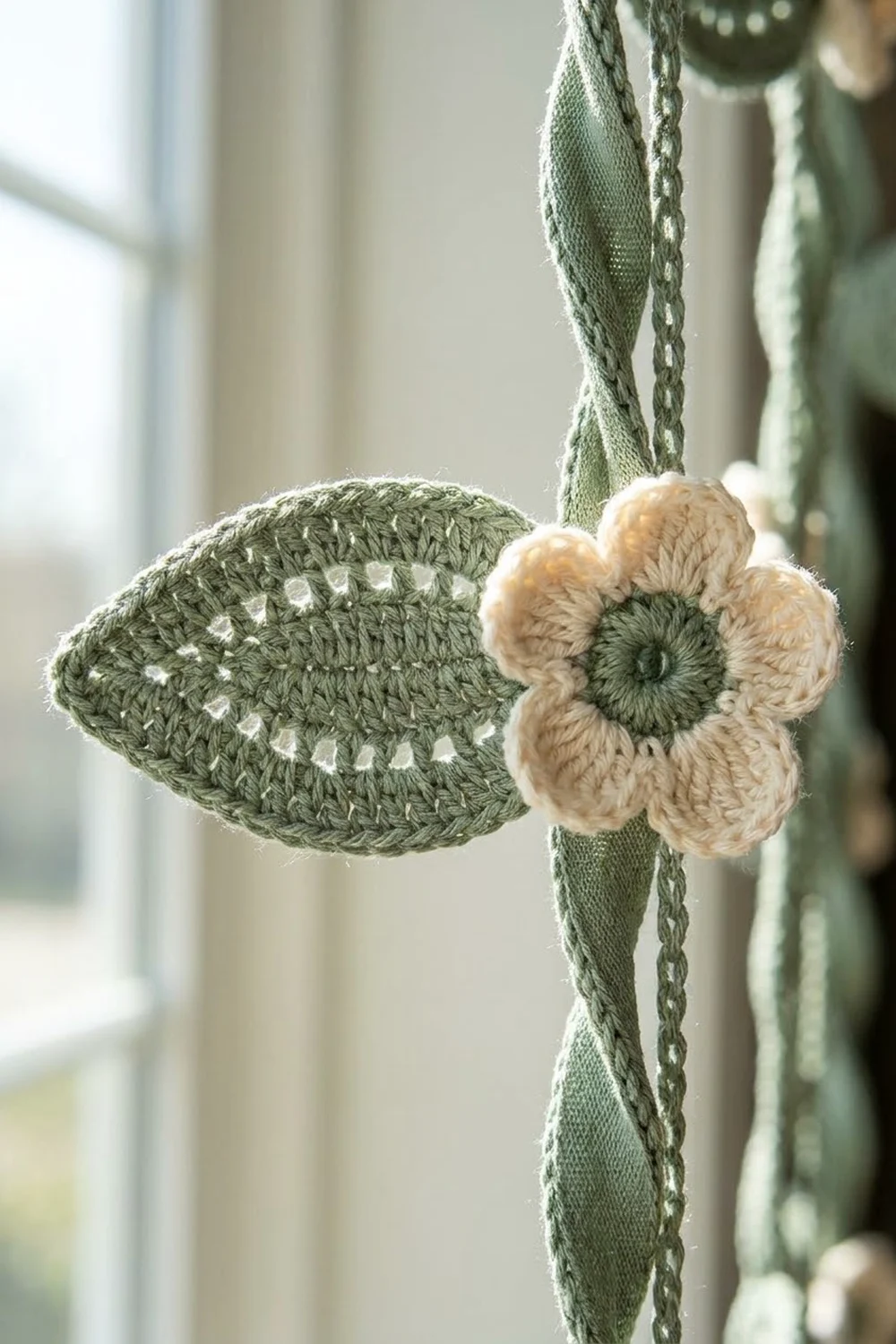
Spine and Leaves
The spine and all the leaves are one continuous piece in sage green. Each leaf is worked on its own chain that branches off the spine. When the leaf is done, you go back to the spine and keep chaining.
Hanging loop: Ch 20, sl st in first ch to form a ring. The ring is 4 in (10.2 cm) around and hangs about 2 in (5.1 cm) deep. It fits a rod up to 1.25 in (3.2 cm) thick.
Leaf (make 24, worked off the spine)
Leaf foundation: Ch 13. The first ch from the hook becomes the leaf tip. Number the other 12 ch from ch 1 (next to the tip) to ch 12 (next to the spine).
Rnd 1 (openwork):
– Side A: Sc in ch 1, hdc in ch 2, dc in ch 3, [ch 1, sk 1 ch, dc in next ch] 4 times (the dc go into ch 5, 7, 9 and 11), hdc in ch 12.
– Base: Ch 2.
– Side B (along the other side of the foundation): Hdc in ch 12, dc in ch 11, [ch 1, sk 1 ch, dc in next ch] 4 times (the dc go into ch 9, 7, 5 and 3), hdc in ch 2, sc in ch 1.
– Tip: Ch 2, sl st in first sc.
Count: 16 sts (8 per side), 8 ch-1 sps (4 per side), 2 ch-2 sps.
The 4 ch-1 spaces on each side are the open windows. The bare foundation chain between the two sides becomes the vein.
Rnd 2 (solid edge):
– Ch 1, sc in the same sc as the join. Sc in each st and each ch-1 sp along Side A, ending in the hdc (12 sc on Side A).
– Base: Sc in base ch-2 sp, sl st in the last spine ch made, sc in same base ch-2 sp.
– Side B: Sc in each st and each ch-1 sp (12 sc).
– Tip: (Sc, ch 2, sc) in tip ch-2 sp, sl st in first sc.
Count: 28 sc (12 + 1 + 1 + 12 + 2), 1 sl st anchor, 1 ch-2 tip point.
The sl st at the base anchors the leaf to the spine. The (sc, ch 2, sc) makes the sharp tip.
Vein: Work 11 surface sl sts along the foundation chain from the tip to the base. Then sl st into the spine ch at the leaf base. The leaf is done and your hook is back on the spine.
Checkpoint: The leaf measures 2.75 x 1.25 in (7.0 x 3.2 cm).
Spine Repeat
Work from the hanging loop downward.
Repeat (work 12 times):
1. Ch 15 for the spine, then work one leaf. This is the right leaf.
2. Ch 15 for the spine, then work one leaf. This is the left leaf.
Each repeat: 30 spine ch, 2 leaves, 6 in (15.2 cm).
Tail: After the 12th repeat, ch 5.
Total spine count: 12 x 30 = 360 ch + 5 tail ch = 365 spine ch.
Checkpoint: Let the strand hang and put a marker at the base of every second leaf (the left leaves). The markers should be 6 in (15.2 cm) apart, and the last leaf should be 72 in (182.9 cm) below the loop. Do not fasten off, because the border comes next.
All the leaves grow from the same chain. You set them on alternating sides during blocking by turning each leaf to its side.
Spiral Ribbon
Make 1 in sage green.
Foundation: Ch 409.
Row 1: Sc in 2nd ch from hook and in each ch across. (408 sc)
Row 2: Ch 1, turn. Sc in BLO of each st across. (408 sc)
Fasten off, leaving a 12 in (30.5 cm) tail.
Working Row 2 in back loops leaves a ridge along one edge. That ridge gives the ribbon its corded look when it twists.
Checkpoint: The ribbon is 81.6 in (207.3 cm) long and 0.4 in (1.0 cm) wide, laid flat without stretching.
Flowers
Make 12.
Rnd 1 (sage green): MR, ch 1, 10 sc in ring, pull the ring tight, sl st in first sc. (10 sc) Fasten off green.
Rnd 2 (cream): Join cream in any sc. Ch 1, 2 sc in each sc around, sl st in first sc. (20 sc)
Rnd 3: Ch 1, sc in same st, ch 3, sk 3, [sc in next st, ch 3, sk 3] 4 times, sl st in first sc. (5 sc, 5 ch-3 sps)
To check: 5 sc + 15 skipped sts = 20, which matches Rnd 2.
Rnd 4 (petals): Work (sc, hdc, 4 dc, hdc, sc) in each ch-3 sp, with a sl st in each Rnd 3 sc between the spaces. Sl st in first sc to join. (5 petals of 8 sts each, 40 sts total)
Fasten off, leaving a 10 in (25.4 cm) cream tail for sewing.
Checkpoint: The flower is 2 in (5.1 cm) across, measured from a petal tip to the gap opposite, lying flat.
Make All Pieces
For one strand:
- Spine with 24 leaves: 1 piece, sage green
- Spiral ribbon: 1 piece, sage green
- Flowers: 12, with Rnd 1 in sage green and Rnds 2–4 in cream
Layout grid (one repeat, read top to bottom):
0 in    (0 cm)      loop base ......... ribbon start sewn
3 in    (7.6 cm)    RIGHT leaf base ... ribbon tack, ribbon in front
6 in    (15.2 cm)   LEFT leaf base .... ribbon tack, ribbon behind + FLOWER
--- repeat 12 times; tack points every 3 in (7.6 cm) ---
72 in   (182.9 cm)  last LEFT leaf .... ribbon end tacked + FLOWER 12
73 in   (185.4 cm)  tail end
Joining
Here, joining means attaching the ribbon and flowers to the finished spine. Work the border (below) first so the spine is at its final length.
Ribbon logic: The ribbon is attached at 25 points: the loop base plus the 24 leaf bases. These points are 3 in (7.6 cm) apart, which is 15 spine ch. Each 15-ch section of spine gets 17 ribbon sts. 24 sections x 17 sts = 408 sts, which matches the ribbon count exactly. The 2 extra sts in each section give the slack for a half twist.
Method:
1. Sew the starting end of the ribbon (the edge of st 1) to the loop base using the yarn tail.
2. Give the ribbon a half turn so it crosses in front of the spine, and tack st 17 to the first right leaf base with 2 small stitches.
3. Give it another half turn so it passes behind, and tack st 34 to the first left leaf base.
4. Keep tacking every 17th st until st 408 is tacked to the 24th leaf base.
Always turn the ribbon in the same direction so the spiral reads as one continuous twist.
Flowers: Center one flower over each left leaf base (12 points). Use the cream tail to sew through Rnd 2 into the spine, making 5 small stitches, one behind each petal. The flower hides the ribbon tack.
Tension: Tack loosely enough that the spine still hangs straight. If the spine bunches between tacks, the ribbon has been pulled too tight.
Size checkpoint: When hanging, the strand measures 73 in (185.4 cm) from loop base to tail end, and the flowers are 6 in (15.2 cm) apart.
Border (Spine Return and Hanging Loop)
The border is a slip-stitch row worked back up the whole spine. It firms the chain, stops it from stretching and gives the spine a corded look.
Border gauge: 5 sl st = 1 in (2.5 cm), matching the chain gauge. Keep the slip stitches loose. If they shorten the spine, go up one hook size for this row only.
Spine return row: Sl st in 2nd ch from hook, then sl st in the back bump of each spine ch up to the loop. At each leaf base, pass the leaf and work only into spine chains.
Count: 365 spine ch − 1 skipped ch = 364 sl st.
Loop finish: Sl st into the base of the hanging loop. Ch 1, then work 30 sc around the 20-ch ring. Sl st in first sc and fasten off.
Why the math works: The return row has one sl st per spine ch, so the spine keeps its 365-ch length (12 repeats x 30 ch = 360, plus 5 tail ch). No stitches are added at the leaves because the leaf chains are skipped. The loop gets 30 sc over 20 ch, or 1.5 sc per ch. That covers the ring without ruffling it and makes it strong enough to carry the weight of the strand.
Final Blocking
- Lay the strand flat on a long mat, or block it in two halves.
- Spray it until damp but not soaking.
- Pin the spine straight so it measures 73 in (185.4 cm) from loop base to tail end.
- Angle each right leaf down and out to the right at about 45°, and each left leaf down and out to the left.
- Pin each leaf tip at its ch-2 point and open the windows slightly.
- Pin each flower’s 5 petals into even, rounded shapes 2 in (5.1 cm) across.
- Let it dry completely, then hang it. The ribbon twist relaxes and settles as it hangs.
Final Quality-Control Checklist
- The strand is 75 in (190.5 cm) long including the loop.
- There are 24 leaves, each 2.75 x 1.25 in (7.0 x 3.2 cm), on alternating sides.
- Each leaf has 8 open windows and a raised vein.
- The ribbon is attached at all 25 points and twists in one direction.
- There are 12 flowers, 6 in (15.2 cm) apart, each covering a tack.
- All ends are woven in along the spine or hidden under a flower.
- The loop sc are even and the loop is not twisted.
Troubleshooting
- Strand too long: Your chains are loose. Leave out repeats (each is 6 in / 15.2 cm), or redo the spine with a smaller hook.
- Strand too short: The return row is too tight. Redo it with a larger hook.
- Leaf curls: Rnd 2 is too tight. Go up a hook size for Rnd 2 only, or block more firmly.
- Leaf tip is rounded: Check that the tip is worked as (sc, ch 2, sc), and pin it to a point.
- Petals cup: The Rnd 3 ch-3 spaces are too short. Ch 4 instead and keep the 8 petal sts the same.
- Ribbon untwists: Tack through both ribbon rows and through the spine, not only through the leaf edge.
Care
Hand wash in cool water with mild soap. Press out the water in a towel, then lay the strand flat and re-pin the leaves and petals while it dries.
Final Notes
The measurements all follow from one number. At 5 ch to 1 in (2.5 cm), each 30-ch repeat comes out at 6 in (15.2 cm). Twelve repeats plus the tail give 73 in (185.4 cm) of spine. The 408-st ribbon fits the 24 sections at 17 sts each, and the 12 flowers land every 6 in (15.2 cm). Check one leaf and one flower on your test piece, and the rest of the strand will follow.
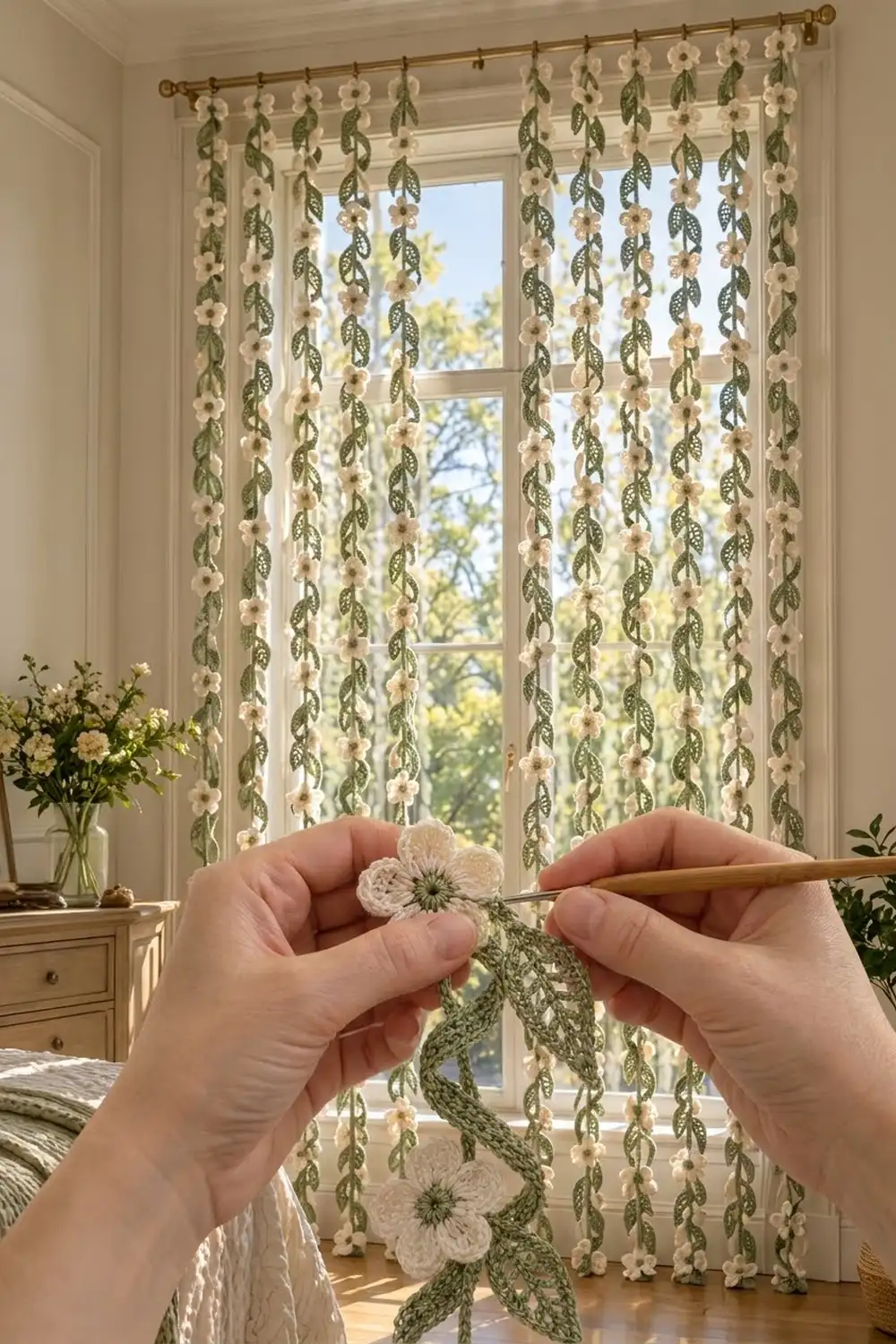
For a curtain like the one in the photo, make as many separate strands as your rod needs and hang each one by its loop. The strands are not joined to each other.
Happy crocheting!