

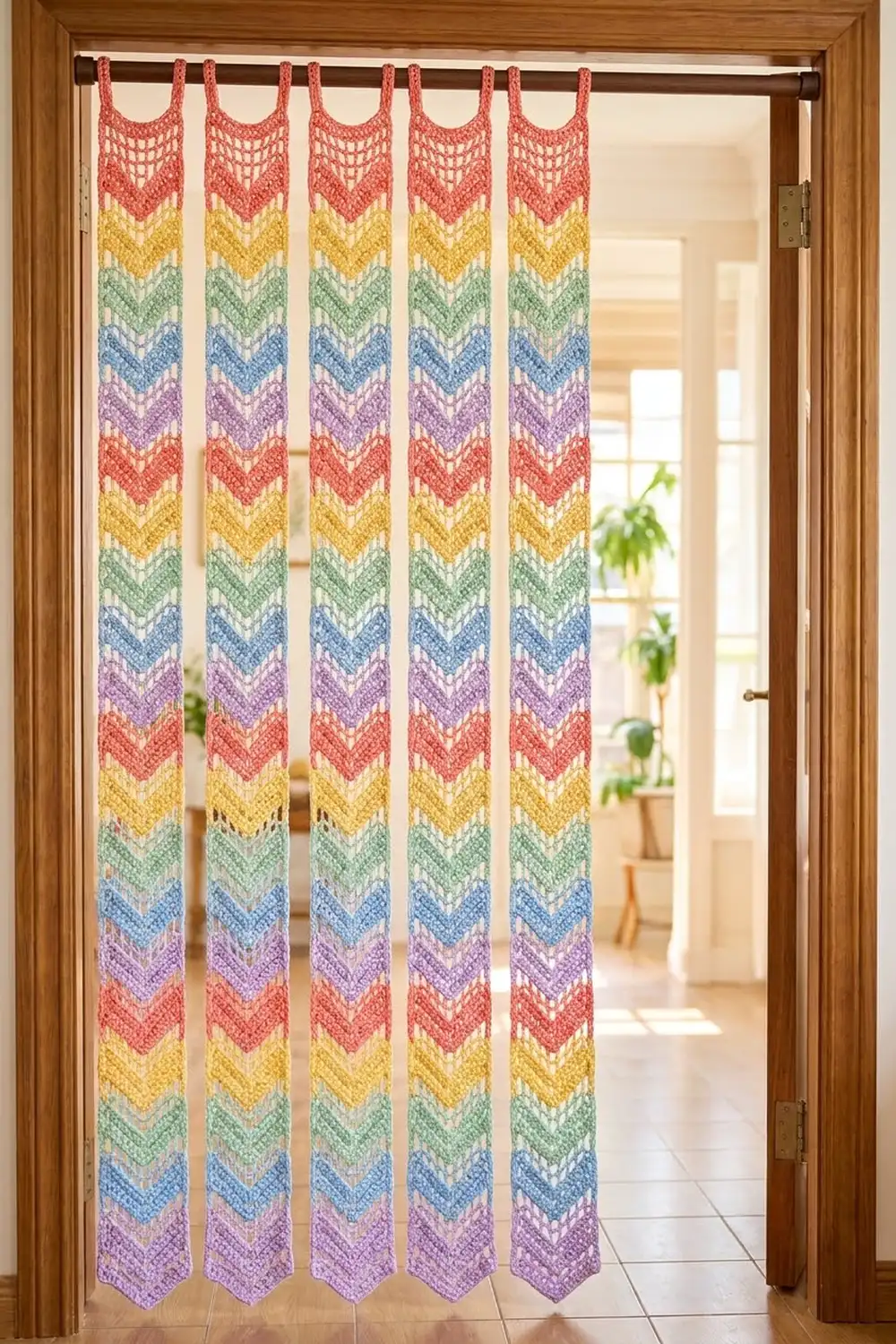
This door curtain is made of seven slim filet-crochet strips. Each strip has stacked chevrons in five soft rainbow colors. The open mesh lets light through, and the solid chevron bands give each strip a crisp, graphic zigzag. Because the strips are not joined, you can walk straight through the doorway and they fall back into place.
The colors repeat in this order: coral, sunshine yellow, mint green, sky blue, and lavender. Each chevron band sits in a few rows of matching mesh. The top of each strip has a coral header with two hanging loops, and the bottom is shaped into two neat zigzag points.
The pattern uses US crochet terms. Each finished strip measures 6.5 in (16.5 cm) wide and 81.8 in (207.8 cm) long at the points, not counting the loops. Seven strips hung with 0.5 in (1.3 cm) gaps cover about 48.5 in (123.2 cm).
Each strip is worked flat in rows from the top down. You start with a foundation row and a mesh header, then work 20 chevron bands. Next you shape the two bottom points, add one round of single crochet border, and finish with the hanging loops.
Finished Size and Construction
- Finished strip size: 6.5 in x 81.8 in (16.5 cm x 207.8 cm) at the points
- Skill level: Easy-intermediate (basic filet crochet)
- Terminology: US
- Yarn weight: DK (#3) cotton
- Hook: 4.0 mm (G-6)
- Number of pieces: 7 identical strips
- Layout: 7 strips side by side on one rod, not joined to each other
- Strip size before border: 6 in x 81.3 in (15.2 cm x 206.5 cm) at the points
- Border depth: 0.25 in (0.6 cm) on each edge
- Hanging loops: 2 per strip, extending 1.5 in (3.8 cm)
Materials
Use a smooth DK cotton or cotton blend. Cotton gives clear stitches and hangs straight without stretching too much. These amounts assume about 115 m per 50 g ball.
- Coral: 400 g (about 920 m) for the headers, chevron bands, borders, and loops
- Sunshine yellow: 250 g (about 575 m)
- Mint green: 250 g (about 575 m)
- Sky blue: 250 g (about 575 m)
- Lavender: 250 g (about 575 m)
All quantities include a safety margin of roughly 20%.
Tools:
– 4.0 mm (G-6) crochet hook
– Tapestry needle
– Scissors
– Stitch markers
– Tape measure
– Blocking pins, and a long surface or clean floor for blocking
– Curtain rod at least 52 in (132.1 cm) long and no thicker than 1.25 in (3.2 cm)
Abbreviations (US Terms)
- ch – chain
- sl st – slip stitch
- sc – single crochet
- dc – double crochet
- sk – skip
- st(s) – stitch(es)
- sp – space
- RS – right side
Special stitches:
– Open block (OB): ch 2, sk 2 sts, dc in next st.
– Filled block (FB): dc in each of next 3 sts. When you work into a ch-2 sp, 2 dc in that sp counts as 2 sts.
– Beginning ch 3: counts as the first dc of the row.
Every full row is ch 3 plus 9 blocks, which is 1 + (9 x 3) = 28 sts. The pattern is symmetrical, so each row reads the same from either edge.
Gauge and Checkpoints
Gauge: 6 blocks and 6 rows = 4 in (10.2 cm) in filet mesh, so each block is about 0.67 in (1.7 cm) square.
Test first: Work Rows 1–10 below (the header plus one chevron band). This piece should measure 6 in (15.2 cm) wide and about 6.7 in (17.0 cm) tall. If it matches, keep going and use it as the start of Strip 1.
Checkpoints (before the border):
– After Row 4 (header): 2.7 in (6.9 cm) long
– After Row 34 (5 bands): 22.7 in (57.7 cm) long
– After Row 64 (10 bands): 42.7 in (108.5 cm) long
– After Row 120: 80 in (203.2 cm) at the edges
– After Row 122: 81.3 in (206.5 cm) at the points
Too big? If your test piece is more than 0.25 in (0.6 cm) too wide, go down one hook size. Too small? Go up one hook size. If only the length is off, check your ch-3 turning chains. Then adjust the number of bands instead of changing the stitch count.
Strip Pattern
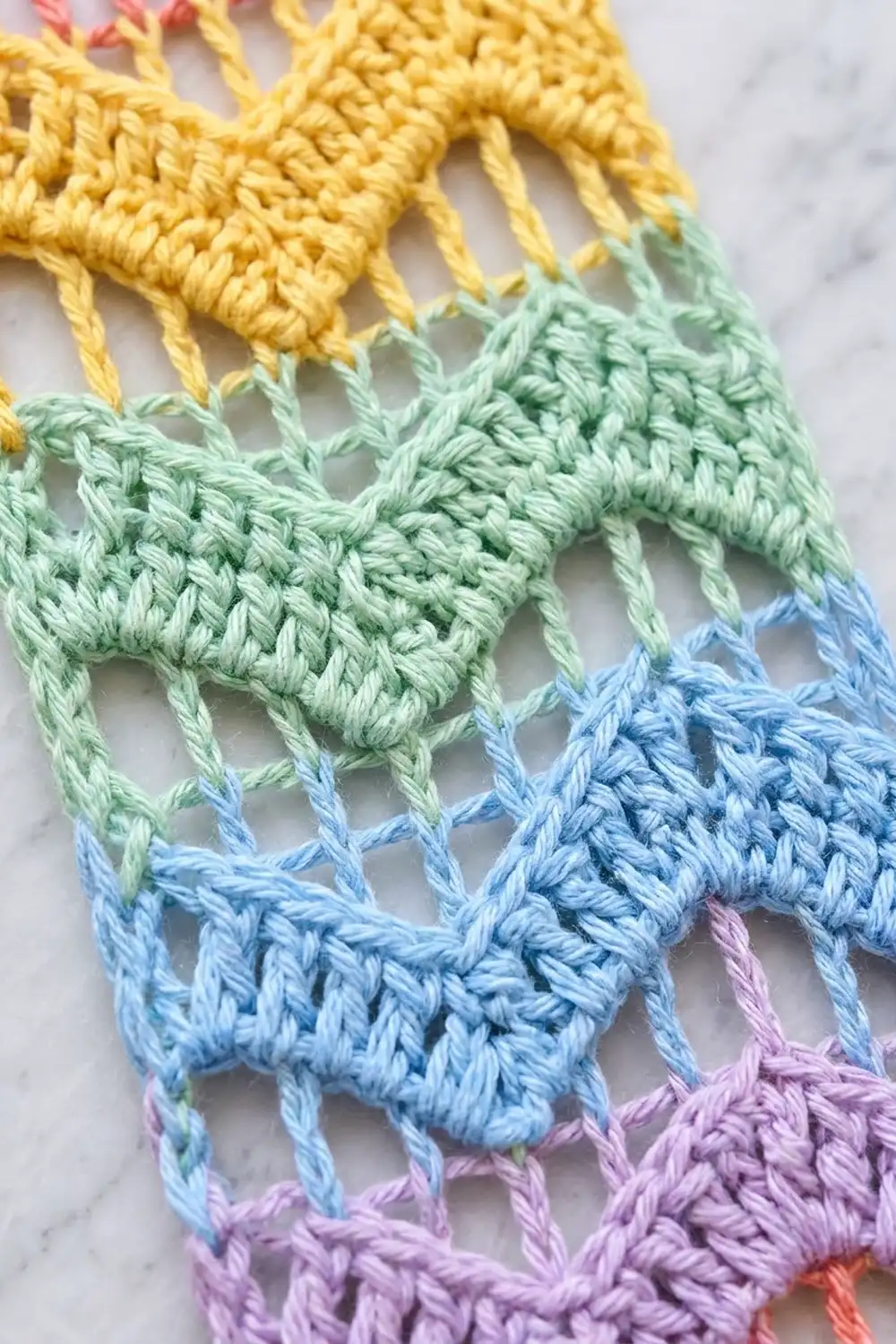
Make 7. Work all of Rows 1–10 in coral. After that, each band of 6 rows uses one color. To change color, use the new color for the final yarn-over of the last dc of the previous row. Leave 6 in (15.2 cm) tails at the side edge. The border round will cover them.
Header
Row 1: With coral, ch 30. Dc in 4th ch from hook and in each ch across. Turn. (28 sts: 27 dc + the skipped ch 3)
Row 2: Ch 3, OB 9 times. Turn. (28 sts: 10 dc, 9 ch-2 sps)
Rows 3–4: Repeat Row 2. (28 sts each)
Chevron Band (6 rows)
Block positions run 1 to 9 across. Filled blocks make an M shape: peaks at blocks 1, 5, and 9, and downward points at blocks 3 and 7.
Band Row A: Ch 3, FB, OB 3 times, FB, OB 3 times, FB. Turn. (28 sts: 3 filled, 6 open)
Band Row B: Ch 3, FB 2 times, OB, FB 3 times, OB, FB 2 times. Turn. (28 sts: 7 filled, 2 open)
Band Row C: Ch 3, OB, FB 3 times, OB, FB 3 times, OB. Turn. (28 sts: 6 filled, 3 open)
Band Row D: Ch 3, OB 2 times, FB, OB 3 times, FB, OB 2 times. Turn. (28 sts: 2 filled, 7 open)
Band Rows E–F: Ch 3, OB 9 times. Turn. (28 sts: 9 open)
Each column of blocks is filled in two rows that touch, so the chevron is a steady 2 blocks thick.
Band Sequence
Work Rows 5–118 as 19 full bands (Rows A–F each). The colors follow this order 4 times: coral, yellow, green, blue, lavender. That gives 20 bands in total, and the 20th band is shaped below.
- Band 1 (coral): Rows 5–10
- Band 2 (yellow): Rows 11–16
- Band 3 (green): Rows 17–22
- Band 4 (blue): Rows 23–28
- Band 5 (lavender): Rows 29–34
- Bands 6–19: Continue the color order. Band 19 (blue) ends on Row 118.
One full rainbow repeat is 30 rows, or 20 in (50.8 cm).
Band 20 and Bottom Points (lavender)
Row 119: Work Band Row A. (28 sts)
Row 120: Work Band Row B. (28 sts) This is the last full-width row. Number its stitches 1–28, starting from the edge where you finish it.
Row 121 (first point): Turn. Sl st in first 4 sts, which brings you to the dc that begins block 2. Ch 3, FB 3 times. Turn. (10 sts: blocks 2–4)
Row 122: Sl st in first 4 sts. Ch 3, FB. (4 sts: block 3) Fasten off.
Second point: With the same side facing as Row 121, join lavender with a sl st in st 16 of Row 120. This is the dc that begins block 6. Ch 3, FB 3 times. Turn. (10 sts: blocks 6–8) Sl st in first 4 sts, ch 3, FB. (4 sts: block 7) Fasten off.
The bottom outline now has flat peaks at blocks 1, 5, and 9 on Row 120. Two points step down 2 rows, or 1.33 in (3.4 cm), at blocks 3 and 7. They line up exactly with the chevron above.
Checkpoint: 6 in (15.2 cm) wide, 80 in (203.2 cm) at the side edges, and 81.3 in (206.5 cm) at the points.
Make All Pieces
Make 7 identical strips. Each strip uses about 45 g of coral and about 30 g of each other color. For all 7 strips, that is about 315 g of coral and 210 g of each other color, which fits within the listed amounts.
Layout on the rod, seen from the room side:
[ S1 ] [ S2 ] [ S3 ] [ S4 ] [ S5 ] [ S6 ] [ S7 ]
  6.5"   6.5"   6.5"   6.5"   6.5"   6.5"   6.5"
     0.5" gap between strips (6 gaps)
Every strip starts with coral at the top, so the color bands line up across the curtain.
Joining (Hanging the Strips)
The strips are not sewn together. They hang side by side so you can walk through the curtain. Each strip is “joined” to the curtain only by its 2 loops on the shared rod.
Method: Slide the loops onto the rod in order, S1 to S7. Every loop sits over the same 4 border sts at its corner, so all the strips hang at the same height.
Spacing logic: 7 strips x 6.5 in = 45.5 in (115.6 cm). Add 6 gaps x 0.5 in = 3 in (7.6 cm), for 48.5 in (123.2 cm) in total.
Tension: Don’t stretch the strips sideways to fill a wider rod. Pulling the loops apart distorts the header mesh. Spread the extra space evenly between the strips instead.
Size checkpoint: Once the strips are hung, the outer edges of S1 and S7 should be 48.5 in (123.2 cm) apart.
Border
The border is worked around each strip separately. Its counts come only from that strip’s own rows and stitches.
Border gauge: 1 sc per st along horizontal edges and 2 sc per dc row-end along vertical edges. This matches the height of a dc, so the edges stay flat. The border adds 0.25 in (0.6 cm) per edge.
Round 1 (coral, RS facing): Join in the base of the first st of Row 1 at a top corner.
- Top edge: 3 sc in first st, sc in next 26 sts, 3 sc in last st. (32 sc: 28 sts plus 2 extra at each corner)
- Side edge: 2 sc in each row-end of Rows 1–120. (240 sc) Work over the color-change tails as you go.
- Bottom edge, from corner to corner:
- 3 sc in st 1 of Row 120 (corner)
- sc in sts 2–3 (2)
- 2 sc in the Row 121 row-end
- sc in 2 free sts of Row 121
- 2 sc in the Row 122 row-end
- sc in each of the 4 sts of Row 122
- 2 sc in the Row 122 row-end
- sc in 2 free sts of Row 121
- 2 sc in the Row 121 row-end (this point totals 16 sc)
- sc in sts 14–15 of Row 120 (2, center peak)
- Repeat the point sequence for the second point (16)
- sc in sts 26–27 (2)
- 3 sc in st 28 (corner)
- Total: 44 sc (3 + 2 + 16 + 2 + 16 + 2 + 3)
- Second side edge: 2 sc in each row-end of Rows 120–1. (240 sc)
- Sl st to first sc to close. Total: 32 + 240 + 44 + 240 = 556 sc.
Why the math works: The top has 28 sts, and the 3-sc corners add 2 sc each, which gives 32. Each side has 120 dc rows at 2 sc each, which gives 240. On the bottom, each point takes 16 sc: 8 sc on top of stitches plus 4 row-ends at 2 sc each. Add the 2-sc center peak, the 2-sc pieces by each corner, and the two 3-sc corners, which gives 44. No corner is counted twice.
Hanging loops: Do not fasten off after Round 1. Sl st into the center sc of the top corner. Ch 16, sk 2 sc, then sl st in the next sc so the loop spans 4 sc. Work 20 sc into the ch-16 loop and sl st into the corner sc. Fasten off. Repeat at the other top corner, mirroring the loop so it spans the 4 sc next to that corner. Each loop extends 1.5 in (3.8 cm) and fits a rod up to 1.25 in (3.2 cm) thick.
Checkpoint: 6.5 in (16.5 cm) wide and 81.8 in (207.8 cm) at the points.
Final Blocking
- Weave in any remaining ends through the filled blocks and the border sc.
- Soak each strip in cool water for 10 minutes. Gently squeeze out the water. Do not wring.
- Roll each strip in a towel to remove extra water.
- Lay the strip flat and pin the side edges straight at 6.5 in (16.5 cm) wide.
- Pin the bottom points so each point drops 1.33 in (3.4 cm) below the peaks.
- Smooth the mesh so the open blocks look square.
- Let it dry completely. Then hang it, and let gravity finish the job for a day.
Final Quality-Control Checklist
- Every row has 28 sts and 9 blocks.
- Each chevron is exactly 2 blocks thick, with no gaps where columns meet.
- The colors run coral, yellow, green, blue, lavender, 4 times.
- Each point is centered on block 3 or block 7.
- The border total is 556 sc, with 32 on the top and 44 on the bottom.
- Every strip measures 6.5 in x 81.8 in (16.5 cm x 207.8 cm).
- All 14 loops match in size, and all 7 strips hang at the same height.
Troubleshooting
The strip slants. You may be skipping the ch-3 turning chain or working into it inconsistently. The ch 3 is the first dc, and the last dc goes into the top of the previous ch 3.
The chevron looks broken. Recount the filled and open blocks against Band Rows A–D. Each row should have 3, 7, 6, and 2 filled blocks in that order.
The edges ripple after the border. Use 2 sc per row-end, not 3. If the edges are tight, check that you are not working only 1 sc per row-end.
The strips are different lengths. Measure every strip at Rows 34 and 64. Re-block any short strip and hang it while it is still damp.
The points curl. Pin them out more firmly during blocking. A light steam also helps on cotton.
Care
Hand wash in cool water with a mild detergent, and dry flat or block again. Steam lightly to freshen it between washes.
Final Notes
The measurement chain is simple. Each block measures 0.67 in (1.7 cm), so 9 blocks make 6 in (15.2 cm). The border adds 0.25 in (0.6 cm) per edge, for a total width of 6.5 in (16.5 cm). The length is 120 rows, or 80 in (203.2 cm), plus 2 point rows. That gives 81.3 in (206.5 cm) before the border and 81.8 in (207.8 cm) after it. Seven strips with 0.5 in (1.3 cm) gaps cover 48.5 in (123.2 cm).
To shorten the curtain, remove full rainbow repeats of 30 rows, or 20 in (50.8 cm), from the middle. Happy crocheting!