

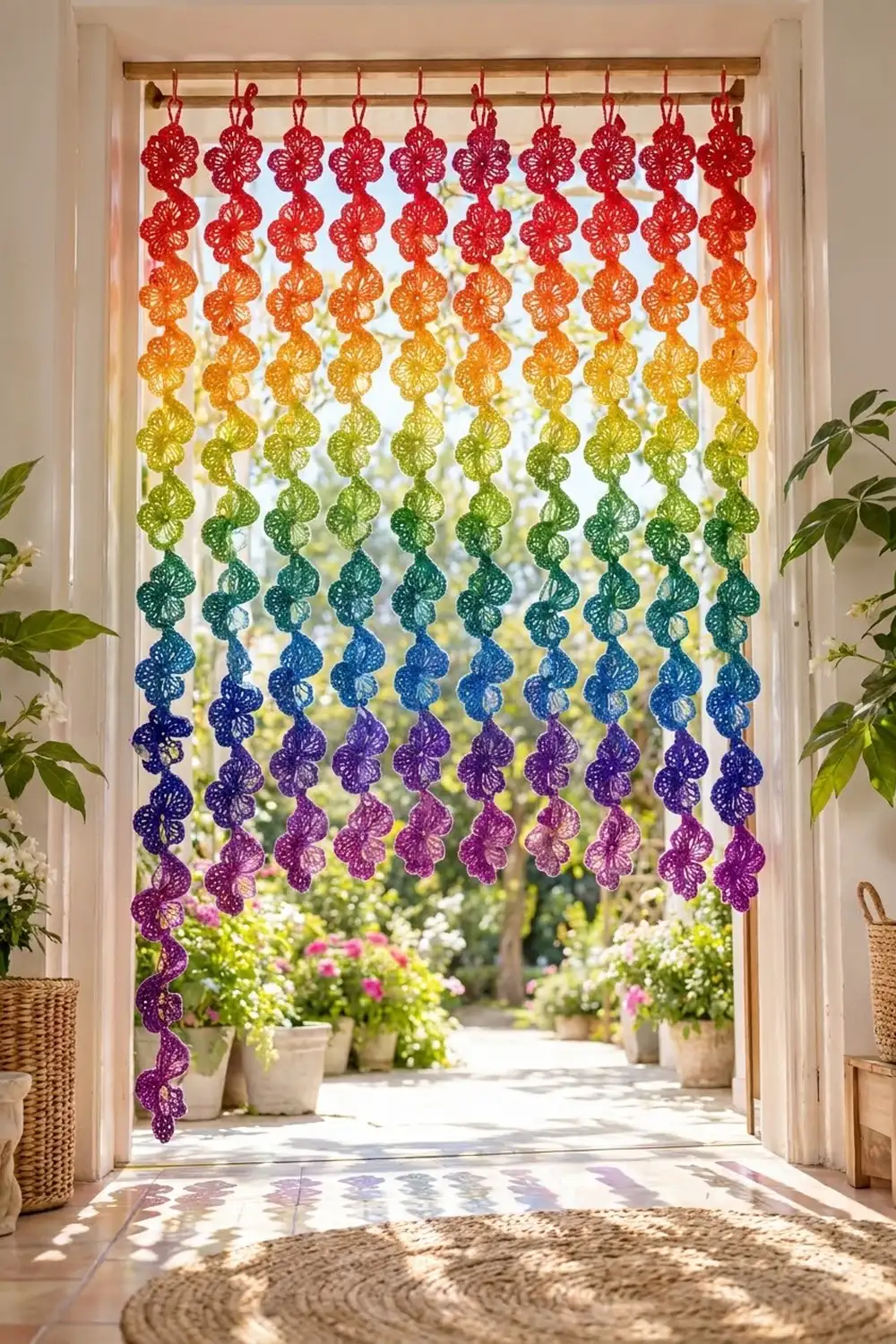
This doorway curtain is made of ten hanging strands. Each strand alternates lacy five-petal flowers with short twisted ribbons. As a result, the strand spirals as it falls and the flowers sit first on one side, then on the other. When light comes through the open petals, the curtain throws soft colored shadows on the floor.
The colors run in rainbow order from the rod down: red, orange, yellow, green, blue and purple. All ten strands use the same color order, so the curtain shows clean horizontal bands of color. The look is light and summery.
The pattern uses US crochet terms. Each finished strand is about 76 in (193.0 cm) long, including its hanging loop. With the strands spaced 3.5 in (8.9 cm) apart, the curtain is about 34.5 in (87.6 cm) wide.
The curtain is built join-as-you-go. First you make a flower and work a ribbon straight off one of its petals. Then you make the next flower and join it to the end of the ribbon in the flower’s last round. Twelve flowers and eleven ribbons make one strand, and each strand hangs on the rod by itself.
Finished Size and Construction
- Finished size: 34.5 in (87.6 cm) wide x 76 in (193.0 cm) long
- Skill level: Intermediate
- Terminology: US
- Yarn weight: Sport (#2) cotton
- Hook: 3.25 mm (US D-3)
- Number of pieces: 10 strands, each with 12 flowers and 11 ribbons (120 flowers and 110 ribbons in total)
- Layout: 10 strands side by side, 3.5 in (8.9 cm) apart, center to center
- Piece size: each flower is 3 in (7.6 cm) across; each twisted ribbon hangs about 3.5 in (8.9 cm)
- Size before border: each ribbon is 1 in (2.5 cm) x 4 in (10.2 cm) when laid flat
- Border depth: about 1/8 in (0.3 cm) on each long edge of every ribbon
Materials
Use a smooth mercerized or combed sport-weight cotton, about 155 m per 50 g. Cotton keeps the petals crisp and holds the ribbon twist after starching. Avoid fuzzy yarns, because they hide the lace.
The amounts below assume balls of 50 g / 155 m:
- Red: 100 g / 310 m
- Orange: 90 g / 280 m
- Yellow: 90 g / 280 m
- Green: 90 g / 280 m
- Blue: 90 g / 280 m
- Purple: 65 g / 200 m
These amounts include a margin of about 20 percent for swatching and gauge differences. You need more red than the other colors because the hanging loops are also red. For a smoother blend, you can work one flower in each color pair in an in-between shade such as lime or teal.
Tools:
- 3.25 mm (US D-3) crochet hook
- Tapestry needle and scissors
- Locking stitch markers
- Spray starch or diluted fabric stiffener
- Blocking mat and rust-proof pins
- A curtain rod or tension rod at least 40 in (101.6 cm) long, with a diameter of 1.25 in (3.2 cm) or less
Abbreviations (US Terms)
- ch: chain
- sl st: slip stitch
- sc: single crochet
- hdc: half double crochet
- dc: double crochet
- st(s): stitch(es)
- RS: right side
Special stitch: join-sl st. Ch 1, insert the hook from front to back through the ribbon stitch named in the instructions, and sl st. Then ch 1 and continue the flower round. Each join-sl st takes the place of one ch-3 loop.
Petal and loop numbering. Petal 1 is the first petal you work in Round 3. In each petal, Round 4 makes six ch-3 loops. They are numbered 1 to 6 in the order you work them. Loops 3 and 4 sit on either side of the center tip sc.
Gauge and Checkpoints
Gauge: 20 dc and 10 dc rows = 4 in (10.2 cm). This works out to 5 sts and 2.5 rows per inch.
Test one piece first: make one flower, work one ribbon off it, and add the ribbon edge trim. Then check these measurements:
- After Round 1: 1.25 in (3.2 cm) across
- After Round 3: 2.6 in (6.6 cm) across, petal tip to petal tip
- After Round 4: 3 in (7.6 cm) across
- Ribbon after Row 10: 1 in (2.5 cm) x 4 in (10.2 cm)
- Ribbon after trim: 1.25 in (3.2 cm) x 4 in (10.2 cm)
A difference of up to 1/8 in (0.3 cm) is fine. If your pieces are too big, use a hook half a millimeter smaller. If they are too small, use a hook half a millimeter larger. Pay special attention to ribbon length: any error repeats in all 110 ribbons.
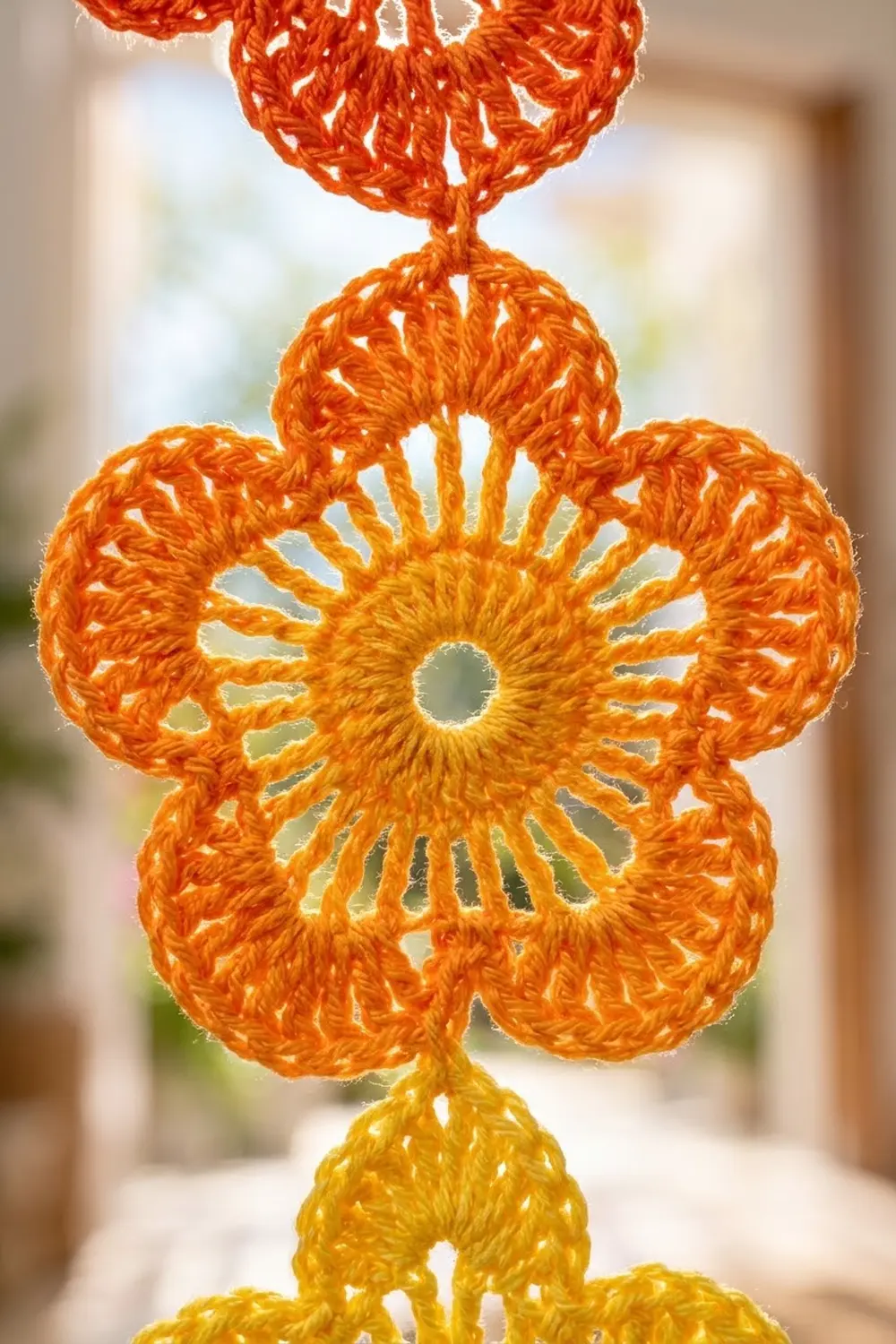
Flower
All flowers use Rounds 1 to 3 exactly as written. Round 4 changes slightly depending on where the flower sits in the strand.
Round 1: Ch 5 and sl st to the first ch to form a ring. Ch 3 (counts as dc), then work 14 dc in the ring. Sl st to the top of the ch-3. (15 dc)
Round 2: Ch 1. Sc in the same st as the join, ch 5, skip 2 dc. Sc in the next dc, ch 5, skip 2 dc. Repeat from * 3 more times. Sl st to the first sc. (5 sc, 5 ch-5 loops)
Round 3 (petals): Sl st into the first ch-5 loop. Ch 1, then work (sc, hdc, 7 dc, hdc, sc) in the same loop and in each loop around. Sl st to the first sc. (5 petals of 11 sts = 55 sts)
Round 4 (lace outline): Ch 1. Work each petal as follows: sc in the sc, sc in the hdc, sc in the first dc, ch 3, sc in the next dc. Repeat from * 5 more times. Then sc in the hdc and sc in the sc. After all 5 petals, sl st to the first sc. (55 sc, 30 ch-3 loops; each petal has 11 sc and 6 loops)
The center tip sc of each petal is the sc worked into the 4th dc. Fasten off and weave in the ends.
Ribbon
Each ribbon is worked straight off a finished flower. On odd-numbered flowers, start the ribbon at Petal 3. On even-numbered flowers, start at Petal 4. Switching petals moves the ribbon from side to side, which gives the strand its zigzag spiral.
Row 1: With the RS of the flower facing you, join yarn with a sl st in loop 3 of the starting petal. Ch 3 (counts as dc), dc in the same loop, dc in the center tip sc, then work 2 dc in loop 4. (5 dc)
Rows 2–10: Ch 3 (counts as dc) and turn. Dc in the next 3 dc and in the top of the turning ch. (5 dc)
After Row 10, don’t fasten off. Go straight on to Part A, Ribbon Edge Trim, in the Border section.
Strand Assembly
Each strand is built from the top down:
- Flower 1: Work Rounds 1 to 4 as written. Later, the hanging loop goes on Petal 1.
- Ribbon 1: Work it off Petal 3 of Flower 1, then add the edge trim.
- Flower 2: Work Rounds 1 to 3. Then give Ribbon 1 a half twist (180°) clockwise, as seen from above. Work Round 4 with the joins described in Joining.
- Ribbon 2: Work it off Petal 4 of Flower 2, then add the edge trim.
- Repeat Steps 3 and 4 through Flower 12, alternating between Petal 3 and Petal 4. Flower 12 has no ribbon.
Colors in each strand:
- Red: Flowers 1–2 and Ribbons 1–2
- Orange: Flowers 3–4 and Ribbons 3–4
- Yellow: Flowers 5–6 and Ribbons 5–6
- Green: Flowers 7–8 and Ribbons 7–8
- Blue: Flowers 9–10 and Ribbons 9–10
- Purple: Flowers 11–12 and Ribbon 11
Make All Pieces
Make 10 strands. That comes to 120 flowers and 110 ribbons:
- Red: 20 flowers, 20 ribbons and 10 hanging loops
- Orange: 20 flowers and 20 ribbons
- Yellow: 20 flowers and 20 ribbons
- Green: 20 flowers and 20 ribbons
- Blue: 20 flowers and 20 ribbons
- Purple: 20 flowers and 10 ribbons
Layout grid (columns are strands S1–S10, read from top to bottom):
        S1  S2  S3  S4  S5  S6  S7  S8  S9  S10
F1-2    R   R   R   R   R   R   R   R   R   R
F3-4    O   O   O   O   O   O   O   O   O   O
F5-6    Y   Y   Y   Y   Y   Y   Y   Y   Y   Y
F7-8    G   G   G   G   G   G   G   G   G   G
F9-10   B   B   B   B   B   B   B   B   B   B
F11-12  P   P   P   P   P   P   P   P   P   P
When the strands are done, lay them side by side. Their lengths should all be within 1 in (2.5 cm) of each other.
Joining
Ribbon to flower (join-as-you-go). Join the ribbon in Round 4 of Flower 2 and every flower after it. Work Petal 1 like this:
- Sc in the sc, sc in the hdc, sc in the first dc.
- (Ch 3, sc in the next dc) 2 times.
- Join-sl st in the 2nd dc of Ribbon Row 10.
- Sc in the next dc. This is the center tip sc.
- Join-sl st in the 4th dc of Row 10.
- Sc in the next dc.
- (Ch 3, sc in the next dc) 2 times, then sc in the hdc and sc in the sc.
Work the other 4 petals as usual. The joined petal still has 11 sc. Its loops 3 and 4 are replaced by join-sl sts, so the flower has 55 sc, 28 ch-3 loops and 2 joins. The 1st, 3rd and 5th dc of the ribbon stay free, so the ribbon end stays flat.
Stitch logic. The top of the ribbon (Row 1) is worked over loop 3, the tip sc and loop 4 of the flower above. The bottom of the ribbon (Row 10) joins at those same three positions on the flower below. Because both ends attach to the same width of petal tip, the ribbon hangs straight and doesn’t pull to one side.
Tension. Keep the join chains loose. A tight join puckers the petal tip and keeps the ribbon from turning. Always twist clockwise; if you mix directions, the spiral goes flat.
Size checkpoint. After Flower 6, hang the strand and measure it from the top of Flower 1. It should be about 35.5 in (90.2 cm): 6 flowers at 3 in (7.6 cm) plus 5 ribbons at 3.5 in (8.9 cm). A finished strand measures 74.5 in (189.2 cm). The hanging loop adds 1.5 in (3.8 cm), for a total of 76 in (193.0 cm).
Hanging. Slide the loops onto the rod and space them 3.5 in (8.9 cm) apart, center to center. The nine gaps add up to 31.5 in (80.0 cm). Add half a flower width at each end, 3 in (7.6 cm) in total, and the curtain is 34.5 in (87.6 cm) wide.
Border
The border has two parts. Part A is a single crochet trim along the long edges of every ribbon. Part B is a reinforced hanging loop on each Flower 1. The usual rule about joined pieces (pieces per side times stitches per side) doesn’t apply here. The strands aren’t joined to each other, so each ribbon gets its own trim.
Border gauge: 2 sc per dc row-end, which gives 5 sc per inch.
Part A: Ribbon Edge Trim. Work this right after Row 10, before you make the next flower.
- Side 1: Ch 1 and rotate. Work 2 sc in the side of each row, from Row 10 down to Row 1. (20 sc)
- Base: Sl st in the center tip sc of the flower, behind the ribbon. (1 sl st)
- Side 2: Work 2 sc in the side of each row, from Row 1 up to Row 10. (20 sc)
- Sl st in the top of the last st of Row 10 and fasten off. (40 sc total)
The short ends are joined to flowers, so they don’t get trim.
Why the math works: Each ribbon has 10 rows in 4 in (10.2 cm), or 2.5 rows per inch. Working 2 sc per row gives 5 sc per inch, the same as the 5 sts per inch across the ribbon. Because the counts match, the edge lies flat without flaring or pulling in. The trim adds about 1/8 in (0.3 cm) to each edge, so the ribbon goes from 1 in (2.5 cm) to 1.25 in (3.2 cm) wide.
Part B: Hanging Loop. With red yarn and the RS of Flower 1 facing you, join with a sl st in the center tip sc of Petal 1. Ch 30, then sl st in the same sc. Work 36 sc into the ch-30 loop, sl st in the same tip sc, and fasten off. Packing 36 sc onto 30 chains stiffens the loop so it doesn’t stretch. The loop hangs about 1.5 in (3.8 cm) and fits rods up to 1.25 in (3.2 cm) across.
Final Blocking
- Hand wash each strand in cool water, then roll it in a towel.
- Pin each flower flat to 3 in (7.6 cm) across. Use a pin tip to open each ch-3 loop and the center ring.
- Check that each ribbon has one clockwise half twist, and pin both ends of each ribbon in place.
- Spray the whole strand generously with starch.
- Let it dry completely, about 24 hours.
- Unpin the strand, hang it, and check that it measures 76 in (193.0 cm).
Final Quality-Control Checklist
- Each flower is 3 in (7.6 cm) across, with 55 sc in Round 4.
- Each ribbon has 10 rows of 5 dc and 40 sc of trim.
- Ribbons alternate between Petal 3 and Petal 4.
- All twists are clockwise half turns.
- The color bands line up across all ten strands.
- All strands are within 1 in (2.5 cm) of each other in length.
- The hanging loops are firm, and all ends are woven in securely.
Troubleshooting
- Petals cup: Round 3 is too tight. Use a hook one size larger for that round.
- Center ring closes up: Loosen Round 1, or start with ch 6 instead of ch 5.
- Ribbon edges flare: Recount the trim; each side should have exactly 20 sc.
- Spiral looks flat: At least one twist goes the wrong way. Undo that join and twist it clockwise.
- Strands are different lengths: Check your row gauge. It should be 2.5 rows per inch.
- Loop stretches: Pack the sc more tightly.
Care
Hand wash in cool water and lay flat or hang to dry. Starch again after each wash to restore the twist.
Final Notes
Each measurement leads to the next. The gauge gives a ribbon of 1 in (2.5 cm) x 4 in (10.2 cm). The trim widens it to 1.25 in (3.2 cm), and the twist gives a hanging drop of 3.5 in (8.9 cm). Twelve flowers of 3 in (7.6 cm) plus eleven ribbons make a strand of 74.5 in (189.2 cm). The hanging loop brings it to 76 in (193.0 cm), and ten strands fill a width of 34.5 in (87.6 cm). If your test flower and ribbon match these measurements, the whole curtain will too.
Happy crocheting!