

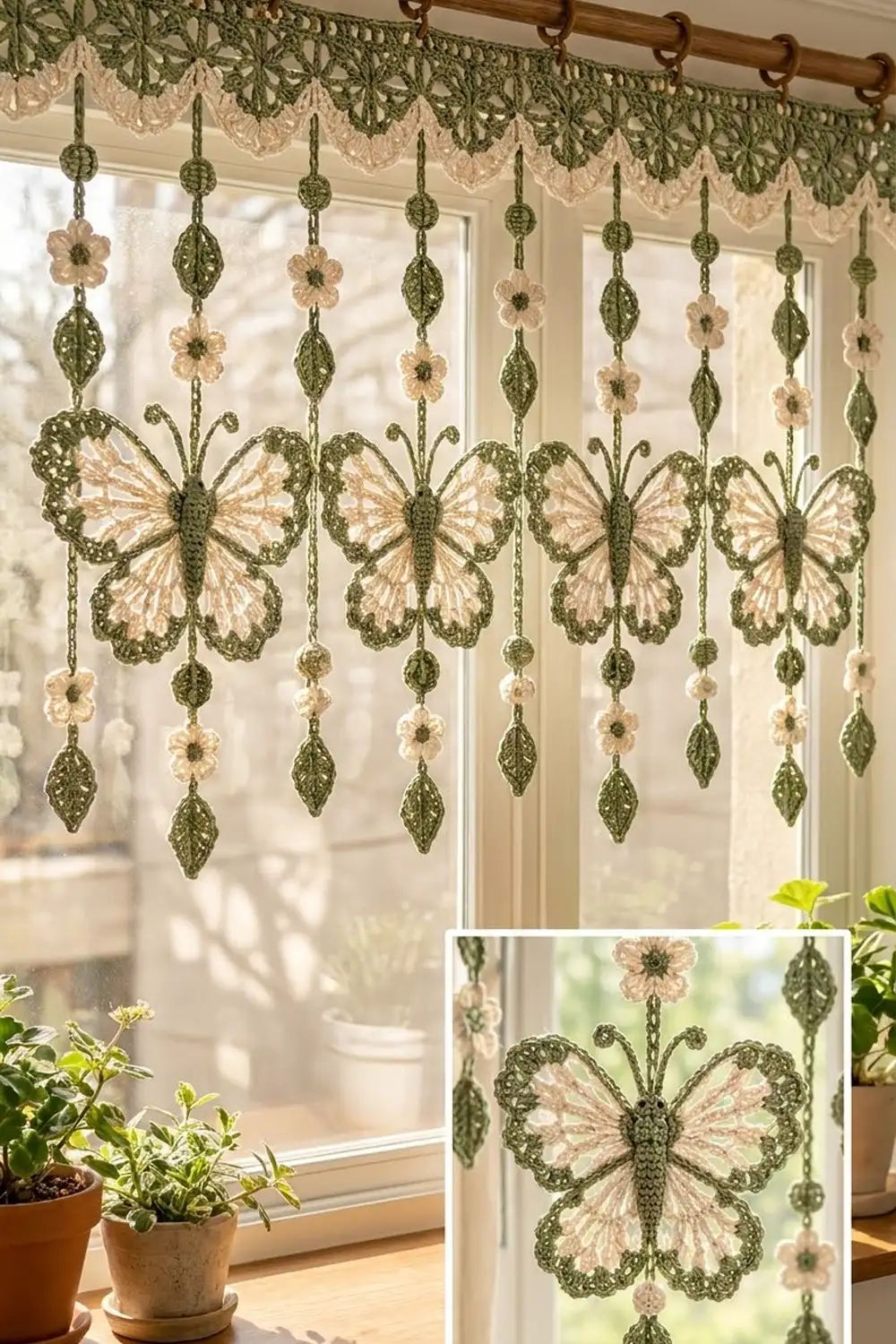
This valance gives a sunny window a soft garden feel. A sage green lace header hangs from a curtain rod and ends in a cream scalloped edge. Nine slim strands drop from the scallop points, carrying flowers, leaves and small round beads. Four lacy butterflies hang across the middle.
The pattern uses two colors. Sage green makes the structure: header lace, cords, leaves, beads, butterfly bodies and wing rims. Cream is used for the scallop edge, the flower petals, the butterfly wings and a small ball under each butterfly. Light shines through every open stitch.
This pattern uses US crochet terms. The finished valance is 43.4 in (110.2 cm) wide and about 31.5 in (80.0 cm) long, from the top of the header to the lowest leaf tip.
You crochet the header in rows across its full width, then add the cream scallop edge. Each cord is chained straight out of a scallop point. Every flower, leaf, bead and butterfly is made separately and sewn onto a cord.
Finished Size and Construction
- Finished size: 43.4 in x 31.5 in (110.2 cm x 80.0 cm)
- Skill level: Intermediate
- Terminology: US
- Yarn weight: DK (#3) cotton
- Hook: 3.5 mm (E-4)
- Number of pieces: 1 header + 9 strands, plus sewn-on motifs
- Layout: 9 strands, one per scallop; butterflies on strands 2, 4, 6 and 8
- Header size: 43.4 in x 5.5 in (110.2 cm x 14.0 cm) at the scallop points
- Header size before border: 43.4 in x 4 in (110.2 cm x 10.2 cm)
- Border depth: 1.5 in (3.8 cm) at the scallop points
- Strand length: 26 in (66.0 cm), including the end leaf
Materials
Use a smooth DK cotton. Cotton holds lace open, blocks crisply and resists fuzzing in sunlight. The butterflies hold their shape best in cotton.
- Sage green: 200 g, about 460 m
- Cream: 100 g, about 230 m
These quantities include a margin of about 25% for swatching and a spare motif.
Tools:
– 3.5 mm (E-4) hook
– Tapestry needle and stitch markers
– Fiberfill or matching scrap yarn for stuffing
– 10 curtain clip rings
– Rust-proof pins, blocking mats, spray bottle
– Tape measure and scissors
– Optional: fabric stiffener
Abbreviations (US Terms)
- ch – chain
- sl st – slip stitch
- sc – single crochet
- hdc – half double crochet
- dc – double crochet
- tr – treble crochet
- sc2tog – single crochet 2 together
- MR – magic ring
- sp(s) – space(s)
- st(s) – stitch(es)
- rnd – round
Special stitches:
– Picot: ch 3, sl st in 3rd ch from hook.
– V-st: (dc, ch 1, dc) in the same st.
– Tr-V: (tr, ch 1, tr) in the same sp.
Gauge and Checkpoints
Gauge: 20 sc and 22 rows = 4 in (10.2 cm), or 5 sc per inch (2.5 cm).
Test one upper wing and one flower first. The wing should measure 3 in (7.6 cm) from the ring to the outer edge. The flower should be 1.5 in (3.8 cm) across.
Header checkpoints:
– Row 1: 43.4 in (110.2 cm) wide
– After Row 2: 0.4 in (1.0 cm) deep
– After Row 6: about 2.2 in (5.6 cm) deep
– After Row 10: 4 in (10.2 cm) deep
– After Row 13: 5.5 in (14.0 cm) deep at the scallop points
If Row 1 is more than 1 in (2.5 cm) too wide, go down one hook size. If it is more than 1 in (2.5 cm) too narrow, go up one size. The stitch counts stay the same.
Header
Work with sage green.
Row 1: Ch 218. Sc in 2nd ch from hook and in each ch across, turn. (217 sc)
Row 2: Ch 1, sc in each sc across, turn. (217 sc)
Row 3 (fans): Ch 1, sc in first sc, *skip 2 sc, 5 dc in next sc, skip 2 sc, sc in next sc; repeat from * across, turn. (36 fans + 37 sc = 217 sts)
Row 4 (V row): Ch 5 (counts as dc + ch 2), sc in center dc of first fan, *ch 2, V-st in next sc, ch 2, sc in center dc of next fan; repeat from * 34 more times, ch 2, dc in last sc, turn. (36 sc, 35 V-sts, 2 edge dc)
Row 5 (offset fans): Ch 3 (counts as dc), 2 dc in first dc, *sc in next sc, 5 dc in ch-1 sp of next V-st; repeat from * 34 more times, sc in next sc, 3 dc in 3rd ch of turning ch, turn. (35 full fans, 2 half fans, 36 sc = 217 sts)
Row 6: Ch 1, sc in each st across, including the top of the turning ch, turn. (217 sts worked 1-per-st + 0 added = 217 sc)
Rows 7–10: Repeat Rows 3–6. (217 sc)
Fasten off green. The header now measures 43.4 in x 4 in (110.2 cm x 10.2 cm).
Border: Cream Scallop Edge
Work the border on Row 10 of the header.
Border gauge: Each ch-5 loop spans 4 header sts, or 0.8 in (2.0 cm). Six loops make one scallop of 24 sts, or 4.8 in (12.2 cm).
Row 11: Join cream in the last st of Row 10. Ch 1, sc in same st, *ch 5, skip 3 sc, sc in next sc; repeat from * across, turn. (54 ch-5 loops, 55 sc)
Row 12 (scallops): Ch 1, sc in first sc, *3 sc in next loop, 5 hdc in next loop, 7 dc in next loop, 7 dc in next loop, 5 hdc in next loop, 3 sc in next loop, sc in next sc; repeat from * 8 more times, turn. Within each scallop, skip the 5 sc between loops. (Each scallop: 30 sts + 1 valley sc. Row total: 1 + 9 x 31 = 280 sts)
Row 13 (picot edge): Ch 1, sc in first sc, *[sc in next 3 sts, picot] 10 times, sc in next sc; repeat from * 8 more times. (280 sts worked 1-per-st + 90 picots added) Fasten off.
Why the math works: 217 sts = 9 x 24 + 1. Each scallop sits on exactly 6 loops (24 sts), and the extra stitch anchors the last valley sc. The scallop grows 3-5-7-7-5-3, so it is symmetric. Picot 5 falls after stitch 15 of 30, at the exact center of the scallop. That picot is where the strand hangs. The strand points are 24 sts, or 4.8 in (12.2 cm), apart. The side edges stay unbordered, and the end sc of Row 13 sit flush with them.
Strand Motifs
Leave a 6 in (15.2 cm) tail on each motif for sewing.
Flower (make 32)
Rnd 1 (green): MR, ch 1, 10 sc in ring, sl st to first sc. (10 sc) Fasten off.
Rnd 2 (cream): Join with sl st in any sc, *(hdc, 3 dc, hdc) in next sc, sl st in next sc; repeat from * 4 more times, ending in the joining st. (5 petals) Fasten off. Size: 1.5 in (3.8 cm).
Leaf (make 37)
With green, ch 10.
Rnd 1: Sc in 2nd ch from hook, hdc in next ch, dc in next 2 ch, tr in next 2 ch, dc in next ch, hdc in next ch, (sc, ch 2, sc) in last ch. Working along the other side of the foundation ch: hdc in next ch, dc in next ch, tr in next 2 ch, dc in next 2 ch, hdc in next ch, sc in next ch, picot, sl st to first sc. (18 sts, 1 ch-2 sp, 1 picot)
The picot is the tip and the ch-2 sp is the stem. Surface sl st a vein from stem to tip. Size: 2 in x 1 in (5.1 cm x 2.5 cm).
Bead Ball (make 28 green, 4 cream)
Rnd 1: MR, 6 sc in ring. (6 sc)
Rnd 2: 2 sc in each st. (12 sc)
Rnd 3: Sc around. (12 sc) Stuff firmly.
Rnd 4: Sc2tog 6 times. (6 sc) Fasten off and close. Size: 0.75 in (1.9 cm).
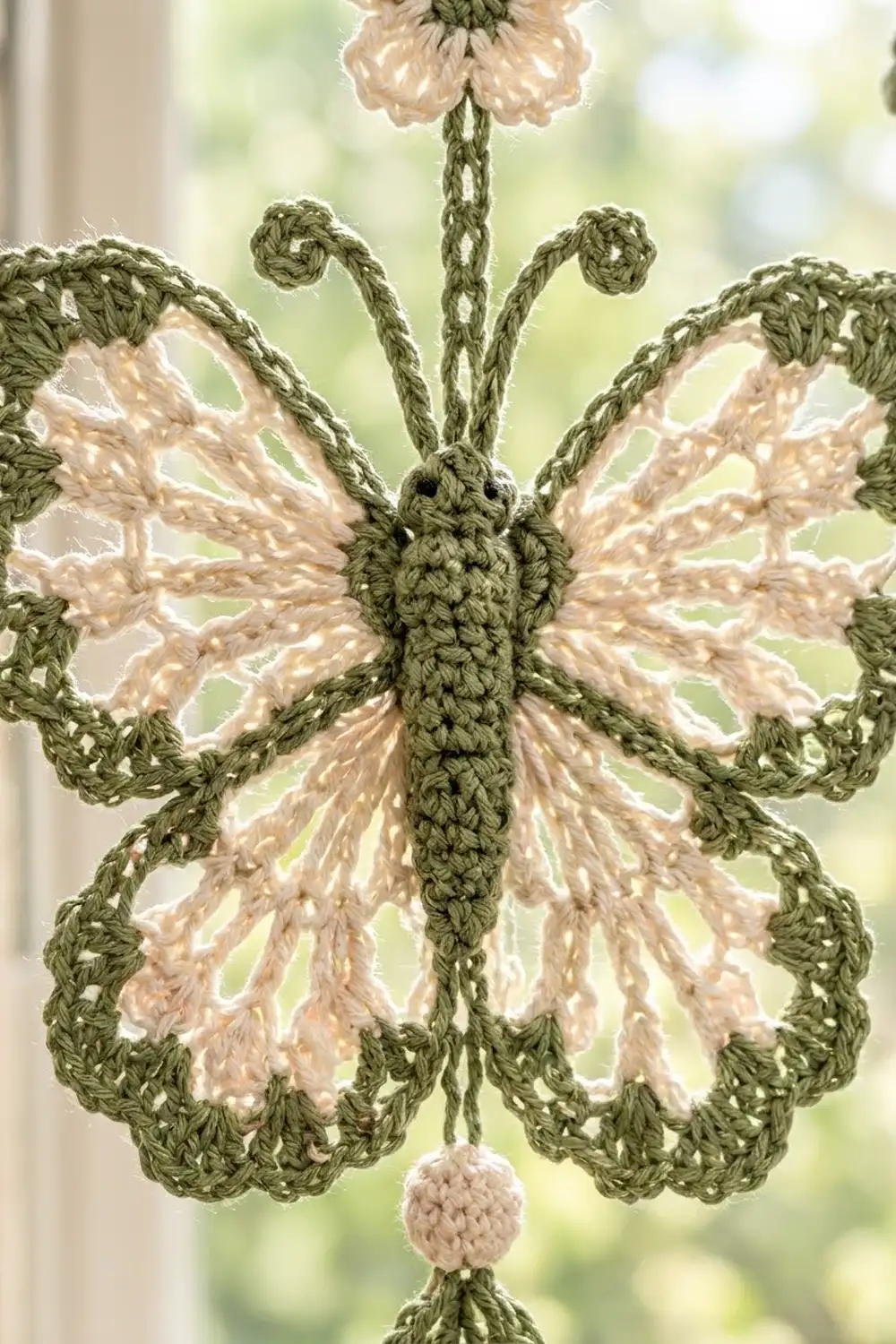
Butterfly (make 4)
Body
With green, work in continuous rounds, stuffing lightly as you go.
Rnd 1: MR, 6 sc in ring. (6 sc)
Rnd 2: 2 sc in each st. (12 sc)
Rnd 3: Sc around. (12 sc)
Rnd 4: Sc2tog 6 times. (6 sc) This closes the head.
Rnd 5: 2 sc in each st. (12 sc)
Rnds 6–7: Sc around. (12 sc)
Rnd 8: (Sc in next 2 sts, sc2tog) 3 times. (9 sc)
Rnds 9–12: Sc around. (9 sc)
Rnd 13: (Sc in next st, sc2tog) 3 times. (6 sc)
Rnd 14: Sc around. (6 sc)
Rnd 15: Sc2tog 3 times. (3 sc) Fasten off. Length: 2.75 in (7.0 cm).
Antennae (2 per body): Join green at the top of the head. Ch 14, 2 sc in 2nd ch from hook and in each of next 3 ch, sl st in remaining 9 ch. Fasten off. The 2-sc section curls into a spiral. Length: 1.5 in (3.8 cm).
Upper Wing (make 8)
With cream, ch 5 and sl st to first ch to form a ring.
Row 1: Ch 3 (counts as dc), 8 dc in ring, turn. (9 dc)
Row 2: Ch 4 (counts as dc + ch 1), *dc in next dc, ch 1; repeat from * 6 more times, dc in 3rd ch of turning ch, turn. (9 dc, 8 ch-1 sps)
Row 3: Ch 5 (counts as dc + ch 2), *dc in next dc, ch 2; repeat from * 6 more times, dc in 3rd ch of turning ch, turn. (9 dc, 8 ch-2 sps)
Row 4: Ch 6 (counts as dc + ch 3), *V-st in next dc, ch 3; repeat from * 6 more times, dc in 3rd ch of turning ch, turn. (7 V-sts, 2 edge dc, 8 ch-3 sps)
Row 5: Ch 7 (counts as tr + ch 3), *Tr-V in ch-1 sp of next V-st, ch 3; repeat from * 6 more times, tr in 3rd ch of turning ch. (7 Tr-Vs, 2 edge tr, 8 ch-3 sps) Fasten off cream.
Row 6 (green): Join green in the last tr made. Ch 1, sc in same st, *4 sc in next ch-3 sp, 2 sc in ch-1 sp of next Tr-V; repeat from * 6 more times, 4 sc in last ch-3 sp, sc in 4th ch of turning ch, turn. (1 + 28 + 14 + 4 + 1 = 48 sc)
Row 7 (green): Ch 1, *sc in next 3 sc, picot; repeat from * 14 more times, sc in last 3 sc. (48 sts worked 1-per-st + 15 picots added) Fasten off.
Size: 3 in (7.6 cm) from the ring to the edge.
Lower Wing (make 8)
Work Rows 1–4 of the upper wing in cream. Fasten off.
Row 5 (green): Join green in the last dc made. Ch 1, sc in same st, *4 sc in next ch-3 sp, 2 sc in ch-1 sp of next V-st; repeat from * 6 more times, 4 sc in last ch-3 sp, sc in 3rd ch of turning ch, turn. (48 sc)
Row 6 (green): Work as upper wing Row 7. (48 sts + 15 picots) Fasten off.
Size: 2.25 in (5.7 cm) from the ring to the edge.
Assembly
Place the upper wing rings against the thorax (Rnds 5–7), angled up and out. Place the lower wing rings against Rnds 8–10, angled down and out, tucked slightly under the upper wings. Sew each ring and the first 0.5 in (1.3 cm) of each straight wing edge to the body. Finished butterfly: 6.5 in x 5.5 in (16.5 cm x 14.0 cm), plus antennae.
Make All Pieces
- Green only: 37 leaves, 28 balls, 4 bodies with antennae
- Green and cream: 32 flowers, 8 upper wings, 8 lower wings
- Cream only: 4 balls
Scallop:  1  2  3  4  5  6  7  8  9
Strand:   P  B  P  B  P  B  P  B  P
P = plain strand (5)   B = butterfly strand (4)
Joining: Cords and Motifs
Cord (make 9): Join green with sl st in picot 5 of a scallop. Ch until the chain measures 24 in (61.0 cm), about 130 ch. Sl st in the back bump of the 2nd ch from hook and in each ch back up to the top, then sl st in the picot. Fasten off.
Each cord grows from one scallop’s center picot, so each scallop holds exactly one strand. Keep the slip stitches loose. Tight slip stitches shorten and twist the cord. Re-measure after the slip-stitch row and add or remove chains until the cord is 24 in (61.0 cm).
Plain strand placement (measured from the top of the cord):
– Flowers: 1, 7, 13, 19 in (2.5, 17.8, 33.0, 48.3 cm)
– Leaves: 3, 9, 15, 21 in (7.6, 22.9, 38.1, 53.3 cm)
– Green balls: 5, 11, 17, 23 in (12.7, 27.9, 43.2, 58.4 cm)
– End leaf: 24 in (61.0 cm)
Butterfly strand placement:
– Flowers: 1, 7, 20 in (2.5, 17.8, 50.8 cm)
– Leaves: 3, 18 in (7.6, 45.7 cm)
– Green balls: 5, 22 in (12.7, 55.9 cm)
– Butterfly: head at 9 in (22.9 cm), centered at 11.5 in (29.2 cm)
– Cream ball: 16 in (40.6 cm)
– End leaf: 24 in (61.0 cm)
Five plain and four butterfly strands use exactly the motif quantities listed above.
Mark each position with a stitch marker. Center each motif over the cord and sew through its back so the cord is hidden behind it. Sew leaves with the stem end up. Sew the stem of each end leaf to the bottom of its cord. For a butterfly, run the cord behind the body and whipstitch the body to it from Rnd 1 to Rnd 15. Sew with gentle, even tension, because tight stitches pucker the cord.
Size checkpoint: Each strand should measure 26 in (66.0 cm) from the picot to the leaf tip. Strands should be 4.8 in (12.2 cm) apart, and strand 1 should be 2.4 in (6.1 cm) from the left edge.
Final Blocking
- Weave in all remaining ends.
- Pin the header flat to 43.4 in x 5.5 in (110.2 cm x 14.0 cm).
- Pin each scallop tip and valley so all 9 scallops match.
- Spray until damp and let dry completely.
- Pin each butterfly flat, open the wing rays and pin every picot. Spray, or apply stiffener, and let dry.
- Clip the 10 rings to Row 1 at sts 1, 25, 49, 73, 97, 121, 145, 169, 193 and 217. The rings are 4.8 in (12.2 cm) apart, one above each valley. Hang the valance and let it settle for a day.
Final Quality-Control Checklist
- Header is 43.4 in (110.2 cm) wide
- 9 matching scallops, each with 10 picots
- 9 cords, each 24 in (61.0 cm) long
- Motifs line up at matching heights
- Butterflies hang level, with curled antennae
- No visible knots or loose tails
Troubleshooting
- Header ruffles: Fans are too loose. Rework Rows 3–5 with a smaller hook.
- Header pulls in: Rows 6 and 10 are too tight. Rework them more loosely.
- Uneven scallops: Recount Row 11; each scallop needs exactly 6 loops.
- Cord twists: Slip-stitch more loosely, then steam the cord and let it hang straight.
- Wings curl: Re-block with more pins, or use stiffener.
- Strands differ in length: Re-measure each cord and adjust its chains.
Care
Hand wash in cool water with mild soap, press out the water in a towel, and dry flat. Re-block the butterflies if they lose shape.
Final Notes
Each measurement in this pattern sets up the next one. Gauge makes the header 43.4 in (110.2 cm) wide. The 24-stitch scallops space the strands 4.8 in (12.2 cm) apart. Each 24 in (61.0 cm) cord plus its end leaf makes a 26 in (66.0 cm) strand. The 5.5 in (14.0 cm) header and the strands together give a finished length of 31.5 in (80.0 cm). Check each step as you go and the valance will hang evenly.
Happy crocheting!