

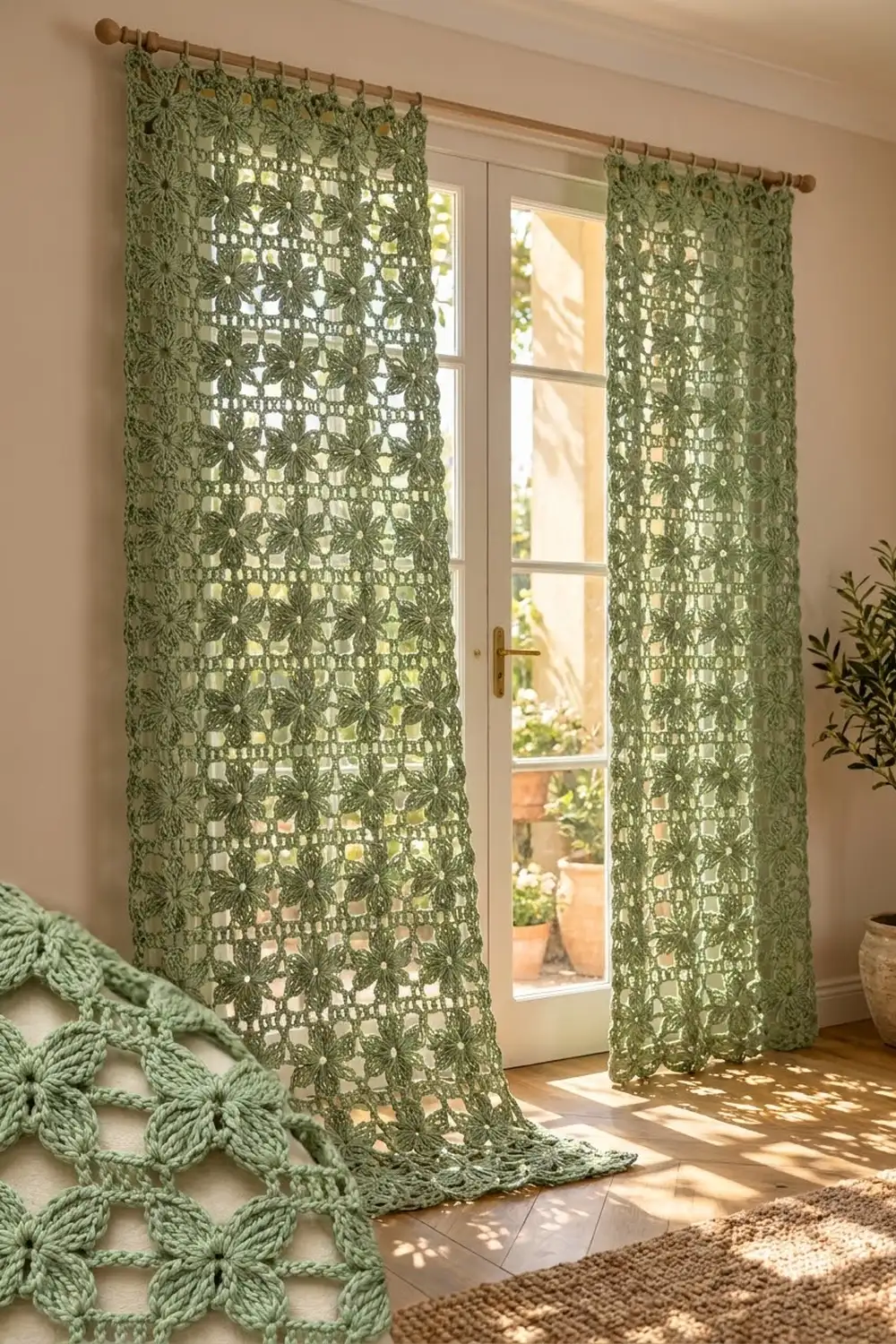
These lace curtains bring a soft garden feel to a sunny door or window. Each panel is a grid of square motifs. Every motif holds a four-petal flower with full, leaf-shaped petals, set inside an open frame of chain bars and double crochet posts. When light comes through, the small center holes and open bars cast a pretty pattern on the floor.
The whole pair is worked in one color, a muted sage green, in a smooth worsted-weight cotton. The look is fresh and a little vintage. It suits farmhouse, cottage and simple modern rooms.
This pattern uses US crochet terms. Each finished panel is about 27 in (68.6 cm) wide and 77.5 in (196.9 cm) long, not counting the hanging loops. The loops add about 2.75 in (7.0 cm) of drop.
The construction is simple. You make 75 square motifs for each panel and join them with a single crochet seam into a grid 5 motifs wide and 15 motifs long. Then you work a three-round border around the panel, with scallops along the bottom edge. Last, you add chain hanging loops along the top. Make two panels for a pair.
Finished Size and Construction
- Finished panel size: 27 in x 77.5 in (68.6 cm x 196.9 cm), plus 2.75 in (7.0 cm) hanging loops
- Skill level: Intermediate
- Terminology: US crochet terms
- Yarn weight: Worsted (CYC 4), cotton or cotton blend
- Hook: 5.0 mm (H-8)
- Number of pieces: 75 motifs per panel, 150 motifs for the pair
- Layout: 5 motifs wide x 15 motifs long per panel
- Motif size: 5 in x 5 in (12.7 cm x 12.7 cm)
- Size before border: 25 in x 75 in (63.5 cm x 190.5 cm)
- Border depth: 1 in (2.5 cm) on the sides and top; 1.5 in (3.8 cm) on the bottom, including scallops
Materials
Choose a smooth cotton or cotton blend in worsted weight. Cotton holds the petal shapes well, blocks flat and does not stretch much while hanging. Avoid very fuzzy yarn, because it hides the open bars and center holes.
- Sage green: 800 g (1,360 m) per panel, or 1,600 g (2,720 m) for the pair. That is about 32 balls of 50 g / 85 m.
Tools:
- 5.0 mm (H-8) crochet hook
- Tapestry needle
- Scissors
- Stitch markers
- Measuring tape
- Blocking mats and rust-proof pins
- Spray bottle with clean water
The quantities include a margin of about 10 percent for gauge differences, the gauge motif and weaving in ends. Buy all the yarn from the same dye lot.
Abbreviations (US Terms)
- ch – chain
- sl st – slip stitch
- sc – single crochet
- hdc – half double crochet
- dc – double crochet
- tr – treble crochet
- dtr – double treble crochet (yarn over 3 times, insert hook, pull up a loop, [yarn over, pull through 2 loops] 4 times)
- sp – space
- st(s) – stitch(es)
- RS / WS – right side / wrong side
Special stitch – Leaf Petal: Work into one ch-8 loop: (sc, hdc, 2 dc, 3 tr, ch 3, 3 tr, 2 dc, hdc, sc). This gives 14 sts plus a ch-3 tip. The tip becomes a corner of the square.
Gauge and Checkpoints
Make one full motif before anything else, then block it lightly and measure it. A correct motif is 5 in (12.7 cm) square, edge to edge. In the last round, that is 19 sc per side, or about 15 sc = 4 in (10.2 cm).
Checkpoints while you work the test motif:
- After Round 1: center circle about 0.75 in (1.9 cm) across.
- After Round 3: flower about 4 in (10.2 cm) from one petal tip to the opposite tip.
- After Round 4: square about 4.5 in (11.4 cm) per side.
- After Round 5: square 5 in (12.7 cm) per side, within 0.25 in (0.6 cm).
If your motif is too big, go down half a hook size. If it is too small, go up half a hook size. If only the petals cup or ruffle, check that you are working the petals into the ch-8 loops and not into the chains themselves. Small errors add up quickly: a motif 0.25 in (0.6 cm) too large makes the panel 3.75 in (9.5 cm) too long over 15 motifs.
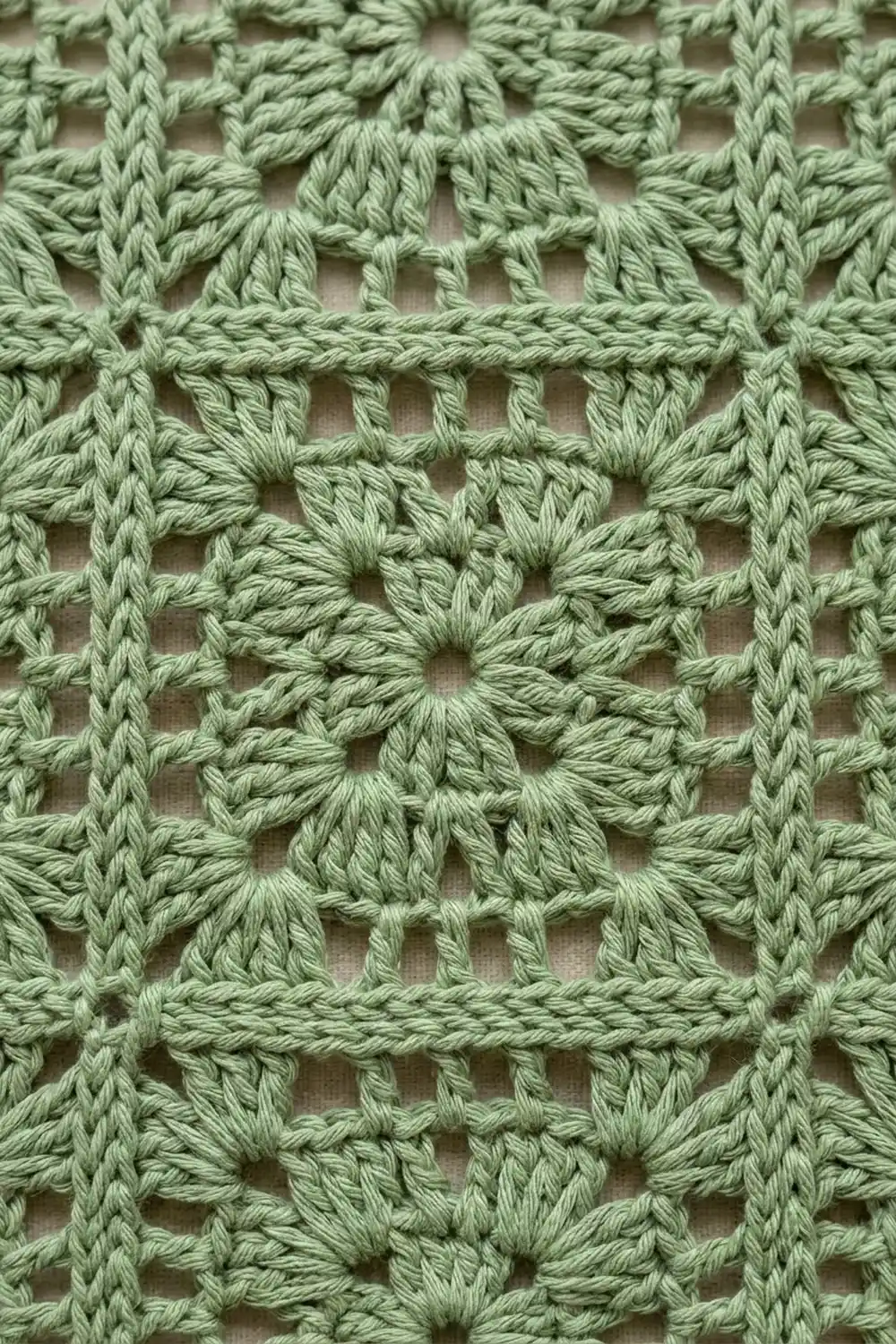
Flower Motif (Make 75 per panel)
Round 1: Make a magic ring. Ch 1, 8 sc in ring. Sl st to first sc. Pull the ring closed, leaving a small hole. (8 sc)
Round 2: Ch 1, sc in first sc, ch 8, skip next sc, sc in next sc, ch 8, skip next sc; repeat from * 2 more times. Sl st to first sc. (4 sc, 4 ch-8 loops)
Round 3: Work 1 Leaf Petal in next ch-8 loop, sl st in next sc; repeat from * 3 more times, working the last sl st into the first sc of Round 2. (4 petals, each 14 sts plus a ch-3 tip, with 4 sl sts between them)
The petals should lie flat and full, pointing out at the four diagonals.
Round 4: Sl st in each of next 7 sts to reach the first ch-3 tip, sl st in tip sp. Ch 3 (counts as dc), (2 dc, ch 2, 3 dc) in same tip sp. Ch 5, dtr in the sl st between petals, ch 5, (3 dc, ch 2, 3 dc) in next tip sp; repeat from * 2 more times. Ch 5, dtr in last sl st between petals, ch 5. Sl st to top of beginning ch-3.
Count per side: 3 dc, ch 5, 1 dtr, ch 5, 3 dc, with a ch-2 corner at each end. (Totals: 24 dc, 4 dtr, 8 ch-5 sps, 4 ch-2 corner sps)
The 3-dc groups make the short ladder posts beside each petal tip. The dtr reaches down into the deep valley between the petals and makes the long post at the middle of each side.
Round 5 (trim round): Sl st in next 2 dc and into the corner ch-2 sp. Ch 1, (sc, ch 2, sc) in same corner sp. Sc in each of next 3 dc, 5 sc in ch-5 sp, sc in dtr, 5 sc in ch-5 sp, sc in each of next 3 dc, (sc, ch 2, sc) in next corner sp; repeat from * 3 more times, leaving out the last corner on the final repeat. Sl st to first sc. Fasten off and weave in ends.
Count per side: 17 sc worked 1 per existing st or chain (3 + 5 + 1 + 5 + 3), + 2 corner sc = 19 sc per side. (Total: 76 sc and 4 ch-2 corner sps)
The 19 sc per side includes both corner sc. Remember this number, because every later count is built from it.
Make All Pieces
Each panel needs 75 sage green motifs, so the pair needs 150.
Block the motifs in batches so they all match at 5 in (12.7 cm) square before joining. Here is the layout for one panel, 5 across and 15 down (M = one motif):
Row 1:  M M M M M   (top edge)
Row 2:  M M M M M
Row 3:  M M M M M
...     (rows 4 to 13 the same)
Row 14: M M M M M
Row 15: M M M M M   (bottom edge)
Place all motifs RS up. The two panels are not joined to each other. They hang one on each side of the window or door.
Joining
Use a single crochet seam. Hold two motifs WS together so the seam ridge sits on the RS. This ridge makes the bold chain-like lines between the flowers.
Stitch-to-stitch logic: Each motif side has 19 sc, from corner sc to corner sc. Start in the corner sc of both motifs. Work 1 sc through both layers in each pair of matching sts, ending in the other pair of corner sc. That is 19 seam sc per motif edge. Skip the ch-2 corner sps. No stitches are added to the motifs, so the outside edges keep exactly 19 sts per motif.
Order: First join the motifs of each row into strips of 5, working the 4 short seams in each strip. Then join the 15 strips with 14 long seams. Each long seam crosses 5 motifs, or 95 seam sc. Where a long seam crosses a short seam, ch 1 over the crossing and keep going. That chain does not count as a stitch in the edge count.
Tension: Keep the seam sc at the same tension as Round 5. Tight seams pucker the panel and pull it short. Loose seams let it stretch when hung. Check that each seam lies flat before moving on.
Size checkpoint: Laid flat and unstretched, the joined panel should measure 25 in x 75 in (63.5 cm x 190.5 cm).
Border
Border gauge is the same as Round 5 of the motif: about 15 sc = 4 in (10.2 cm). Work all border rounds with the RS facing.
Starting counts: The short sides (top and bottom) have 5 motifs x 19 sc = 95 sts. The long sides have 15 motifs x 19 sc = 285 sts. At each seam, the corner sc of the two motifs each get 1 border stitch. The seam corner sps are skipped, so nothing is added.
Round 1 (sc): Join yarn in the top right corner ch-2 sp. Ch 1, (sc, ch 2, sc) in the corner sp. Sc in each sc around, working (sc, ch 2, sc) in each remaining panel corner sp. Sl st to first sc.
Count per side: short sides 95 worked 1 per st, + 2 corner sc = 97 sc. Long sides 285 + 2 = 287 sc.
Round 2 (ladder): Sl st into corner sp. Ch 5 (counts as dc and ch 2), dc in same corner sp. On each side, dc in first sc, ch 1, skip next sc, dc in next sc; repeat to the end of the side. In each remaining corner sp, work (dc, ch 2, dc). Sl st to 3rd ch of beginning ch-5.
Count per side: short sides 49 dc + 48 ch-1 sps = 97 worked 1 per st, + 2 corner dc = 99. Long sides 144 dc + 143 ch-1 sps = 287, + 2 corner dc = 289.
Round 3 (sc and scallops): Sl st into corner sp, ch 1, (sc, ch 2, sc) in same sp. Continue as follows:
- Top and long sides: Sc in each dc and each ch-1 sp, working (sc, ch 2, sc) in each corner sp. The top side has 99 + 2 corner sc = 101 sc. Each long side has 289 + 2 = 291 sc.
- Bottom side: After the corner, sc in the corner dc. Then work across the 97 ladder sts: sc in first dc, skip 2 sts, 7 dc in next ch-1 sp, skip 2 sts, sc in next dc; repeat from * 15 more times. Sc in the last corner dc, then work the corner. (16 scallops and 17 sc across the 97 ladder sts)
Sl st to first sc. Fasten off.
Hanging loops (top edge): Join yarn in the first sc of the top side (the corner sc). Ch 16, sl st in same sc, sl st in each of next 10 sc; repeat from * 9 more times. Ch 16, sl st in same sc (the last corner sc). Fasten off. (11 loops, at sc 1, 11, 21 and so on up to sc 101)
Why the math works: Every side count stays odd, so the dc-ch 1 ladder starts and ends on a dc at each corner. The scallop repeat is a multiple of 6 + 1, and 97 = 6 x 16 + 1, so the scallops end evenly at both bottom corners. The 11 loops sit 10 sts apart, and 101 = 10 x 10 + 1, so there is a loop at each top corner.
Final Blocking
- Weave in all remaining ends along the seam ridges, where they hide well.
- Soak the panel in cool water for 15 minutes. Press out the water gently; do not wring.
- Roll the panel in towels to remove more water.
- Lay it flat on mats or a clean sheet, RS up.
- Pin the edges straight to 27 in x 77.5 in (68.6 cm x 196.9 cm).
- Open out each scallop and pin its center point.
- Pat each flower so the petals lie flat and the center hole is round.
- Let it dry completely, at least 24 hours.
Final Quality-Control Checklist
- All 75 motifs in each panel measure 5 in (12.7 cm) square.
- Every motif has 19 sc per side, including corners.
- All petal tips sit at the motif corners.
- All seam ridges are on the RS and lie flat.
- Border Round 3 has 101 sc on the top and 291 sc on each long side.
- There are 16 scallops along the bottom and 11 hanging loops along the top.
- The two panels match within 0.5 in (1.3 cm).
Troubleshooting
Petals cup or curl: Check the ch-8 loops in Round 2. If they are too short, the petals bunch up. Add 1 ch to each loop if needed.
Motif sides bow inward: The dtr is too short for your tension. Pull up a slightly longer first loop, or work a triple treble instead.
Square corners are rounded: Make sure each corner has (3 dc, ch 2, 3 dc) in Round 4 and a ch-2 in Round 5.
Seams pucker: Your seam tension is too tight. Go up half a hook size for joining only.
Ladder round ruffles at the corners: Check that you worked (dc, ch 2, dc) in each corner and nothing more.
Scallops do not end evenly: Count the bottom ladder section. It must have exactly 97 sts.
Panel grows longer after hanging: This is normal for cotton. Re-block it and let it dry flat.
Care
Hand wash in cool water with a mild detergent and dry flat. Do not hang the curtains while they are wet, because the weight of the water will stretch them.
Final Notes
The measurement chain is short and easy to check. One motif has 19 sc per side and is 5 in (12.7 cm) square. Five motifs across make 95 sts and 25 in (63.5 cm). Fifteen motifs down make 285 sts and 75 in (190.5 cm). The border adds 1 in (2.5 cm) on the sides and top and 1.5 in (3.8 cm) at the bottom, for a finished panel of 27 in x 77.5 in (68.6 cm x 196.9 cm). If the first motif is right, the whole curtain will be right.
Happy crocheting!