

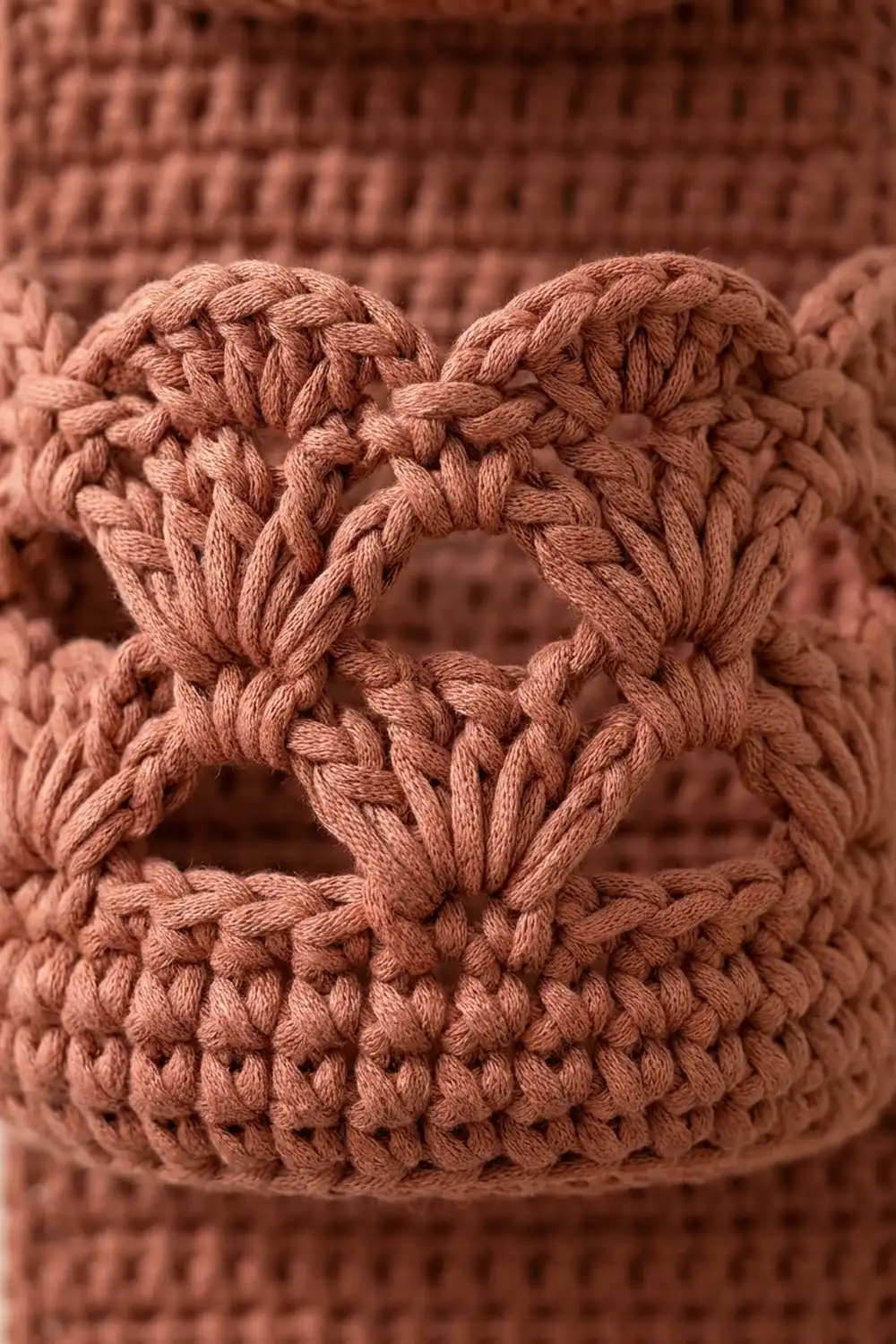
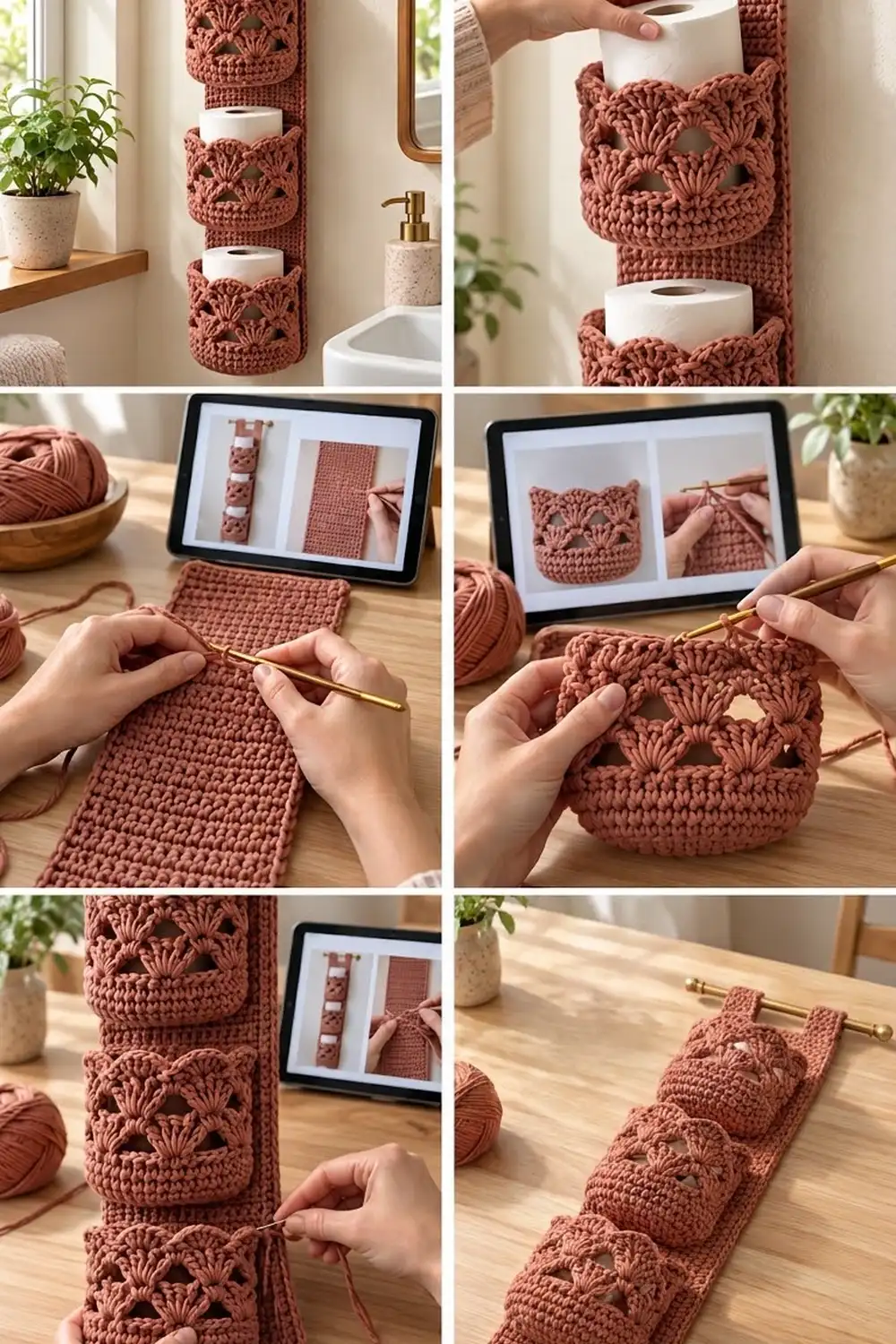
This hanging holder keeps three spare rolls in plain sight and within easy reach. A long, solid backing panel hangs from a towel bar by two folded tabs. Three round pockets are stacked down its front, each with a fan-shell lace band and a pointed scalloped rim.
The sample uses one warm terracotta shade in a thick, smooth cotton. Using a single color keeps the look calm and puts the focus on texture: firm single crochet on the panel, and airy fans with triangular windows on the pockets.
The pattern uses US crochet terms. The finished panel measures 6 in (15.2 cm) wide by 30 in (76.2 cm) long. The whole holder hangs about 32 in (81.3 cm) from the top of the tab loops to the bottom edge.
You crochet the panel in rows, work two tabs off the top, and edge everything with one round of single crochet. Then you make three pockets in joined rounds from the base up and whipstitch the back of each pocket flat to the panel.
Finished Size and Construction
- Finished panel: 6 in x 30 in (15.2 cm x 76.2 cm), plus tabs
- Flat length including tabs: 35 in (88.9 cm)
- Hanging length: about 32 in (81.3 cm)
- Skill level: Intermediate (simple stitches, careful counting, sewing)
- Terminology: US
- Yarn weight: Bulky (#5) cotton or cotton blend
- Hook: 6.0 mm (US J-10)
- Number of pieces: 4 (1 panel, 3 pockets)
- Layout: 1 column, with 3 pockets stacked vertically on the panel
- Pocket size: about 5 in (12.7 cm) across, 3 1/3 in (8.5 cm) tall
- Panel size before border: 5 1/3 in x 29 1/3 in (13.5 cm x 74.5 cm) for the body
- Border depth: 1/3 in (0.8 cm), one round of single crochet
Materials
Choose a bulky cotton or cotton-blend yarn with a smooth, rounded twist. Cotton holds the pocket shape well and does not stretch much under the weight of the rolls. The quantities below assume a yarn of about 110 m (120 yd) per 100 g.
- Terracotta: 250 g, about 275 m (300 yd)
You will use about 175 g (about 190 m) in total: roughly 85 g for the panel and 30 g for each pocket. The quantity listed includes a margin for the gauge swatch and small tension differences.
Tools:
- 6.0 mm (US J-10) crochet hook
- 4 locking stitch markers
- Tapestry needle with a large eye
- Long ball-head sewing pins
- Measuring tape
- Scissors
- One toilet paper roll for test-fitting
Abbreviations (US Terms)
- ch: chain
- sl st: slip stitch
- sc: single crochet
- dc: double crochet
- tr: treble crochet
- BLO: back loop only
- inc: 2 sc in the same stitch
- st(s): stitch(es)
- sp: space
- RS / WS: right side / wrong side
Special stitch – Shell: 7 dc in the same stitch. The 4th dc is the center of the shell.
Gauge and Checkpoints
Gauge: 12 sc and 12 rows = 4 in (10.2 cm) in sc rows with a 6.0 mm hook.
This square gauge matters. Since 3 sts and 3 rows each measure 1 in (2.5 cm), the border can take exactly 1 sc per row end and still lie flat.
Make one pocket first as your test piece. It checks your gauge and lets you test the fit with a real roll.
Checkpoints:
- Pocket Rnd 8: the base is about 5 in (12.7 cm) across and lies flat.
- Pocket Rnd 10: a standard roll, about 4 1/2 in (11.4 cm) across, slides in with a little room.
- Pocket complete: about 3 1/3 in (8.5 cm) tall.
- Panel Row 1: 5 1/3 in (13.5 cm) wide.
- Panel Row 12: 4 in (10.2 cm) tall.
- Panel Row 88: 29 1/3 in (74.5 cm) tall.
If your pieces are too big, go down a hook size (5.5 mm). If they are too small, go up a hook size (6.5 mm). Don’t change the stitch counts, because the pocket placement depends on the row count.
Backing Panel
The panel is worked in sc rows. The ch 1 at the start of a row does not count as a stitch.
Row 1 (RS): Ch 17, sc in 2nd ch from hook and in each ch across, turn. (16 sc)
Rows 2–88: Ch 1, sc in each st across, turn. (16 sc)
Checkpoint: 88 rows measure 29 1/3 in (74.5 cm). Do not fasten off.
Tabs
First tab, Row 89: Ch 1, sc in first 5 sts, turn. Leave the remaining 11 sts unworked. (5 sc)
Rows 90–103: Ch 1, sc in each st across, turn. (5 sc)
Fasten off.
Second tab, Row 89: Turn the panel so the same side faces you as for the first tab’s Row 89. Skip the 6 sts of Row 88 next to the first tab and join yarn in the 12th st. Ch 1, sc in the same st and in the next 4 sts, turn. (5 sc)
Rows 90–103: Ch 1, sc in each st across, turn. (5 sc)
Fasten off. Each tab is 5 sts (1 2/3 in / 4.2 cm) wide and 15 rows (5 in / 12.7 cm) tall. The gap between the tabs is 6 sts (2 in / 5.1 cm). The full piece now measures 34 1/3 in (87.2 cm) long.
Pockets
Make 3. Work in joined rounds with the RS facing. The ch 1 at the start of a round does not count. Join each round with a sl st to the first sc.
Base
Rnd 1: Make a magic ring, ch 1, 6 sc in ring, join. (6 sc)
Rnd 2: Ch 1, inc in each st around, join. (12 sc)
Rnd 3: Ch 1, sc in next st, inc; repeat from * around, join. (18 sc)
Rnd 4: Ch 1, sc in next 2 sts, inc; repeat around, join. (24 sc)
Rnd 5: Ch 1, sc in next 3 sts, inc; repeat around, join. (30 sc)
Rnd 6: Ch 1, sc in next 4 sts, inc; repeat around, join. (36 sc)
Rnd 7: Ch 1, sc in next 5 sts, inc; repeat around, join. (42 sc)
Rnd 8: Ch 1, sc in next 6 sts, inc; repeat around, join. (48 sc)
The base should be about 5 in (12.7 cm) across and lie flat.
Solid Wall
Rnd 9: Ch 1, sc in BLO of each st around, join. (48 sc)
This round turns the wall upward. It also leaves a ridge of unused front loops at the base edge, which you’ll use for sewing later.
Rnd 10: Ch 1, sc in each st around, join. (48 sc)
Lace Band
Rnd 11 (lower fans): Ch 1, sc in same st as join, skip 2 sts, shell in next st, skip 2 sts, sc in next st; repeat from * 6 more times, skip 2 sts, shell in next st, skip 2 sts, join to first sc. (8 shells, 8 sc; 64 sts)
Each 6-st section of Rnd 10 becomes 1 sc and 1 shell, so 48 ÷ 6 = 8 repeats.
Rnd 12 (windows): Sl st in next 4 sts to reach the center dc of the first shell. Ch 1, sc in same st, ch 2, tr in next sc, ch 2, sc in center dc of next shell, ch 2, tr in next sc, ch 2; repeat from * 6 more times, join to first sc. (8 sc, 8 tr, 16 ch-2 sps)
Each tall tr sits between two lower fans, and the ch-2 spaces leave triangular windows above the edges of the fans.
Rnd 13 (upper fans): Ch 1, sc in first sc, skip ch-2 sp, shell in next tr, skip ch-2 sp, sc in next sc; repeat from * 6 more times, skip ch-2 sp, shell in last tr, skip ch-2 sp, join to first sc. (8 shells, 8 sc; 64 sts)
The upper fans are staggered so each one sits above a window.
Rnd 14 (pointed rim): Ch 1, sc in same st as join, sc in next 3 dc, (sc, ch 1, sc) in center dc, sc in next 3 dc, sc in next sc, sc in next 3 dc, (sc, ch 1, sc) in center dc, sc in next 3 dc; repeat from * 6 more times, join. (72 sc, 8 ch-1 sps)
This trim round has 64 sts worked 1 per stitch, plus 8 extra sc (one at each shell center), for 72 sc. A ch-1 point sits at each fan tip. Fasten off and weave in the ends.
Pocket checkpoint: about 5 in (12.7 cm) across and 3 1/3 in (8.5 cm) tall.
Make All Pieces
All pieces use Terracotta.
- Panel: 1, about 85 g
- Pockets: 3, about 30 g each (90 g total)
Layout (front view, top to bottom):
 [Tab]        [Tab]
 +-----------------+
 |                 |
 |   [ Pocket 3 ]  |   base at 21 in (53.3 cm)
 |                 |
 |   [ Pocket 2 ]  |   base at 11 in (27.9 cm)
 |                 |
 |   [ Pocket 1 ]  |   base at 1 in (2.5 cm)
 +-----------------+
Heights are measured up from the bottom edge of the bordered panel.
Border
Add the border to the panel before you attach the pockets.
Border gauge: 1 sc in each stitch and 1 sc in each row end. At 3 sts and 3 rows per inch, this ratio lies flat without ruffling or pulling in.
In this pattern, a corner is 3 sc worked into one corner stitch. The edge counts below include their corner groups.
Border Rnd 1: With RS facing, join yarn in the first foundation ch at one bottom corner.
- Bottom edge: Ch 1, 3 sc in first ch, sc in next 14 ch, 3 sc in last ch. (20 sc: 16 sts worked into, plus 4 extra at the corners)
- First long side: Sc in each row end of Rows 1–103, up to the top of the tab. (103 sc)
- First tab top: 3 sc in first st, sc in next 3 sts, 3 sc in last st. (9 sc: 5 + 4)
- First tab inner side: Sc in each row end going down, Rows 103–89. (15 sc)
- Gap: Sc in each of the 6 unworked sts of Row 88. (6 sc)
- Second tab inner side: Sc in each row end going up, Rows 89–103. (15 sc)
- Second tab top: 3 sc in first st, sc in next 3 sts, 3 sc in last st. (9 sc)
- Second long side: Sc in each row end going down, Rows 103–1. (103 sc)
Join to the first sc. (280 sc total) Fasten off and weave in the ends.
Why the math works: 20 + 103 + 9 + 15 + 6 + 15 + 9 + 103 = 280. Each long side gets exactly one sc per row, so the 103 rows give 103 sc. The bottom edge gets one sc per foundation chain plus 2 extra at each corner. The inner corners of the gap get no extra stitches, so the gap stays crisp.
The border adds 1/3 in (0.8 cm) to every edge. The panel is now 5 1/3 + 2/3 = 6 in (15.2 cm) wide. The body is 29 1/3 + 2/3 = 30 in (76.2 cm) long from the bottom edge to the gap edge. Each tab is 2 1/3 in (5.9 cm) wide, the gap is 1 1/3 in (3.4 cm) wide, and the flat length is 35 in (88.9 cm).
Joining
Fold the Tabs
Lay the panel WS up. Fold each tab toward the back so its top edge sits 1 in (2.5 cm) below the gap edge. Whipstitch the tab top to the WS of the panel, keeping the stitches from showing on the front.
Each tab now forms a loop about 2 in (5.1 cm) tall, which fits a rod up to about 1 1/4 in (3.2 cm) across. If your bar has fixed ends, put it through the loops before you sew them closed.
Attach the Pockets
Method: Whipstitch, one pocket loop to one panel stitch.
- On each pocket, mark 12 front loops in a row on the Rnd 9 ridge. These 12 loops form the flat back, which is one quarter of the 48 sts.
- On the RS of the panel, find the base line for each pocket: the top of Row 2 for Pocket 1, Row 32 for Pocket 2, and Row 62 for Pocket 3. These lines sit 1 in (2.5 cm), 11 in (27.9 cm), and 21 in (53.3 cm) above the bottom edge.
- Line up the 12 marked loops with panel sts 3–14 of that row. This leaves 2 sts (2/3 in / 1.7 cm) free on each side.
- Whipstitch the 12 loops to the 12 panel sts, one to one. Don’t skip or double up any stitches, or the pocket will twist.
- Press the back of the pocket flat against the panel. Find the 2 fan repeats (18 sc) of Rnd 14 that sit above the base seam. Tack the 3 valley sc in that section (the sc worked into the Rnd 13 sc) to the panel with 2 small stitches each.
Tension: Pull each stitch snug enough to close the gaps, but not so tight that the panel puckers.
Size checkpoint: The pocket rims sit about 4 1/3 in (11.0 cm), 14 1/3 in (36.4 cm), and 24 1/3 in (61.8 cm) above the bottom edge. The top rim is 5 2/3 in (14.4 cm) below the gap edge. Each pocket bulges out into a rounded D shape with a flat back about 4 in (10.2 cm) across.
Final Blocking
- Mist the whole holder lightly with water until it is damp but not soaked.
- Lay the panel flat on a blocking mat or towel, RS up.
- Pin the panel to 6 in x 30 in (15.2 cm x 76.2 cm), keeping the long edges straight.
- Put a toilet roll, or a towel rolled to the same size, into each pocket.
- Open each fan gently and straighten the 8 rim points with your fingers.
- Let it dry completely, then remove the pins and rolls.
Final Quality-Control Checklist
- The panel is 6 in (15.2 cm) wide and 30 in (76.2 cm) long below the gap.
- The border has 280 sc and the long sides don’t ruffle.
- Both tabs are the same width and are folded to the same depth.
- Each pocket has 8 lower fans, 8 windows, 8 upper fans, and 8 rim points.
- Each pocket has 2 free panel sts on each side.
- The pocket bases sit at 1 in, 11 in, and 21 in (2.5 cm, 27.9 cm, 53.3 cm).
- All ends are woven in on the WS.
- A roll slides in and out of each pocket easily.
Troubleshooting
Panel edges wave: The border is too loose. Redo it with a smaller hook and keep to 1 sc per row end.
Panel edges pull in: You may have skipped some row ends. Recount: each long side needs 103 sc.
Pocket base cups: Work Rnds 5–8 more loosely, or use a hook one size larger for the base only.
Fans look crowded: Make sure you skipped 2 sts on each side of every shell in Rnd 11. There should be exactly 8 shells.
Windows look closed: Pull the tr in Rnd 12 up to full height and keep the ch-2 spaces relaxed.
Pocket twists after sewing: The base seam wasn’t matched 12 to 12. Unpick it and sew it again.
Care
Hand wash in cool water with mild soap, press the water out in a towel, and dry flat. While the holder is damp, reshape the pockets around a roll.
Final Notes
Here is the measurement chain. Three sts and three rows make 1 in (2.5 cm). Sixteen sts and 88 rows make a 5 1/3 in x 29 1/3 in (13.5 cm x 74.5 cm) body, and one border round brings it to 6 in x 30 in (15.2 cm x 76.2 cm). Each pocket grows from 6 to 48 sts, becomes 8 fan repeats, and finishes about 5 in (12.7 cm) across. The three pockets are spaced 10 in (25.4 cm) apart, and the folded tabs hang the holder at about 32 in (81.3 cm).
Happy crocheting!