

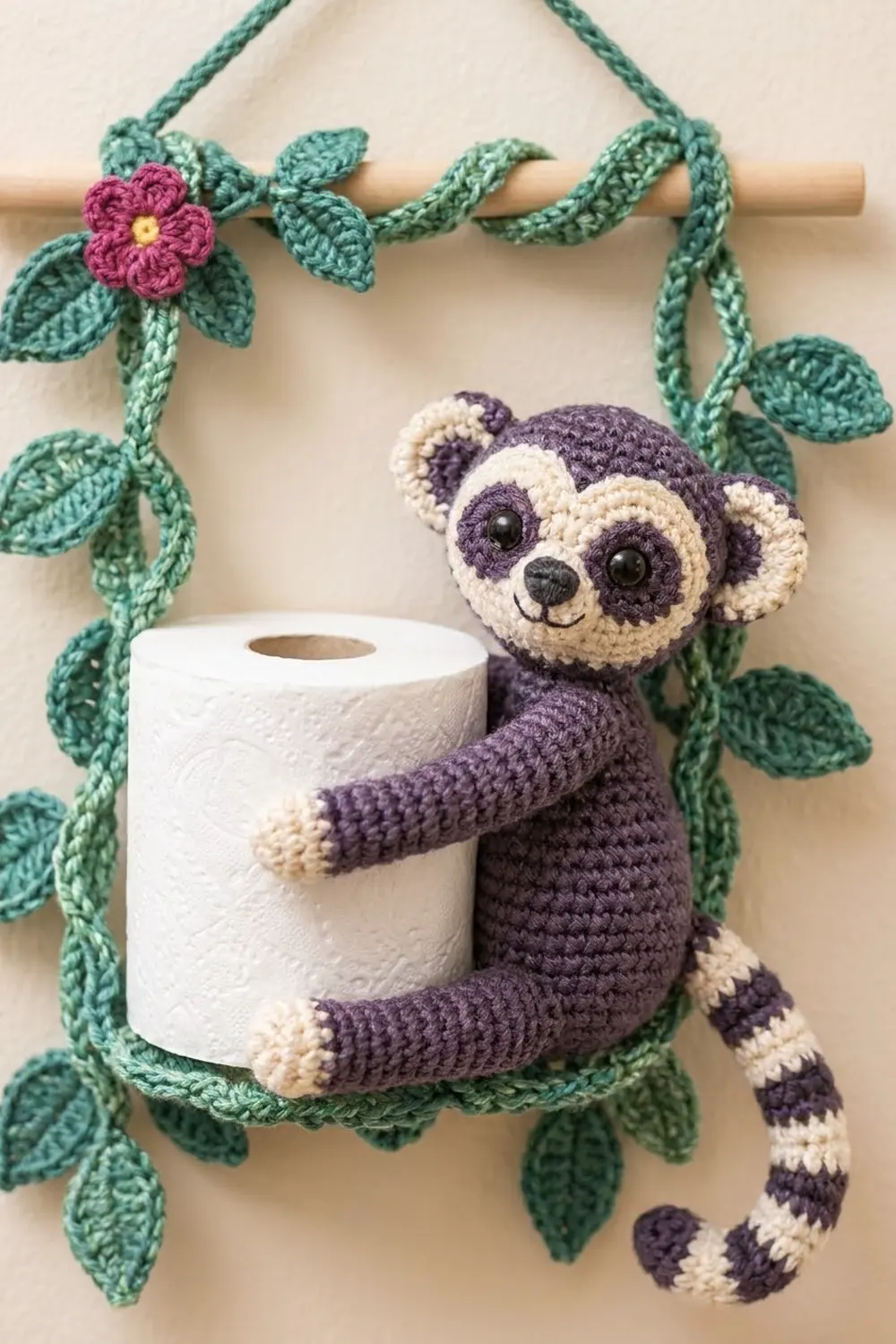
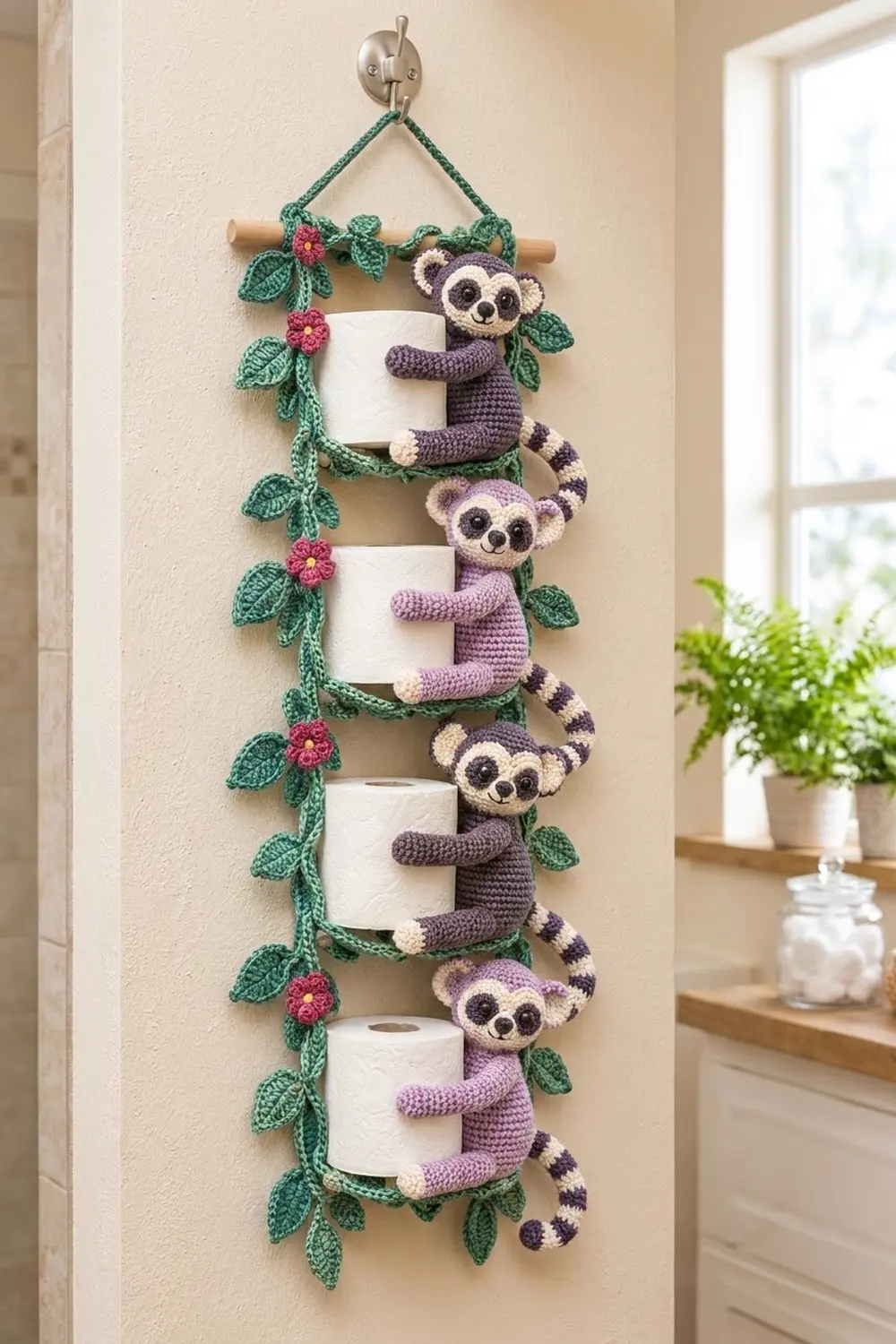
This holder is a leafy vine ladder with four lemurs climbing it. Each lemur sits on its own shelf and wraps its long arms around a toilet roll, and its striped tail curls down outside the frame. Small magenta flowers dot the green vines.
The palette is soft and botanical: teal-green vines and leaves, dark eggplant purple and lilac lemurs, cream faces, hands, and tail stripes, and berry-magenta flowers with yellow centers. The lemurs alternate dark, light, dark, light from top to bottom.
The pattern uses US crochet terms. The finished holder measures 8 in (20.3 cm) wide by 25 in (63.5 cm) tall. With the hanger it hangs about 29 in (73.7 cm) long, and it holds four standard rolls.
You’ll crochet two flat rails and five tube rungs, then join them into a ladder and add a crab-stitch vine border. Next come the leaves, flowers, and hanger. Last, you make the four lemurs in the round and sew one into each compartment.
Finished Size and Construction
- Finished size: 8 in (20.3 cm) wide × 25 in (63.5 cm) tall; about 29 in (73.7 cm) including the hanger
- Skill level: Intermediate
- Terminology: US
- Yarn weight: Worsted (#4)
- Hooks: 4.0 mm (G-6) for the frame; 3.5 mm (E-4) for the lemurs
- Number of pieces: 2 rails, 5 rungs, 24 leaves, 6 flowers, 1 hanger cord, and 4 lemurs of 13 parts each
- Layout: 1 column of 4 stacked compartments
- Compartment (piece) size: 6 in (15.2 cm) wide × 5.5 in (14.0 cm) tall inside
- Size before border: 7 in (17.8 cm) × 25 in (63.5 cm)
- Border depth: 0.5 in (1.3 cm) on each long side
Materials
Use a smooth worsted cotton or cotton blend. Cotton holds its shape on the shelves, and stitch definition matters for the crab-stitch vines. The amounts below assume about 200 m per 100 g.
- Green (vines, leaves, hanger): 80 g / 160 m
- Dark purple (2 lemurs, all eye patches, tail stripes): 140 g / 280 m
- Lilac (2 lemurs): 110 g / 220 m
- Cream (faces, muzzles, ear rims, hands, feet, tail stripes): 65 g / 130 m
- Magenta (flowers): 10 g / 20 m
- Yellow (flower centers): 2 g / 4 m
All quantities include a margin of about 15–20%.
Tools:
– 4.0 mm (G-6) and 3.5 mm (E-4) hooks
– 8 black safety eyes, 10 mm
– Black embroidery floss for the noses
– Fiberfill
– Wooden dowel, 1/2 in (1.3 cm) thick × 10 in (25.4 cm) long
– Optional: 4 chenille stems for shaping the tails
– Tapestry needle, stitch markers, scissors, pins
Abbreviations (US Terms)
- ch – chain
- sl st – slip stitch
- sc – single crochet
- hdc – half double crochet
- dc – double crochet
- inc – 2 sc in the same stitch
- dec – single crochet decrease (invisible decrease recommended)
- MR – magic ring
- BLO – back loop only
- st(s) – stitch(es)
- rnd – round
Special stitch – reverse sc (crab stitch): Don’t turn. Working from left to right (right to left if you crochet left-handed), insert the hook into the next stitch to the right, yarn over, pull up a loop, then yarn over and pull through both loops. It makes a twisted, rope-like edge that looks like a vine.
Gauge and Checkpoints
Frame gauge (4.0 mm): 16 sc and 16 rows = 4 in (10.2 cm), which is 4 sts and 4 rows per inch.
Lemur gauge (3.5 mm): 20 sc and 20 rnds = 4 in (10.2 cm), which is 5 sts and 5 rnds per inch.
Make one rung first as your test piece. It should measure 6 in (15.2 cm) long. If it’s longer, go down a hook size; if it’s shorter, go up one. Make one lemur head next and check that it’s about 2.25 in (5.7 cm) across.
Checkpoints:
– Rail after Row 1: 25 in (63.5 cm)
– Rung: 6 in (15.2 cm)
– Lemur arm: 4.4 in (11.2 cm)
– Lemur tail: 7.2 in (18.3 cm)
– Lemur body: 3.4 in (8.6 cm)
Frame
Rails (make 2, green, 4.0 mm)
Ch 101.
Row 1: Sc in 2nd ch from hook and in each ch across. (100 sts)
Row 2: Ch 1, turn, sc in each st across. (100 sts)
Fasten off. The rail measures 25 in (63.5 cm) × 0.5 in (1.3 cm). The tops of Row 2 form the outer edge, and the foundation chain forms the inner edge.
Place markers on the inner edge of each rail, counting from the top:
– Top sleeve: sts 1–4
– Shelf 1: sts 27–28
– Shelf 2: sts 51–52
– Shelf 3: sts 75–76
– Shelf 4: sts 99–100
The math: 4 + (22 + 2) × 4 = 100. That leaves 22 open sts, or 5.5 in (14.0 cm), between rungs.
Shelf Rungs (make 4, green, 4.0 mm)
Ch 25.
Row 1: Sc in 2nd ch from hook and in each ch across. (24 sts)
Rows 2–4: Ch 1, turn, sc 24. (24 sts)
Leave a long tail. Fold the strip lengthwise so Row 1 meets Row 4, and whipstitch it closed into a tube. The tube measures 6 in (15.2 cm) long and lies 0.5 in (1.3 cm) wide when flat.
Top Sleeve (make 1, green, 4.0 mm)
Work as for a shelf rung, but work 8 rows of 24 sts. Fold and seam it the same way. It lies 1 in (2.5 cm) wide when flat, and the 1/2 in (1.3 cm) dowel fits through it.
Leaves (make 24, green, 4.0 mm)
Ch 8. Working into the chains from the 2nd ch from the hook:
– First side: sl st, sc, hdc, dc, dc, hdc
– In the last ch: (sc, ch 2, sc) for the tip
– Working along the opposite side of the chain: hdc, dc, dc, hdc, sc, sl st
That’s 14 sts plus a ch-2 tip. Embroider a center vein with a line of surface sl sts. Each leaf measures 1.75 in (4.4 cm).
Flowers (make 6, 4.0 mm)
Rnd 1 (yellow): 5 sc in MR, then sl st to the first sc. (5 sts) Fasten off yellow.
Rnd 2 (magenta): In each st, work (sl st, ch 2, 2 dc, ch 2, sl st). (5 petals)
Each flower measures 1.25 in (3.2 cm).
Hanger (green, 4.0 mm)
Ch 61. Sl st in the back bump of the 2nd ch from the hook and of each ch across. (60 sl sts, 15 in / 38.1 cm)
Lemurs (make 4, 3.5 mm)
Make 2 lemurs in dark purple and 2 in lilac. Wherever you see “main color” (MC) below, use that lemur’s purple. Work in continuous spirals and move a marker up each round.
Head (MC)
- Rnd 1: 6 sc in MR. (6)
- Rnd 2: Inc in each st. (12)
- Rnd 3: (Sc, inc) × 6. (18)
- Rnd 4: (Sc 2, inc) × 6. (24)
- Rnd 5: (Sc 3, inc) × 6. (30)
- Rnd 6: (Sc 4, inc) × 6. (36)
- Rnds 7–14: Sc 36. (36)
- Rnd 15: (Sc 4, dec) × 6. (30)
- Rnd 16: (Sc 3, dec) × 6. (24)
Stop here, add the face (see Face Assembly below), and stuff the head.
- Rnd 17: (Sc 2, dec) × 6. (18)
- Rnd 18: (Sc, dec) × 6. (12)
- Rnd 19: Dec × 6. (6)
Close the opening.
Face Oval (cream)
Ch 6.
Rnd 1: Sc in 2nd ch from hook, sc 3, 3 sc in the last ch. Working along the opposite side of the chain, sc 3, then 2 sc in the last ch. (12)
Rnd 2: Inc, sc 3, inc × 3, sc 3, inc × 2. (18)
Rnd 3: (Sc, inc), sc 3, (sc, inc) × 3, sc 3, (sc, inc) × 2. (24)
Sl st to join and fasten off. The oval measures 2 in (5.1 cm) × 1.5 in (3.8 cm).
Eye Patches (make 2, dark purple)
Rnd 1: 6 sc in MR. (6)
Rnd 2: Inc in each st. (12)
Sl st to join and fasten off. Each patch measures 0.75 in (1.9 cm).
Muzzle (cream)
Rnd 1: 6 sc in MR. (6)
Rnd 2: (Sc, inc) × 3. (9)
Rnd 3: Sc 9. (9)
Stuff lightly. Embroider a black triangle nose at the tip. The muzzle is 0.6 in (1.5 cm) across.
Face Assembly
- Push one eye post through the center of each patch.
- Push both posts through the upper half of the face oval, with the patches angled slightly downward toward the outer corners.
- Push the posts into the head between Rnds 10 and 11, about 6 sts apart. Secure the washers.
- Sew the edge of the oval to the head, then sew the muzzle centered just below the patches.
Ears (make 2)
Rnd 1 (MC): 6 sc in MR. (6)
Rnd 2 (MC): Inc in each st. (12)
Rnd 3 (cream): (Sc, inc) × 6. (18)
Keep the ears flat. Each one measures 1.1 in (2.8 cm). Sew them to the sides of the head at Rnds 6–10.
Body (MC)
- Rnds 1–4: Work as Head Rnds 1–4. (24)
- Rnds 5–14: Sc 24. (24)
- Rnd 15: (Sc 2, dec) × 6. (18)
- Rnds 16–17: Sc 18. (18)
Stuff firmly and leave the top open. The body is 3.4 in (8.6 cm) long. Sew the open edge to the underside of the head.
Arms (make 2)
Rnd 1 (cream): 6 sc in MR. (6)
Rnd 2: (Sc, inc) × 3. (9)
Rnd 3: Sc 9. (9)
Rnds 4–22 (MC): Sc 9. (9)
Stuff the hand and stuff the rest of the arm lightly. Flatten the top and sc 4 across to close it. Each arm is 4.4 in (11.2 cm) long.
Legs (make 2)
Work as for the arms, but stop after Rnd 14. Each leg is 2.8 in (7.1 cm) long.
Tail (dark purple and cream for every lemur)
Rnd 1 (dark purple): 6 sc in MR. (6)
Rnd 2: (Sc, inc) × 3. (9)
Rnds 3–4: Sc 9. (9)
Rnds 5–36: Sc 9 in every round, changing color every 2 rounds. Start with 2 rounds in cream and end with Rnds 35–36 in dark purple. That makes 8 cream and 8 dark stripes.
The tail is 7.2 in (18.3 cm) long. Stuff it lightly, or insert a folded chenille stem so you can curl it. Sew it to the lower back of the body.
Lemur Assembly
- Sew the arms to the sides of the body just below the neck.
- Sew the legs to the lower front of the body, with the feet pointing forward.
The seated lemur stands about 6 in (15.2 cm) tall.
Make All Pieces
| Color | Pieces |
|---|---|
| Green | 2 rails, 4 shelf rungs, 1 top sleeve, 24 leaves, 1 hanger |
| Magenta + yellow | 6 flowers |
| Dark purple | 2 complete lemurs, 8 eye patches, 4 tail bases and stripes |
| Lilac | 2 complete lemurs |
| Cream | 4 face ovals, 4 muzzles, 8 ear rims, 16 hands and feet, tail stripes |
Layout (top to bottom):
 /\  hanger
[====] top sleeve + dowel
| L1 |  dark purple lemur
[----] shelf 1
| L2 |  lilac lemur
[----] shelf 2
| L3 |  dark purple lemur
[----] shelf 3
| L4 |  lilac lemur
[----] shelf 4
Joining
Method: Whipstitch the rungs to the inner edges of the rails with a green tail, going through both loops.
Stitch-to-stitch logic:
– A flattened shelf rung is 2 rows wide, so it covers exactly 2 rail sts (0.5 in / 1.3 cm).
– The flattened top sleeve is 4 rows wide, so it covers rail sts 1–4 (1 in / 2.5 cm).
– Each rung is 24 sts long, so the inside width between the rails is 6 in (15.2 cm).
Pin all five rungs between the two rails at the marked positions, keeping the rung seams at the back. Sew each rung end with 3–4 snug stitches through the rung’s row ends and the marked rail sts. Pull just firmly enough to close any gaps; if you pull too hard, the rails will curve inward.
Size checkpoint: The frame should measure 7 in (17.8 cm) × 25 in (63.5 cm), with four openings of 6 in (15.2 cm) × 5.5 in (14.0 cm). Fix any difference before you start the border.
Border
Border gauge: Same as the frame, 4 sts per inch. Two rows add 0.5 in (1.3 cm).
Work the border along the outer edge (the Row 2 sts) of each rail only. The top and bottom ends are not bordered.
Border Row 1: Join green at the top of the outer edge. Ch 1, and sc in each st down the edge.
– Left side: 100 + 0 = 100 sts
– Right side: 100 + 0 = 100 sts
Border Row 2: Don’t turn. Ch 1, and work reverse sc in each st back up the edge.
– Left side: 100 sts
– Right side: 100 sts
Fasten off.
Why the math works: The rail has 100 sts at 4 sts per inch, which is 25 in. The border works exactly 1 st into each existing st, so the edge doesn’t ruffle or pull in. Adding 0.5 in on each side brings the width from 7 in (17.8 cm) to 8 in (20.3 cm).
Finishing the frame:
1. Sew 12 leaves along each rail, alternating pointing outward and inward, about 2 in (5.1 cm) apart.
2. Sew a flower at each top corner and one on the left rail at each of the four shelf junctions.
3. Slide the dowel through the top sleeve so 1 in (2.5 cm) sticks out on each side.
4. Tack the top of each rail to the dowel.
5. Tie each end of the hanger tightly around one end of the dowel, using about 1.5 in (3.8 cm) of cord for each knot. The hanger should peak about 4 in (10.2 cm) above the dowel.
Placing the lemurs: Seat one lemur on each shelf at the right side, alternating dark purple, lilac, dark purple, lilac from the top. Sew the bottom and back of each lemur to its shelf and to the right rail. Let each tail drape outside the right rail and curl it. Leave the arms free so they rest across a roll and lift out of the way when you change it.
Final Blocking
- Lightly mist the frame (not the lemurs) with water.
- Pin it flat to a mat at 8 in (20.3 cm) × 25 in (63.5 cm).
- Check that every opening is 6 in (15.2 cm) × 5.5 in (14.0 cm), and that all rungs are level and parallel.
- Pin the leaves flat and open, and spread the flower petals.
- Let everything dry completely before unpinning.
- Shape the lemurs by hand: curl the tails and bend the arms forward.
Final Quality-Control Checklist
- Rails have 100 sts each and measure 25 in (63.5 cm)
- All five rungs are 24 sts long and level
- Border has 100 sts per side and the crab stitch twists evenly
- 24 leaves and 6 flowers are firmly sewn on
- Safety eyes are secure and the face ovals are sewn all the way around
- Lemurs alternate dark, light, dark, light from the top
- Each tail has 8 cream stripes and ends in dark purple
- A 4.5 in (11.4 cm) roll fits each opening without stretching the frame
- The dowel sticks out evenly and the hanger is tied tight
Troubleshooting
- Rails ruffle along the border: You added stitches. Rip back and work exactly 1 sc per st.
- Rails curve inward: The joining seams are too tight. Re-sew the rung ends more loosely.
- Rolls don’t fit: Your gauge is tight. Remake the rungs with a larger hook.
- Stuffing shows through the lemurs: Go down to a 3.0 mm hook.
- Tail droops: Add a chenille stem or stuff it a little more firmly.
- Arms can’t reach across the roll: Add 2–3 rounds before closing each arm.
Care
Spot clean with mild soap and cool water, then reshape and air dry flat. Because of the safety eyes and the dowel, avoid machine washing.
Final Notes
Here’s the full measurement chain:
1. Gauge is 4 sts per inch for the frame.
2. That makes each 100-st rail 25 in (63.5 cm) long and each 24-st rung 6 in (15.2 cm) wide.
3. Joining gives a 7 in (17.8 cm) frame with 5.5 in (14.0 cm) openings.
4. The border adds 0.5 in (1.3 cm) per side, for a finished 8 in (20.3 cm) × 25 in (63.5 cm).
5. Each 6 in (15.2 cm) lemur sits on its shelf and holds its roll.
Check each stage against these numbers and the holder will come together square and sturdy.
Happy crocheting!