

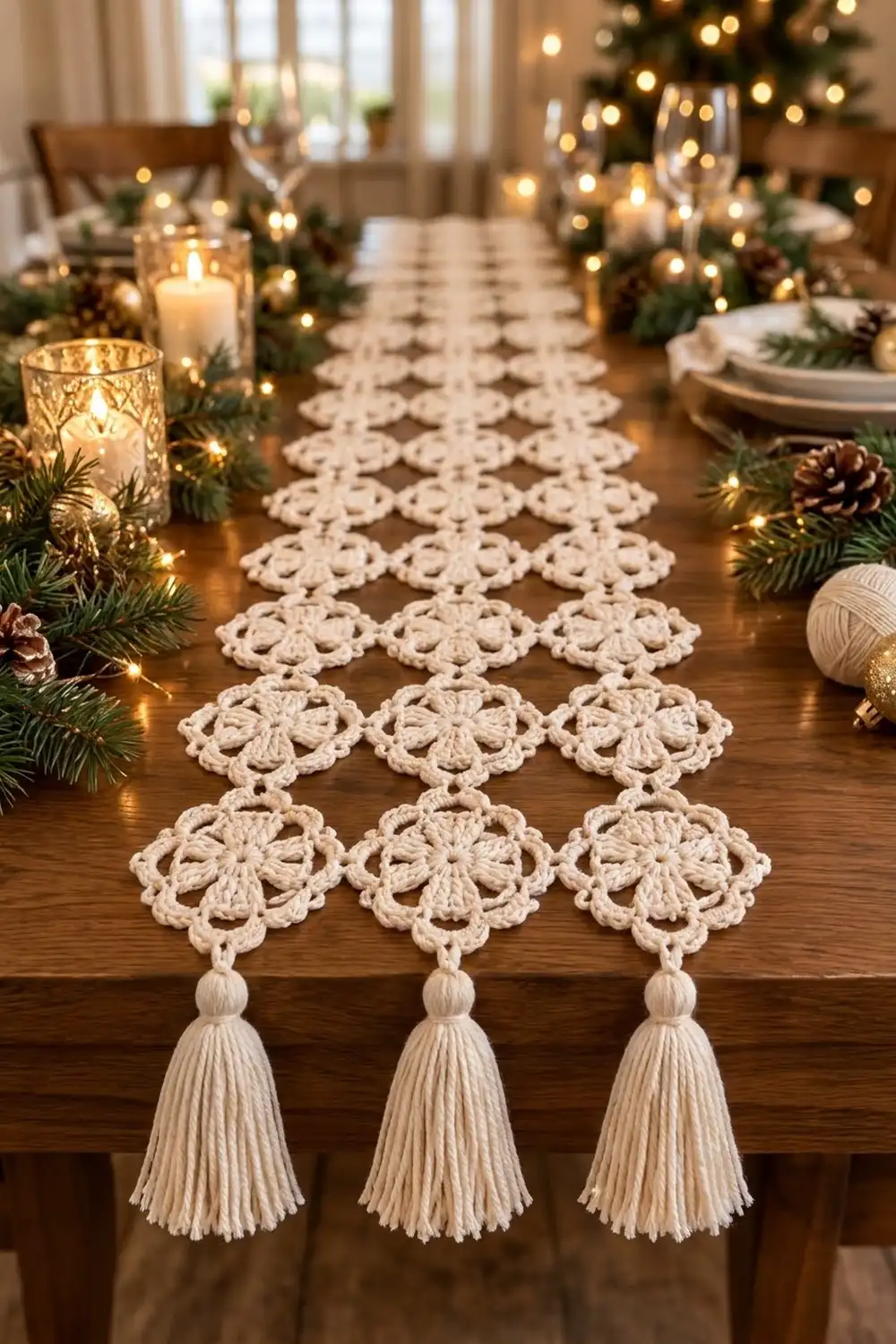
The Candlelight Medallion Table Runner is a lacy holiday runner made from round flower medallions. Each medallion has a small open center, eight solid fan-shaped wedges, and a scalloped edge of chain loops with tiny picots. The medallions are joined three across into a long, airy strip with small diamond-shaped openings between them, so the wood of your table shows through.
The whole runner is one shade of cream cotton. A single color keeps it calm and elegant and goes well with candles, greenery and gold ornaments. Three chunky cream tassels hang from each short end, one at the bottom of each column.
This pattern uses US crochet terms. Before tassels, the runner measures 15 in (38.1 cm) wide by 60 in (152.4 cm) long. With the 5 in (12.7 cm) tassels at both ends, it is 70 in (177.8 cm) long.
You will make 36 identical medallions. Work the first one on its own, then join each of the others as you go on its final round, at the picots. There is no separate stitched border. The scalloped edges of the outer medallions are the finished edge, and the tassels complete each end.
Finished Size and Construction
- Finished size: 15 in x 60 in (38.1 cm x 152.4 cm), plus 5 in (12.7 cm) tassels at each end
- Skill level: Easy intermediate
- Terminology: US crochet terms
- Yarn weight: Worsted weight (4) cotton
- Hook: US H-8 (5.0 mm)
- Number of pieces: 36 medallions + 6 tassels
- Layout: 3 medallions wide x 12 medallions long
- Piece size: 5 in (12.7 cm) across, measured flat from scallop tip to scallop tip
- Size before border: 15 in x 60 in (38.1 cm x 152.4 cm)
- Border depth: 0 in (0 cm), because the scalloped edge is the border
Materials
Choose a smooth mercerized or combed cotton in worsted weight. Cotton gives crisp stitch definition, keeps the picots open after blocking, and washes well, which matters for anything that sits on a dining table. Avoid fuzzy or very soft yarns, because they blur the wedges and the lace.
- Cream (worsted cotton): about 800 g / 1,360 m (approx. 1,490 yd)
- Medallions: about 17 g / 30 m each, 36 medallions
- Tassels: about 6 g / 11 m each, 6 tassels
These quantities include a margin of about 15–20% for your gauge medallion, joining tails and differences in tension. Buy all the yarn from the same dye lot.
Tools:
- US H-8 (5.0 mm) crochet hook
- Tapestry needle
- Scissors
- Stiff card 5 in (12.7 cm) tall, for the tassels
- Rust-proof pins and a blocking surface
- Spray bottle
- Measuring tape
Abbreviations (US Terms)
- ch: chain
- sl st: slip stitch
- sc: single crochet
- dc: double crochet
- sp: space
- st(s): stitch(es)
- sk: skip
- rep: repeat
- beg: beginning
Special stitches:
- Picot: ch 3, sl st in 3rd ch from hook.
- Joining picot: ch 1, sl st in the matching picot of the finished neighbor medallion, ch 1, sl st in the first ch of this picot. This makes the joining picot the same height as a regular picot, so joined and free scallops match.
Gauge and Checkpoints
Make one complete medallion before anything else, then block it lightly and measure it. Every dimension of the runner is a multiple of this one piece, so it controls the size of the whole project.
Medallion checkpoints (measured flat across the widest point):
- After Round 1: 1.25 in (3.2 cm)
- After Round 3: 2.75 in (7.0 cm)
- After Round 4: 3.5 in (8.9 cm)
- After Round 5: 4.5 in (11.4 cm)
- After Round 6: 5 in (12.7 cm)
If your medallion is too big (over 5.25 in / 13.3 cm), go down one hook size to US 7 (4.5 mm). If it is too small (under 4.75 in / 12.1 cm), go up one size to US I-9 (5.5 mm).
An error of only 0.25 in (0.6 cm) per medallion adds up to 3 in (7.6 cm) over the 12-medallion length, so it is worth checking now.
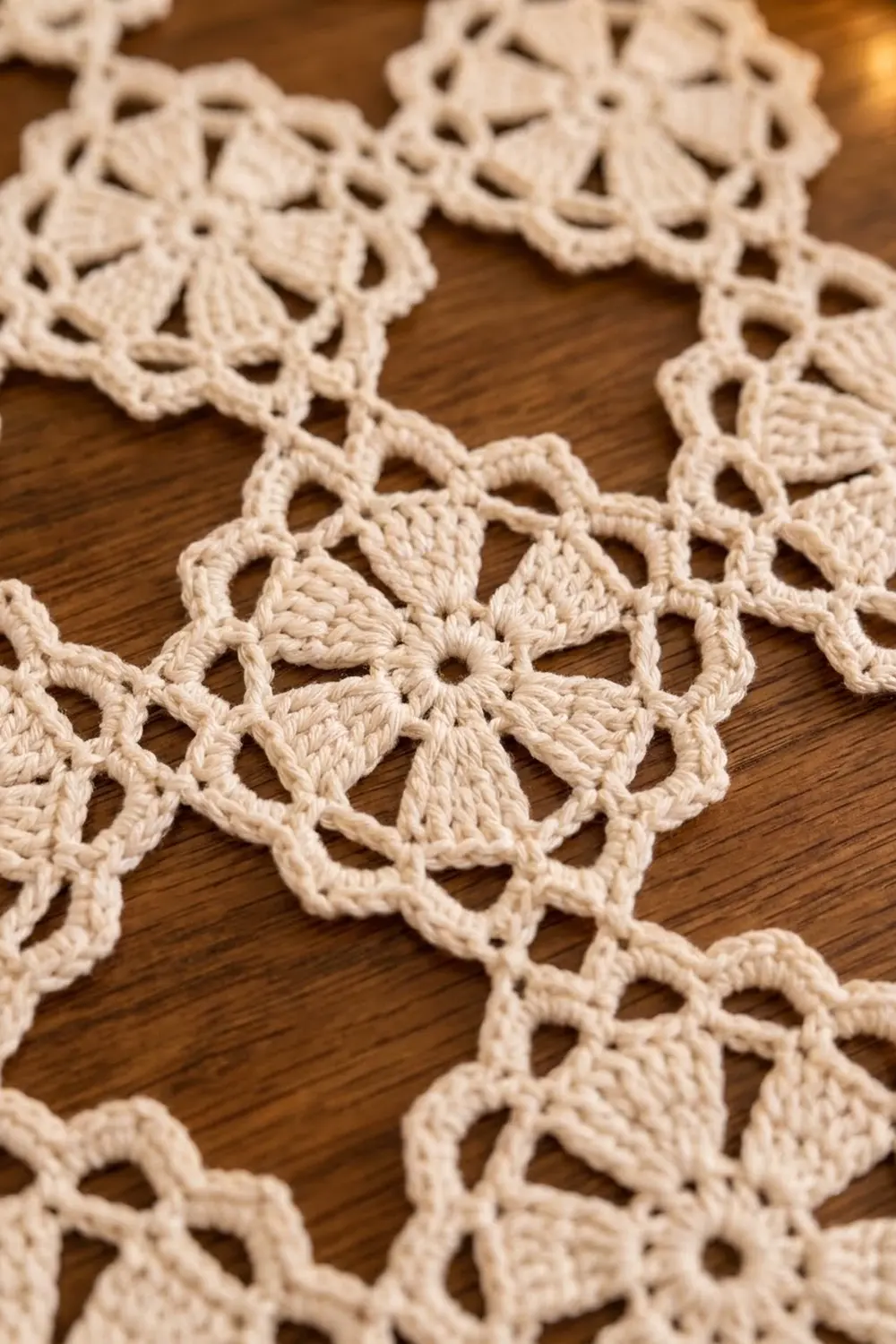
Medallion
Make 1 exactly as written. Join all other medallions as you go on Round 6 (see Joining).
Round 1: Ch 5, sl st in first ch to form a ring. Ch 3 (counts as dc here and throughout), 15 dc in ring, sl st in top of beg ch-3. (16 dc)
The ch-5 ring leaves the small open hole at the center.
Round 2: Ch 3, dc in same st, ch 2, sk next dc, 2 dc in next dc, ch 2, sk next dc; rep from * 6 more times, sl st in top of beg ch-3. (16 dc in 8 groups of 2, 8 ch-2 sps)*
These eight groups start the wedges.
Round 3: Ch 3, dc in same st, 2 dc in next dc, ch 3, sk ch-2 sp, 2 dc in each of next 2 dc, ch 3, sk ch-2 sp; rep from * 6 more times, sl st in top of beg ch-3. (32 dc in 8 wedges of 4, 8 ch-3 sps)*
Round 4: Ch 3, dc in same st, dc in next 2 dc, 2 dc in next dc, ch 3, sk ch-3 sp, 2 dc in next dc, dc in next 2 dc, 2 dc in next dc, ch 3, sk ch-3 sp; rep from * 6 more times, sl st in top of beg ch-3. (32 dc worked 1-per-st + 16 added = 48 dc; 8 wedges of 6 dc, 8 ch-3 sps)*
The wedges are now solid triangles that are narrow at the center and wide at the outside, with a narrow open gap between each pair.
Round 5: Sl st in next 2 dc, then sl st in the sp between the 3rd and 4th dc of the wedge. Ch 1, sc in same sp, ch 6, sc in next ch-3 sp, ch 6, sc in sp between 3rd and 4th dc of next wedge, ch 6, sc in next ch-3 sp, ch 6; rep from * 6 more times, sl st in first sc. (16 sc, 16 ch-6 loops)*
Round 6 (first medallion only): Sl st in first ch-6 loop, ch 1. (3 sc, picot, 3 sc) in loop; rep from * in each loop around, sl st in first sc. Fasten off. (96 sc, 16 picots)*
Each loop becomes one scallop with a picot at its tip. Weave in the tails now, before you start joining.
Scallop map: Hold the medallion so that the first scallop of Round 6 sits just left of top center. Number the scallops 1–16 clockwise. Scallops 1–4 face the top, 5–8 the right, 9–12 the bottom and 13–16 the left. The two middle scallops of each side (2–3, 6–7, 10–11, 14–15) are the join points.
Make All Pieces
- Cream: 36 medallions (1 worked on its own, 35 joined as you go)
- Cream: 6 tassels (made at the end)
Layout grid (A = column 1, B = column 2, C = column 3):
Row 1:  A1  B1  C1   <- tassels
Row 2:  A2  B2  C2
Row 3:  A3  B3  C3
 ...    ...  ...  ...
Row 11: A11 B11 C11
Row 12: A12 B12 C12  <- tassels
Work across each row from left to right (A, B, C), then start the next row at A.
Joining
Join every medallion after the first on Round 6, using joining picots. Work Rounds 1–5 exactly as written.
Stitch-to-stitch logic: Each join connects two picots on the new medallion to the two matching picots on its finished neighbor:
- Left neighbor: new scallops 14 and 15 join to the neighbor’s scallops 7 and 6.
- Upper neighbor: new scallops 2 and 3 join to the neighbor’s scallops 11 and 10.
Work Round 6 in order around the new medallion. When you reach a scallop that needs to join, work (3 sc, joining picot, 3 sc) in that loop instead of (3 sc, picot, 3 sc). Work all other scallops as normal.
Join counts:
- Row 1: A1 has no joins. B1 and C1 each join to the left (2 picots each).
- Rows 2–12: A joins up (2 picots). B and C each join up and left (4 picots each).
- Total: 24 side-to-side joins and 33 top-to-bottom joins, for 57 joins or 114 picot-to-picot connections.
Every medallion keeps its own 16 scallops. No stitches are added at the seams, so the runner width is simply 3 x 5 in = 15 in (38.1 cm).
Tension advice: Keep the ch 1 on each side of the joining sl st loose and even. If the joining picot is pulled tight, the medallions bunch together and the diamond openings close up. If it is too loose, the runner sags when you lift it.
Size checkpoint: After Row 2 (6 medallions), lay the piece flat. It should measure 15 in (38.1 cm) wide by 10 in (25.4 cm) long. After Row 6 it should be 30 in (76.2 cm) long.
Border: Edge Finish and Tassels
Border gauge: This runner has no separate border rounds. The free scallops of the outer medallions form the edge, so the border gauge equals the medallion gauge: one scallop with its picot covers about 1 in (2.5 cm) of edge.
Free scallops per side:
- Each long side: 12 medallions x 4 free outward scallops = 48 scallops
- Each short end: 3 medallions x 4 free outward scallops = 12 scallops
Why the math works: Nothing is added to the outside, so the edge stays exactly the size of the joined medallions: 15 in (38.1 cm) wide by 60 in (152.4 cm) long. A stitched border would add width, stiffen the scallops and hide the lace outline that defines the design.
Tassels (make 6):
- Wrap yarn 40 times around the 5 in (12.7 cm) card.
- Slide a 12 in (30.5 cm) strand under the wraps at the top and tie it tightly, leaving both ends long.
- Cut through the wraps at the bottom.
- Wrap a separate strand 6 times around the tassel 0.75 in (1.9 cm) below the top to form a rounded head. Knot it, then thread the ends down into the tassel.
- Trim the bottom evenly to 5 in (12.7 cm) total length.
Attach: On each end medallion (A1, B1, C1 and A12, B12, C12), find the Round 5 sc between the two middle scallops of the outer side. That is between scallops 2 and 3 on Row 1, and between scallops 10 and 11 on Row 12. Thread the tie ends through this point, knot them securely on the wrong side, and weave the ends into the tassel head.
Final Blocking
- Weave in any remaining tails, following the stitches on the wrong side.
- Lay the runner flat on a blocking surface, right side up.
- Measure and pin the outside corners first, at 15 in (38.1 cm) wide by 60 in (152.4 cm) long.
- Pin each medallion into a round shape, with one pin through each outer picot.
- Open each diamond-shaped gap between medallions so the joins sit straight.
- Mist evenly with water until damp but not soaked.
- Leave it to dry completely, for at least 12 hours.
- Unpin. Steam the tassels lightly and straighten them with your fingers.
Final Quality-Control Checklist
- [ ] All 36 medallions have 8 wedges of 6 dc and 16 scallops.
- [ ] Each medallion measures 5 in (12.7 cm) across.
- [ ] Every join uses 2 picots, for 114 picot-to-picot connections in total.
- [ ] No medallion is twisted: scallops 2–3 and 10–11 line up in every column.
- [ ] The runner measures 15 in x 60 in (38.1 cm x 152.4 cm).
- [ ] There are 6 tassels, each 5 in (12.7 cm) long, centered on the end medallions.
- [ ] All tails are woven in and trimmed.
Troubleshooting
Medallion cups like a bowl: Your stitches are too tight for the increases. Go up a hook size, or work Round 4 more loosely.
Medallion ruffles: The ch-6 loops are too long for your tension. Try ch-5 loops in Round 5.
Wedges look uneven: Check Round 4. Each wedge needs exactly 6 dc, with the increases only in its first and last dc.
Joined medallions overlap: The joining picots are too tight. Relax the ch 1 before and after the joining sl st.
Runner is crooked: A medallion was joined at the wrong scallops. Count from your starting scallop to find the correct ones, then redo that round.
Tassels look thin: Add 10 more wraps to each tassel.
Care
Hand wash in cool water with a mild detergent, then press the water out in a towel. Lay flat to dry, pinning lightly if needed to restore the shape.
Final Notes
This runner is built on a simple measurement chain. One medallion measures 5 in (12.7 cm). Three medallions across give 15 in (38.1 cm), and twelve down give 60 in (152.4 cm). Because no border is added, these numbers hold after joining. The 5 in (12.7 cm) tassels at each end bring the full length to 70 in (177.8 cm). Get your first medallion right and the rest will follow.
Happy crocheting!