

This garland strings five little crochet houses along a cream cord, ready to drape across a window, mantel, or shelf. Each house is a flat cream appliqué with open windows and a gable “star” window, topped with a burgundy peaked roof and a dangling cluster of three burgundy berries.
The palette is simple: soft cream for the houses and cord, deep wine-red for the roofs and berries. The style is Scandinavian-cottage: crisp edges, open filet-style windows, and a ribbed roof that adds texture and depth against the flat house front.
This pattern uses US crochet terms. Each house measures about 5 in (12.7 cm) wide at the eaves and 5.2 in (13.2 cm) tall. The finished cord is 54 in (137.2 cm) long, plus a 1 in (2.5 cm) hanging loop at each end.
Construction: each house body is worked flat in rows from the bottom up. Filet spaces form the windows, and stepped decreases shape the gable. The roof is a separate mitered strip with a peak loop. You sew it over the gable, add a sc border to the walls and bottom, attach a berry cluster at one eave, and thread the house onto the cord.
Finished Size and Construction
- Finished garland: 54 in (137.2 cm) cord, 5 houses
- Each house: about 5 in (12.7 cm) wide at the eaves × 5.2 in (13.2 cm) tall
- Skill level: Intermediate (filet spaces, popcorns, seaming)
- Terminology: US
- Yarn weight: DK (#3) cotton
- Hook: 3.5 mm (E-4)
- Number of pieces: 5 house bodies, 5 roofs, 5 berry clusters, 1 cord
- Layout: 5 houses in a single line, peak loops 7 in (17.8 cm) apart center to center
- House body before border: 4.0 in (10.2 cm) wide × 4.3 in (10.9 cm) tall
- House body after border: 4.4 in (11.2 cm) wide × 4.5 in (11.4 cm) tall
- Border depth: about 0.2 in (0.5 cm), walls and bottom only
Materials
Use a smooth, mercerized or matte DK cotton (about 120 m per 50 g). Cotton gives crisp window openings and holds the roof shape well. Avoid fuzzy yarns, which blur the filet spaces.
- Cream: 60 g / 144 m (5 house bodies, borders, gable star embroidery, cord)
- Burgundy: 25 g / 60 m (5 roofs, 5 peak loops, 5 berry clusters)
Tools:
– 3.5 mm (E-4) crochet hook
– Tapestry needle
– Scissors
– Stitch markers
– Ruler or tape measure
– Blocking mat, rust-proof pins, spray bottle
Quantities include a margin of roughly 20% for gauge differences and a test swatch.
Abbreviations (US Terms)
- ch – chain
- sl st – slip stitch
- sc – single crochet
- dc – double crochet
- BLO – back loop only
- st(s) – stitch(es)
- sp – space
- RS – right side
Special stitch – Popcorn (PC): Work 5 dc in the indicated st. Remove the hook from the loop, insert it front to back into the top of the first dc, pick up the dropped loop, and pull it through. Ch 1 to lock.
Gauge and Checkpoints
Gauge: 22 dc and 12 dc rows = 4 in (10.2 cm). In sc, 22 sts and 24 rows = 4 in (10.2 cm).
Make one complete house body first and check it before making the rest. Measure flat, without stretching.
- After Row 3: width 4.0 in (10.2 cm)
- After Row 9: height 2.7 in (6.9 cm)
- After Row 14: height 4.3 in (10.9 cm)
- Roof, after Row 4: each half of the inner (foundation) edge measures 2.8 in (7.1 cm)
- After border: 4.4 in (11.2 cm) wide × 4.5 in (11.4 cm) tall
If your body is too big, go down to a 3.0 mm hook. If it’s too small, go up to a 4.0 mm hook. Change hooks before adjusting stitch counts, because all later counts (roof, border) depend on the body’s 22-stitch width.
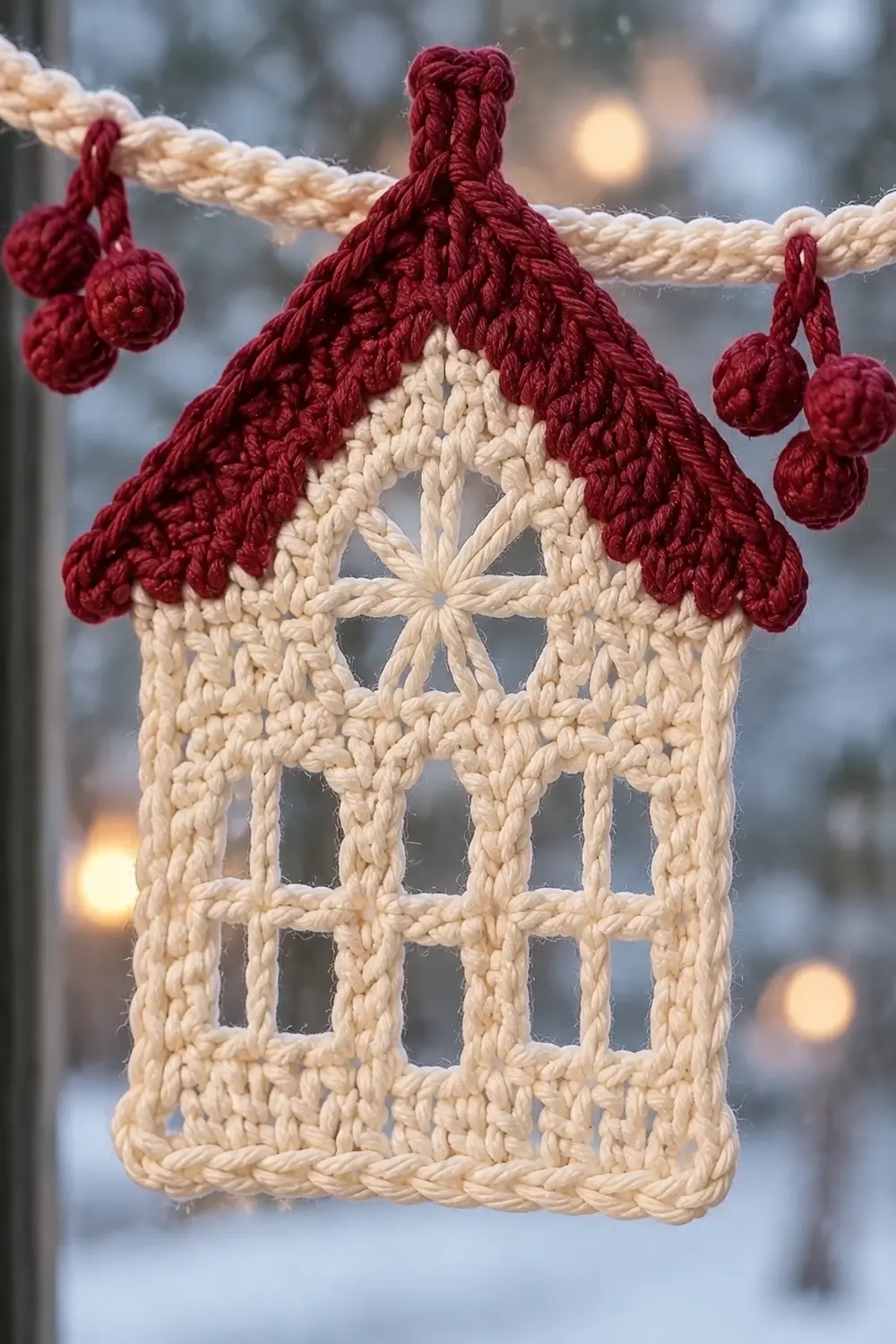
House Body (Make 5, Cream)
The ch-3 at the start of a row counts as a dc throughout.
Row 1: Ch 23. Sc in 2nd ch from hook and in each ch across. (22 sc)
Row 2: Ch 1, turn. Sc in each st across. (22 sc)
Row 3: Ch 3, turn. Dc in each st across. (22 sts)
Row 4 (window row): Ch 3, turn. Dc in next 3 sts. Ch 2, sk 2, dc in next st twice. Dc in next 3 sts. Repeat from * to * twice. Dc in last 3 sts. (14 dc + 4 ch-2 sps = 22 sts)
This gives a 7-column grid: solid, open, open, solid, open, open, solid. That makes two windows, each two panes wide, with a single-dc mullion between panes.
Row 5: Ch 3, turn. Work as Row 4: dc in each dc and ch 2 over each ch-2 sp. (22 sts)
Row 6 (crossbar): Ch 3, turn. Dc in each dc and 2 dc in each ch-2 sp. (14 dc + 8 dc = 22 sts)
Rows 7–8: Repeat Row 4 (worked over the solid row), then Row 5. (22 sts each)
Row 9 (lintel): Repeat Row 6. (22 sts)
Checkpoint: 2.7 in (6.9 cm) tall.
Gable
Each gable row steps in 2 sts at each end. The roof will cover these stepped edges.
Row 10: Turn. Sl st in first 3 sts. Ch 3 (counts as dc in the 3rd st). Dc in next 17 sts. Leave the last 2 sts unworked. (18 sts)
Row 11: Turn. Sl st in first 3 sts. Ch 3, dc in next 4 sts. Ch 4, sk 4. Dc in next 5 sts. Leave 2 unworked. (10 dc + 4 ch = 14 sts)
Row 12: Turn. Sl st in first 3 sts. Ch 3, dc in next 2 sts. Ch 4, sk the ch-4 sp. Dc in next 3 sts. Leave 2 unworked. (6 dc + 4 ch = 10 sts)
Row 13: Turn. Sl st in first 3 sts. Ch 3, 4 dc in the ch-4 sp, dc in next st. Leave 2 unworked. (6 sts)
Row 14: Turn. Sl st in first 3 sts. Ch 3, dc in next st. Leave 2 unworked. (2 sts)
Fasten off and weave in ends. Checkpoint: 4.3 in (10.9 cm) tall.
Star window: Rows 11–12 leave an opening about 0.7 in (1.8 cm) square in the gable. Thread a cream tail on the tapestry needle. Sew four straight stitches across the opening: one vertical, one horizontal, and two diagonal, all crossing at the center. This forms an eight-point star.
Roof (Make 5, Burgundy)
The roof is a mitered strip. Increases at the center stitch bend the strip into a peak, and the foundation chain becomes the inner edge that sits on the gable.
Row 1: Ch 32. Sc in 2nd ch from hook and in next 14 ch. 3 sc in next ch (the center ch), and place a marker in the middle sc of the three. Sc in last 15 ch. (33 sc)
Row 2: Ch 1, turn. Working in BLO, sc in each st to the marked st. 3 sc in the marked st, then move the marker to the middle sc. Sc in each remaining st. (35 sc)
Row 3: Repeat Row 2. (37 sc)
Row 4: Repeat Row 2. (39 sc)
Fasten off. Each row is a complete growth row that adds 2 sts at the peak. Roof depth is about 0.7 in (1.8 cm).
Peak loop: Join burgundy with a sl st in the marked center st of Row 4. Ch 8, then sl st in the same st. Fasten off, leaving a 6 in (15.2 cm) tail for tacking the loop to the cord later.
Berry Cluster (Make 5, Burgundy)
- Leave a 6 in (15.2 cm) tail. Ch 6.
- Berry 1: PC in 3rd ch from hook. Three stem chains remain.
- Sl st in next stem ch. Berry 2: Ch 3, PC in 3rd ch from hook, then sl st in the same stem ch.
- Sl st in next stem ch. Berry 3: Ch 3, PC in 3rd ch from hook, then sl st in the same stem ch.
- Sl st in the last stem ch. Fasten off, leaving a 6 in (15.2 cm) tail.
The cluster hangs about 1 in (2.5 cm) long with three berries.
Cord (Make 1, Cream)
Hold 2 strands of cream together. Ch 10, then sl st in the first ch to form a 1 in (2.5 cm) hanging loop. Chain until the cord measures 54 in (137.2 cm) from the loop. Turn, and sl st in the back bump of each ch back to the loop. This firms the chain into a rope-like cord. Ch 10 and sl st at the base to form the second loop. Fasten off.
Make All Pieces
- Cream: 5 house bodies (with star embroidery) and 1 cord
- Burgundy: 5 roofs (each with peak loop) and 5 berry clusters
Layout grid:
CORD:   [LOOP] -- 13 in -- H1 -- 7 in -- H2 -- 7 in -- H3 -- 7 in -- H4 -- 7 in -- H5 -- 13 in -- [LOOP]
ROW 1:  CREAM HOUSE / BURGUNDY ROOF  x 5
The 13 in (33.0 cm) end sections leave room to tie the garland to hooks or curtain rods.
Joining
Joining has three steps: sew the roof onto the body, work the Border (next section), then thread the house onto the cord.
Step 1 – Sew the roof. Place the body RS up. Lay the roof on top with its foundation edge along the gable steps and the roof covering the stepped edges. Whipstitch with burgundy through the roof’s foundation loops and the gable’s edge stitches.
Stitch-to-stitch logic: each roof half has 15 sts plus the shared center st. The gable climbs 5 steps per side, so match 3 roof sts per step:
- Roof st 16 (center) sits on the 2-st top of Row 14.
- Sts 13, 10, 7, and 4 sit at the outer corners of Rows 13, 12, 11, and 10.
- St 1 sits at the top corner of Row 9.
- Mirror this on the other side, ending with st 31 at the opposite wall corner.
The roof edge is very slightly longer than the gable slope. Ease it in evenly and don’t stretch the gable.
Tension: keep whipstitches snug but not tight. The roof should lie flat without puckering the gable.
Step 2 – Attach berries. Sew one berry cluster to the right eave tip (roof st 31, Row 1 corner) so it dangles from the base of the roof. Weave in the tails.
Step 3 – Thread onto the cord. Pass the cord through each peak loop. Place House 1’s loop 13 in (33.0 cm) from the first hanging loop, then space the remaining loops 7 in (17.8 cm) apart center to center. Use the peak-loop tail to tack each loop to the cord with two small stitches so the houses don’t slide.
Size checkpoint: House 1’s loop to House 5’s loop measures 28 in (71.1 cm). The full cord measures 54 in (137.2 cm).
Border
The border is worked on each house body individually, along the two walls and the bottom only. It is not worked around the assembled garland, and the gable is skipped because the roof covers it.
Border gauge: 5.5 sc per in along the bottom, which matches the body’s stitch gauge. Along the walls, work 6 sc per in, which matches the sc row gauge.
Border Row 1: With RS facing, join cream with a sl st at the top of the right wall (the Row 9 corner, just under the roof). Ch 1.
- Right wall: Work 1 sc in the end of each sc row (Rows 1–2) and 2 sc in the end of each dc row (Rows 3–9), working down. (2 + 14 = 16 sc)
- Bottom: Work 3 sc in the first foundation loop, sc in each of the next 20 loops, and 3 sc in the last loop. (22 loops worked + 4 corner extras = 26 sc)
- Left wall: Work as the right wall, going up. (16 sc)
Total: 54 sts worked one per existing stitch or row position, plus 4 corner extras, for 58 sc.
Border Row 2: Ch 1, turn. Sl st loosely in each sc, working (sl st, ch 1, sl st) in the center sc of each bottom corner. (60 sl st + 2 ch-1 sps)
Fasten off and weave in ends.
Why the math works:
- The walls are 2.7 in tall at 6 sc per in, which gives 16 sc.
- The bottom is 4.0 in wide at 5.5 sts per in, which gives 22 sts.
- The 3-sc corners turn the edge cleanly without cupping.
- The border adds about 0.2 in (0.5 cm) per side, bringing the body to 4.4 in (11.2 cm) wide × 4.5 in (11.4 cm) tall.
Final Blocking
- Before threading, lightly mist each house (body, roof, and berries).
- Pin the body to 4.4 in (11.2 cm) wide × 4.5 in (11.4 cm) tall, keeping the walls straight and square.
- Pin the window openings open, with one pin per pane.
- Pin the roof peak sharp and the eaves level with each other.
- Shape each popcorn berry round with your fingers.
- Let everything dry completely, then unpin and thread onto the cord as described in Joining.
- Hang the garland. If the cord twists, mist it and let it hang straight to dry.
Final Quality-Control Checklist
- [ ] Each body has 22 sts in Rows 3–9 and 2 sts in Row 14
- [ ] Windows are open, square, and symmetric
- [ ] The gable star has 4 crossing stitches
- [ ] Each roof has 39 sc in Row 4, with a centered peak loop
- [ ] The roof center sits on the gable peak, and both eaves are level
- [ ] Each border has 58 sc in Row 1, and the walls are straight
- [ ] One berry cluster hangs from each right eave
- [ ] Houses are 7 in (17.8 cm) apart, and each loop is tacked to the cord
- [ ] All ends are woven in
Troubleshooting
- Body narrower at the top than the bottom: The dc rows are tighter than the sc base. Relax your tension on the window rows.
- Windows close up or look uneven: Make sure you skip exactly 2 sts under each ch-2, then block with pins.
- Roof ruffles: Your Row 1 chain is too loose. Redo it with a smaller hook for the chain only.
- Roof won’t reach the wall corners: Your gauge is tight. Ease the gable slightly when sewing, or remake the roof with a 4.0 mm hook.
- Border flares along the walls: Work 1 sc per dc row on one or two rows, keeping both walls matched.
- Popcorns look flat: Pull the dropped loop through firmly and ch 1 tightly to lock.
- Houses slide together on the cord: Re-tack each peak loop through the cord, not just around it.
Care
Hand wash cold and lay flat to dry, reshaping the roofs and windows while damp. Store the garland flat or loosely coiled, with tissue between the houses.

Final Notes
The measurement chain runs like this:
- Gauge of 22 dc = 4 in (10.2 cm) gives a 4.0 in (10.2 cm) body.
- The gable brings the body to 4.3 in (10.9 cm) tall.
- The 58-sc border brings it to 4.4 in (11.2 cm) × 4.5 in (11.4 cm).
- The roof adds height and overhang for a house about 5 in (12.7 cm) wide and 5.2 in (13.2 cm) tall.
- Five houses spaced 7 in (17.8 cm) apart on a 54 in (137.2 cm) cord complete the garland.
Optional: for a longer window, add more houses at the same 7 in (17.8 cm) spacing and lengthen the cord to match.
Happy crocheting!