

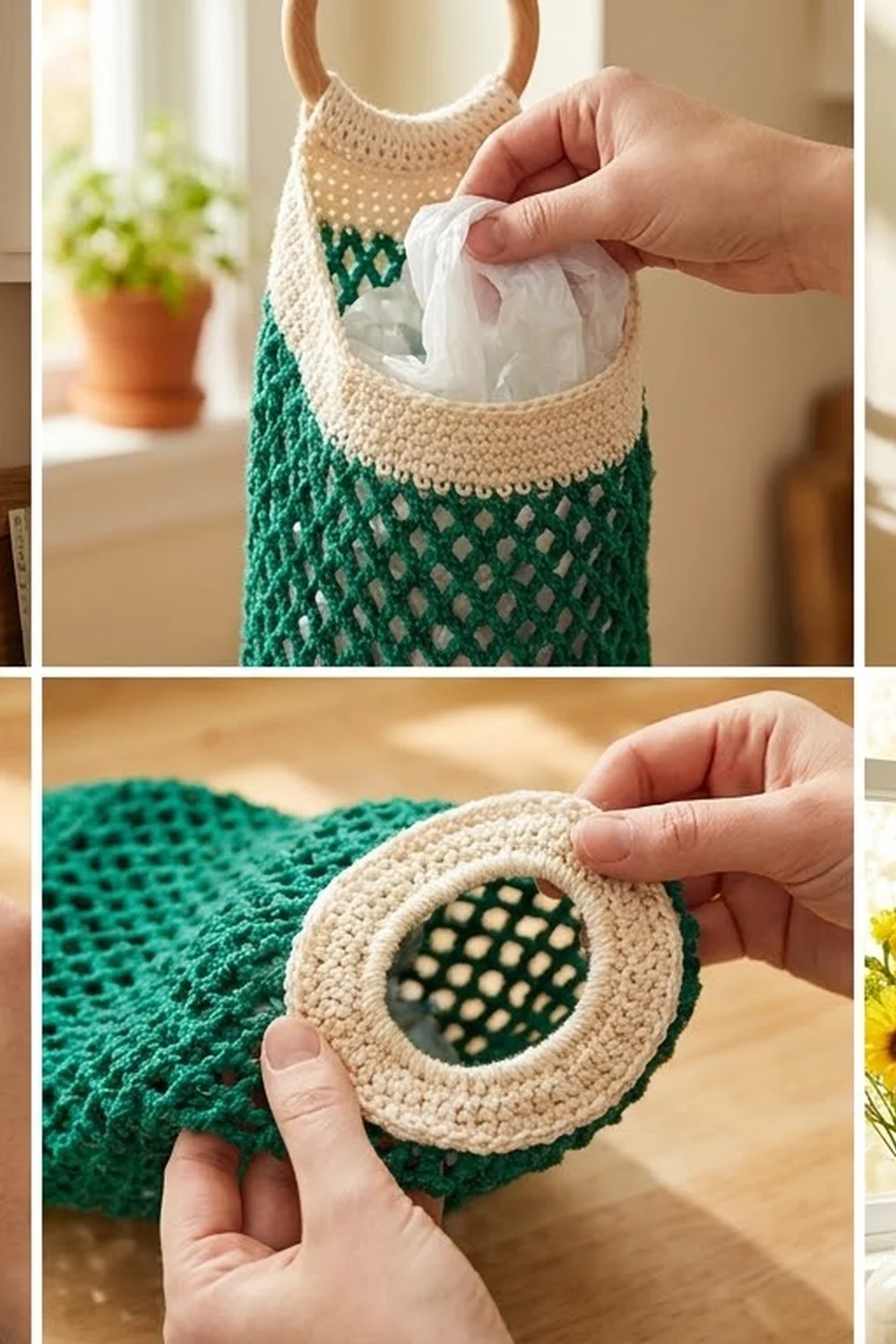
This hanging bag holder makes a kitchen chore look pretty. The body is an open diamond mesh in deep emerald green, so you can see at a glance how many bags are left. A soft cream band frames the top. You stuff bags in from above and pull them out one at a time through the cream-ringed hole near the bottom.
A vine of white daisies with yellow centers and sage-green leaves climbs up the front from the hole. A wooden ring and a simple green strap let the holder hang from any hook or cabinet knob.
The pattern uses US crochet terms. The finished holder is 6 in (15.2 cm) wide laid flat and 19.5 in (49.5 cm) tall from the bottom to the top edge, not counting the strap.
You crochet the holder in one piece from the bottom up. You start with a small solid base, then work mesh rounds that open into a tube, with the dispensing hole built into one round. Next you add the cream top band and the hole collar. Last, you make the strap, daisies, leaves and stem separately and sew them on.
Finished Size and Construction
- Finished size: 6 in (15.2 cm) wide flat, 12 in (30.5 cm) around, 19.5 in (49.5 cm) tall
- Height including strap: about 23.5 in (59.7 cm)
- Skill level: Easy-intermediate
- Terminology: US
- Yarn weight: Worsted (#4) cotton
- Hooks: 5.0 mm (H-8) for the body, 4.0 mm (G-6) for the appliqués
- Number of pieces: 1 main body, plus 1 strap and 9 small appliqués (3 daisies, 5 leaves, 1 stem)
- Layout: a single tube with the hole centered on the front and the vine rising from it
- Mesh body size: 6 in × 18 in (15.2 cm × 45.7 cm)
- Size before top band: 6 in × 18 in (15.2 cm × 45.7 cm)
- Top band depth: 1.5 in (3.8 cm)
- Hole: 2.4 in (6.1 cm) opening, about 3.5 in (8.9 cm) across the outside of the collar
Materials
Pick a smooth, firm worsted-weight cotton or cotton blend. Cotton keeps the mesh open, won’t sag under a load of bags, and can go in the washing machine. The amounts below assume about 85 m (93 yd) per 50 g.
- Emerald green (MC): 100 g / 170 m (body, strap)
- Cream (CC1): 30 g / 51 m (top band, hole collar)
- White (CC2): 10 g / 17 m (petals)
- Yellow (CC3): 5 g / 8.5 m (daisy centers)
- Sage green (CC4): 10 g / 17 m (leaves, stem)
These quantities include a margin of about 15% for swatching and redoing a round.
Tools:
– 5.0 mm (H-8) and 4.0 mm (G-6) crochet hooks
– 1 wooden ring, 2.75 in (7.0 cm) across
– Stitch marker
– Tapestry needle
– Scissors
– Measuring tape
– Rust-proof pins and a rolled towel
Abbreviations (US Terms)
- ch – chain
- sl st – slip stitch
- sc – single crochet
- hdc – half double crochet
- dc – double crochet
- sp – space
- sk – skip
- st(s) – stitch(es)
- rep – repeat
- Rnd – round
Special technique, the mesh join: You close each mesh round with a short chain plus a taller stitch worked into the first sc. “Ch 2, dc in first sc” equals a ch-5 loop. “Ch 1, dc in first sc” equals a ch-4 loop. “Ch 1, hdc in first sc” equals a ch-3 loop. This leaves your hook in the middle of the last loop, ready to start the next round.
Gauge and Checkpoints
Solid gauge (5.0 mm hook): 16 sc × 16 rnds = 4 in (10.2 cm). That is 4 sc and 4 rounds per inch (2.5 cm).
Mesh gauge: Each ch-5 loop spans 1 in (2.5 cm) when lightly stretched. 6 mesh rounds = 4 in (10.2 cm).
The body works as your test piece. Measure at each of these checkpoints:
- After Rnd 4: The flat base is about 2 in (5.1 cm) across.
- After Rnd 10: Laid flat, the tube is 6 in (15.2 cm) wide.
- After Rnd 30: The body is 18 in (45.7 cm) tall.
- After Rnd 36: The band is 1.5 in (3.8 cm) deep, and the total height is 19.5 in (49.5 cm).
Too big? Go down to a 4.5 mm hook. Too small? Go up to a 5.5 mm hook. If the mesh is narrow, your chains are usually too tight. Make each chain the same size as the loop on your hook.

Body
Use MC and the 5.0 mm hook. Work in joined rounds with the right side facing you. Place a marker at the start of the round; this marks the left side of the holder. The first 6 mesh loops of each round form the front.
Rnd 1: Make a magic ring, ch 1, work 6 sc in the ring, sl st to the first sc. (6 sts)
Rnd 2: Ch 1, 2 sc in each st around, sl st to the first sc. (12 sts)
Rnd 3: Ch 1, sc in next st, 2 sc in next st; rep from * 6 times total, sl st to the first sc. (18 sts)
Rnd 4: Ch 1, sc in next 2 sts, 2 sc in next st; rep from * 6 times total, sl st to the first sc. (24 sts)
Rnd 5 (conversion to mesh): Ch 1, sc in first st, ch 3, sk next st, sc in next st; rep from * 10 more times. Ch 1, sk last st, hdc in first sc. (12 sc, one in every other base st, + 12 ch-3 loops)
Rnd 6: Ch 1, sc around the post of the joining hdc, ch 4, sc in next ch-3 sp; rep from * 10 more times. Ch 1, dc in first sc. (12 sc + 12 ch-4 loops)
Rnd 7: Ch 1, sc around the post of the joining dc, ch 5, sc in next ch-4 sp; rep from * 10 more times. Ch 2, dc in first sc. (12 sc + 12 ch-5 loops)
Rnd 8 (hole round): Ch 1, sc around the post of the joining dc (sc 1). Ch 5, sc in next ch-5 sp (sc 2). Ch 15, sk next 2 ch-5 sps, sc in next sp (sc 5). Ch 5, sc in next ch-5 sp; rep from * 6 more times (sc 6 to sc 12). Ch 2, dc in first sc. (10 sc + 9 ch-5 loops + 1 ch-15 loop)
The 2 skipped Rnd 7 loops stay free and form the bottom edge of the hole. The ch-15 forms the top edge.
Rnd 9: Ch 1, sc around the post of the joining dc. Ch 5, sc in next ch-5 sp. Ch 5, sc in 3rd ch of the ch-15. Ch 5, sc in 8th ch of the ch-15. Ch 5, sc in 13th ch of the ch-15. Ch 5, sc in next ch-5 sp. Ch 5, sc in next ch-5 sp; rep from * 5 more times. Ch 2, dc in first sc. (12 sc + 12 ch-5 loops)
The 3 anchors on the ch-15 are 5 chains apart, which brings the mesh back to 12 even loops.
Rnds 10–30: Ch 1, sc around the post of the joining dc, ch 5, sc in next ch-5 sp; rep from * 10 more times. Ch 2, dc in first sc. (12 sc + 12 ch-5 loops each round)
Rnds 7–30 are 24 rounds of ch-5 mesh, which comes to 16 in (40.6 cm). With the base and Rnds 5–6 added, the body is 18 in (45.7 cm) tall. Fasten off MC.
Hole Collar
Use CC1 and the 5.0 mm hook, with the front facing you.
Rnd 1: Join CC1 with a sc in sc 5 of Rnd 8. Work 6 sc in each of the 2 free Rnd 7 loops (12 sc). Sc in sc 2 of Rnd 8. Work 16 sc evenly over the ch-15, wrapping the chain between the Rnd 9 anchors. Sl st to the first sc. (1 + 12 + 1 + 16 = 30 sts)
Rnds 2–3: Ch 1, sc in each st around, sl st to the first sc. (30 sts)
These rounds have no increases, so they rise from the mesh as a short collar. Roll the collar gently toward the front. The 30 sc measure 7.5 in (19.1 cm) around, which gives a 2.4 in (6.1 cm) opening. Fasten off.
Strap
Use MC and the 5.0 mm hook.
Row 1: Ch 5, sc in 2nd ch from hook and in each ch across. (4 sts)
Rows 2–48: Ch 1, turn, sc in each st across. (4 sts)
The finished strap is 1 in × 12 in (2.5 cm × 30.5 cm). Fasten off, leaving a long tail.
Daisies
Use the 4.0 mm hook, and leave long tails for sewing.
Large daisy (make 1): With CC3, Rnd 1: magic ring, 8 sc in the ring, sl st to the first sc. (8 sts) Rnd 2: ch 1, 2 sc in each st, sl st to the first sc. (16 sts) Fasten off. Join CC2. Rnd 3: ch 7, sc in 2nd ch from hook, hdc in next ch, dc in next 2 ch, hdc in next ch, sc in last ch, sk next center st, sl st in next st; rep from * 8 times total. (8 petals) The daisy is about 2.75 in (7.0 cm) across.
Medium daisy (make 1): With CC3, Rnd 1: magic ring, 8 sc in the ring, sl st to the first sc. (8 sts) Fasten off. Join CC2. Rnd 2: ch 6, sc in 2nd ch from hook, hdc in next ch, dc in next ch, hdc in next ch, sc in last ch, sl st in next center st; rep from * 8 times total. (8 petals) The daisy is about 2.25 in (5.7 cm) across.
Small daisy (make 1): Work Rnd 1 as for the medium daisy. Join CC2. Rnd 2: ch 4, sc in 2nd ch from hook, hdc in next ch, sc in last ch, sl st in next center st; rep from * 8 times total. (8 petals) The daisy is about 1.5 in (3.8 cm) across.
Leaves and Stem
Use CC4 and the 4.0 mm hook.
Leaf (make 5): Ch 8. Sc in 2nd ch from hook, hdc in next ch, dc in next 3 ch, hdc in next ch, 3 sc in last ch for the tip. Working along the other side of the chain: hdc, dc in next 3 ch, hdc, sc. Sl st to the first sc. (15 sts) Each leaf is about 1.75 in (4.4 cm) long.
Main stem: Ch 45, sl st in the back bump of the 2nd ch from hook and of each ch across. (44 sl sts, about 11 in / 27.9 cm)
Branch: Ch 13, sl st in the back bump of the 2nd ch from hook and of each ch across. (12 sl sts, about 3 in / 7.6 cm)
Border: Top Band
Border gauge: 4 sc and 4 rounds per inch (2.5 cm), using CC1 and the 5.0 mm hook.
Rnd 31 (conversion): Join CC1 in the joining loop of Rnd 30, at the marker. Ch 1, work 4 sc in each of the 12 ch-5 loops, sl st to the first sc. (12 sc, one per loop, + 36 extra sc, three more per loop = 48 sts: 24 front, 24 back)
Rnds 32–36: Ch 1, sc in each st around, sl st to the first sc. (48 sts: 24 front, 24 back)
Fasten off. The 6 band rounds measure 1.5 in (3.8 cm).
Why the math works: 12 mesh loops at 1 in (2.5 cm) each make a circumference of 12 in (30.5 cm). Working 4 sc per loop gives 48 sc. At 4 sc per inch, 48 sc is also 12 in (30.5 cm), or 6 in (15.2 cm) per side. So the band sits flat, with no flaring and no pulling in.
Attach the strap: Thread the strap through the wooden ring. Sew 1 in (2.5 cm) of one end to the inside of the band at the marker. Sew the other end at the opposite side, 24 sts away. The free 10 in (25.4 cm) of strap peaks about 4 in (10.2 cm) above the band, with the ring at the top.
Final Blocking
- Soak the body in cool water for 10 minutes, then gently press the water out. Don’t wring it.
- Slide a rolled towel about 4 in (10.2 cm) thick inside the tube.
- Ease the mesh to 6 in (15.2 cm) wide flat and 18 in (45.7 cm) tall below the band. Straighten the diamond columns.
- Round the collar with your fingers so the opening is 2.4 in (6.1 cm) across.
- Pin the daisy petals and leaf tips flat on a towel. Let everything dry completely.
- Sew the main stem from the upper left edge of the collar in a gentle curve up and to the right, ending 3 in (7.6 cm) below the band. Sew the medium daisy at the top of the stem and the large daisy to the left at mid-height. Sew the branch angled to the left, with the small daisy at its tip, about 1.5 in (3.8 cm) above the collar. Space the 5 leaves along the stem, alternating sides.
- Sew through the backs of the appliqués and catch only the mesh strands, so your stitches don’t show inside.
Final Quality-Control Checklist
- Every mesh round has 12 loops, including Rnd 9
- The tube is 6 in (15.2 cm) flat and 19.5 in (49.5 cm) tall
- Each band round has 48 sts, 24 per side
- The collar has 30 sts and stands evenly all the way around
- The strap ends sit exactly opposite each other
- Each daisy has 8 even petals
- All ends are woven in
Troubleshooting
- The mesh spirals: Work each first sc around the post of the joining stitch, not beside it.
- The hole is lopsided: Check that the Rnd 9 anchors are in chains 3, 8 and 13 of the ch-15.
- The collar ruffles: Work 28 sc in each collar round instead of 30.
- The band flares: Use a 4.5 mm hook for the band only.
- The base puckers: Make sure Rnd 4 has exactly 24 sts.
Care
Machine wash cool on a gentle cycle inside a laundry bag, then reshape the holder and lay it flat to dry. Don’t tumble dry.
Final Notes
Here is the full measurement chain. A 24-st base opens into 12 mesh loops of 1 in (2.5 cm) each, which makes a tube 12 in (30.5 cm) around and 6 in (15.2 cm) wide flat. Rnds 1–30 build 18 in (45.7 cm) of body, and the 48-st band adds 1.5 in (3.8 cm), for 19.5 in (49.5 cm) in total. The 30-st collar frames a 2.4 in (6.1 cm) opening, and a 12 in (30.5 cm) strap hangs everything from the wooden ring.
Happy crocheting!