

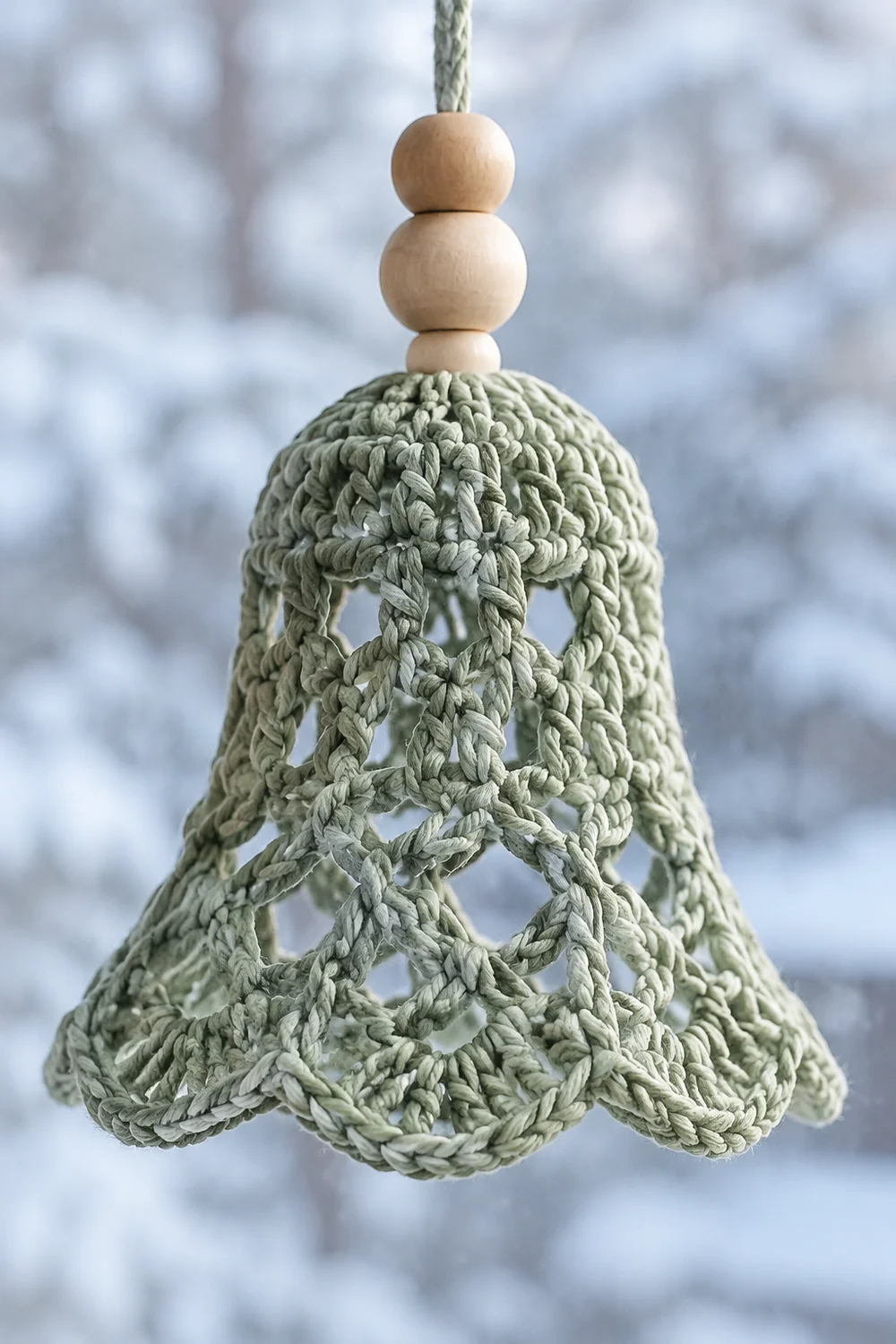
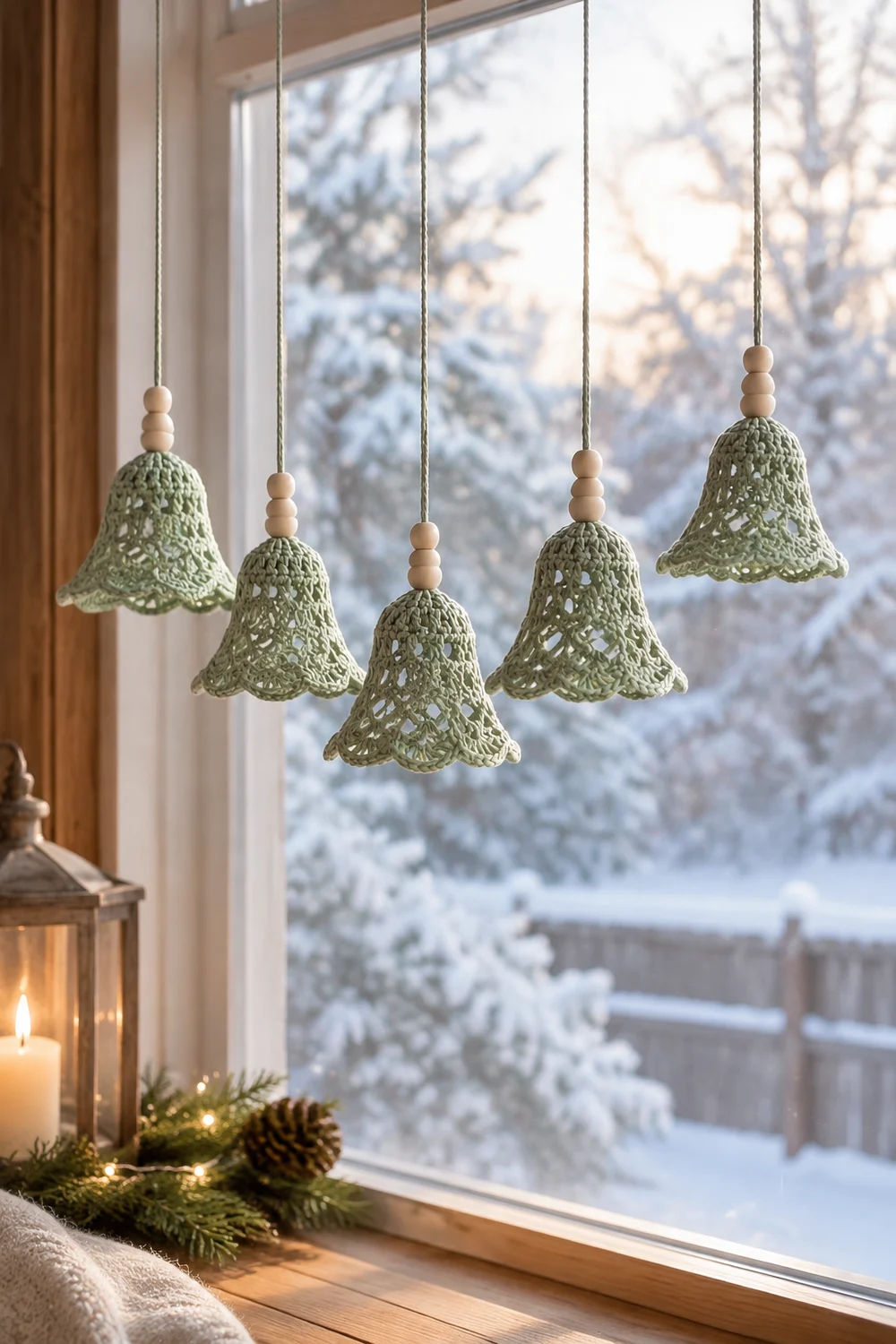
These little lace bells are made to hang in a window. Each one has a rounded dome crown, an openwork body that flares wide at the bottom, and a soft scalloped shell trim around the opening. When daylight comes through the lace, the stitch pattern shows clearly against the glass.
The set has five bells, all in sage green cotton. Each bell hangs on its own gray twine string with a small wooden bead at the top. The style is calm, natural, and a little Scandinavian, so the bells work well with wood, white, and winter greenery.
This pattern uses US crochet terms. Each finished bell is 2.75 in (7.0 cm) tall, and its blocked opening is 3 in (7.6 cm) across.
Each bell is worked top-down in the round as one piece. You start with a magic ring and shape a rounded crown with sc increases and eyelet rounds. Next you work four lace rounds of V-stitches and shells that flare outward. Two border rounds add the scalloped trim. After that, you stiffen the bell over a form and thread on the bead and hanging cord.
Finished Size and Construction
- Finished size (one bell): 2.75 in (7.0 cm) tall × 3 in (7.6 cm) across the opening
- Skill level: Intermediate (lace in the round)
- Terminology: US crochet terms
- Yarn weight: Sport weight (#2) cotton
- Hook: 2.75 mm (US C/2)
- Number of pieces: 5 identical bells, worked separately and not joined
- Layout: Hung individually in a staggered row
- Piece size: 2.75 in (7.0 cm) tall × 3 in (7.6 cm) opening
- Size before border (after Rnd 11): 2.25 in (5.7 cm) tall × 2.75 in (7.0 cm) opening
- Border depth: 0.5 in (1.3 cm)
Materials
Yarn advice: Choose a smooth mercerized or combed cotton in sport weight. Cotton gives crisp stitch definition and takes stiffener well. Avoid fuzzy or very stretchy acrylic, because the lace will blur and the flare will not hold its shape.
- Sage green: 40 g / about 135 m total for five bells. One bell uses about 6 g / 20 m.
- Gray twine: about 3.7 m total, cut into five pieces of 24 in (61.0 cm) each
Tools:
- 2.75 mm (US C/2) crochet hook
- 5 wooden beads, 12 mm, with holes wide enough for doubled twine (about 4 mm)
- Tapestry needle
- Scissors
- Stitch marker
- Fabric stiffener, or a strong starch solution
- A bell-shaped form, such as a small funnel, a shot glass topped with a foil cone, or a small balloon
- Plastic wrap and rust-proof pins
- Optional: a drop of clear craft glue for the twine knot
The quantities above include a margin of about 30% for your gauge swatch and weaving in ends.
Abbreviations (US Terms)
- ch – chain
- sl st – slip stitch
- sc – single crochet
- dc – double crochet
- inc – 2 sc in the same stitch
- st(s) – stitch(es)
- sp – space
- sk – skip
- MR – magic ring
- rep – repeat
Special stitches:
- V-st (V-stitch): (dc, ch 1, dc) in the same stitch or space.
- Shell: (2 dc, ch 1, 2 dc) in the same space in Rnd 10, and (2 dc, ch 2, 2 dc) in the same space in Rnd 11.
- Fan: 7 dc in the same space.
Counting rule: In this pattern, every dc, sc, and ch counts as one stitch in the stated totals. A turning chain that “counts as” a stitch is included in the count.
Gauge and Checkpoints
Gauge: 6 sc and 6 sc rounds = 1 in (2.5 cm), worked in a flat circle.
Make one complete bell before you start the others, and check each stage as you go:
- After Rnd 4 (flat): The circle should measure 1.3 in (3.3 cm) across.
- After Rnd 7 (crown): The crown should be 1.6 in (4.1 cm) across at its widest point and about 1 in (2.5 cm) tall.
- After Rnd 9: Total height should be 1.75 in (4.4 cm).
- After Rnd 11: Total height should be 2.25 in (5.7 cm), with a 2.75 in (7.0 cm) opening.
- After the border and blocking: The bell should be 2.75 in (7.0 cm) tall with a 3 in (7.6 cm) opening.
If your bell is too big: Go down to a 2.5 mm hook, or pull your chains a little tighter.
If your bell is too small: Go up to a 3.0 mm hook. Do not add extra repeats, because the 10-repeat structure carries through to the border.
Crown (Rnds 1–7)
The crown is a rounded dome. Rnds 1–4 increase evenly to form a flat top. Rnd 5 is worked even, so the fabric starts to curve down. Rnd 6 adds a gentle increase, and Rnd 7 is worked even again. This “increase, even, increase, even” rhythm is what rounds the dome.
Work in continuous rounds for Rnds 1–4, and move your marker each round.
Rnd 1: MR, 6 sc in ring. (6 sts)
Rnd 2: Inc in each st around. (12 sts)
Rnd 3: (Sc in next st, inc) 6 times. (18 sts)
Rnd 4: (Sc in next 2 sts, inc) 6 times. Sl st to the first sc. (24 sts)
Checkpoint: The circle measures 1.3 in (3.3 cm) across.
Rnd 5 (eyelet round, even): Ch 4 (counts as dc + ch 1), sk next st. Dc in next st, ch 1, sk next st. Rep from * 10 more times. Sl st to the 3rd ch of the beg ch-4. (12 dc + 12 ch = 24 sts)
Rnd 6 (gentle increase): Ch 1. Sc in next dc, sc in next ch-1 sp, sc in next dc, 2 sc in next ch-1 sp. Rep from * 5 more times. Sl st to the first sc. (6 repeats × 5 sts = 30 sts)
Rnd 7 (eyelet round, even): Ch 4 (counts as dc + ch 1), sk next st. Dc in next st, ch 1, sk next st. Rep from * 13 more times. Sl st to the 3rd ch of the beg ch-4. (15 dc + 15 ch = 30 sts)
Checkpoint: The crown is a rounded dome, 1.6 in (4.1 cm) across and about 1 in (2.5 cm) tall. Lightly cup it in your palm and check that it curves down rather than lying flat.
Lace Body (Rnds 8–11)
The body has 10 repeats all the way down. Each round is a growth round, and the stated total is that round’s own complete count.
Rnd 8: Ch 4 (counts as dc + ch 1), dc in the same st. This is the first V-st. Ch 1, sk next 2 sts. V-st in next st, ch 1, sk next 2 sts. Rep from * 8 more times. Sl st to the 3rd ch of the beg ch-4.
- In this round, each dc and each ch-1 sp of Rnd 7 counts as one stitch.
- Result: 10 V-sts. (20 dc + 20 ch = 40 sts)
Rnd 9: Sl st into the first V-st ch-1 sp. Ch 4 (counts as dc + ch 1), dc in the same sp. Ch 2. V-st in next V-st sp, ch 2. Rep from * 8 more times. Sl st to the 3rd ch of the beg ch-4.
- Each repeat is 2 dc + 1 ch + 2 ch = 5 sts.
- Result: 10 repeats × 5 sts = 50 sts.
Checkpoint: Total height is 1.75 in (4.4 cm). The body should hang fairly straight below the crown.
Rnd 10: Sl st into the first V-st sp. Ch 3 (counts as dc), (dc, ch 1, 2 dc) in the same sp. Ch 2. (2 dc, ch 1, 2 dc) in next V-st sp, ch 2. Rep from * 8 more times. Sl st to the top of the beg ch-3.
- Each repeat is 4 dc + 1 ch + 2 ch = 7 sts.
- Result: 10 repeats × 7 sts = 70 sts.
Rnd 11 (flare round): Sl st in next dc and into the shell ch-1 sp. Ch 3 (counts as dc), (dc, ch 2, 2 dc) in the same sp. Ch 2, sc in next ch-2 sp, ch 2. (2 dc, ch 2, 2 dc) in next shell ch-1 sp, ch 2, sc in next ch-2 sp, ch 2. Rep from * 8 more times. Sl st to the top of the beg ch-3.
- Each repeat is 4 dc + 2 ch + 2 ch + 1 sc + 2 ch = 11 sts.
- Result: 10 repeats × 11 sts = 110 sts.
The ch-2 loops on each side of each sc open into the diamond-shaped lace you see in the photo.
Checkpoint: Total height is 2.25 in (5.7 cm), and the opening is 2.75 in (7.0 cm) across.
Make All Five Bells
Work the full pattern, including the border below, five times. Use your first bell as the size reference for the other four.
Quantities per color:
- Sage green: 5 bells, about 6 g / 20 m each
- Gray twine: 5 lengths of 24 in (61.0 cm)
- Wooden beads: 5
Suggested hanging layout (drop = length from the rod to the top of the bead):
POSITION: BELL 1 | BELL 2 | BELL 3 | BELL 4 | BELL 5
COLOR:    SAGE   | SAGE   | SAGE   | SAGE   | SAGE
DROP:     8 in   | 9 in   | 10 in  | 9 in   | 6 in
          20.3cm | 22.9cm | 25.4cm | 22.9cm | 15.2cm
The bells are never joined to each other. Each one hangs on its own string.
Border (Rnds 12–13)
Border gauge: The border has 10 fans around a blocked opening of 3 in (7.6 cm). That opening has a circumference of about 9.4 in (23.9 cm), so each fan is about 0.9 in (2.3 cm) wide.
Rnd 12 (fan round): Sl st in next dc and into the shell ch-2 sp. Ch 3 (counts as dc), 6 dc in the same sp. This is the first fan. Sc in next sc. Fan (7 dc) in next shell ch-2 sp, sc in next sc. Rep from * 8 more times. Sl st to the top of the beg ch-3.
- Skip the ch-2 loops on either side of each sc. The fans sit over them.
- This round is worked into spaces, not one stitch per stitch, so its total is lower than Rnd 11’s total.
- Each repeat is 7 dc + 1 sc = 8 sts.
- Result: 10 repeats × 8 sts = 80 sts (10 fans).
Rnd 13 (sc trim round): Ch 1. Sc in each of the next 3 dc, 3 sc in the 4th (center) dc, sc in each of the next 3 dc, sl st in next sc. Rep from * 9 more times. Sl st to the first sc. Fasten off, leaving a 6 in (15.2 cm) tail.
- This is a conversion round. You work 1 stitch into each existing stitch, which gives 80 sts. You also add 2 extra sc at each fan’s center, which gives 10 × 2 = 20 sts.
- Result: 80 + 20 = 100 sts.
- Per scallop, that is 3 + 3 + 3 sc + 1 sl st = 10 sts.
Why the math works:
- Ten repeats run unbroken from Rnd 7 (30 sts ÷ 3 = 10 V-st bases) through Rnd 11, so every shell lines up with exactly one fan.
- The 3-sc peak in Rnd 13 lets each scallop curve outward without cupping, which adds the last 0.25 in (0.6 cm) of width.
- The fan depth plus the sc trim adds the 0.5 in (1.3 cm) border depth. That takes the height from 2.25 in (5.7 cm) to 2.75 in (7.0 cm).
Final Blocking
- Weave in ends. Weave the starting tail into the crown on the wrong side, but leave the MR loose enough for the twine to pass through. Weave the border tail along the sc trim.
- Prepare the form. Cover your bell form with plastic wrap. It should be about 1.6 in (4.1 cm) across at the top and 3 in (7.6 cm) at the base.
- Soak. Dip the bell in fabric stiffener, then squeeze out the excess. Do not wring it.
- Shape. Slide the bell over the form and center the crown. Gently open each lace diamond with your fingertip.
- Pin the scallops. Pin the center of each of the 10 scallops so the opening measures 3 in (7.6 cm). Check that the height is 2.75 in (7.0 cm).
- Dry. Let the bell dry completely, usually 12–24 hours, then remove it from the form.
- Attach the bead and cord.
- Fold a 24 in (61.0 cm) length of twine in half.
- Thread both ends through the bead.
- Push both ends down through the center of the MR into the bell.
- Tie an overhand knot inside that is larger than the ring hole.
- Add a drop of glue to the knot if you like.
- Trim the ends, then tie the loop to your rod at the drop given in the layout.
Final Quality-Control Checklist
- [ ] The crown is rounded, not pointed or flat.
- [ ] Rnd 7 has 30 sts, and Rnd 8 has exactly 10 V-sts.
- [ ] Rnd 11 has 110 sts with 10 shells.
- [ ] Rnd 12 has 10 even fans, and Rnd 13 has 100 sts.
- [ ] The bell is 2.75 in (7.0 cm) tall with a 3 in (7.6 cm) opening.
- [ ] The lace diamonds are open and let light through.
- [ ] The bell is stiff enough to hold its flare when hanging.
- [ ] The bead sits snugly on top, and the knot inside holds.
- [ ] All five bells match within 0.25 in (0.6 cm).
Troubleshooting
Crown is flat, not domed. You probably added extra increases in Rnd 5 or Rnd 7. Both rounds must stay at 24 and 30 sts.
Crown is pointed. Your tension in Rnds 1–4 is too tight. Loosen up, or go up a hook size for those rounds only.
Body flares too early. Check that Rnd 9 uses ch 1 inside each V-st, not ch 2.
Fans are crowded or ruffle. Check that you skipped the ch-2 loops beside each sc in Rnd 12.
Scallops are uneven. Re-pin each fan at its center while it is still damp with stiffener.
Bell collapses when hanging. Apply a second coat of stiffener and dry it on the form again.
Bead slips off. Use a larger knot, or tie a second knot through the knot loop.
Care
Dust the bells gently with a soft dry brush. Do not wash them, because water will soften the stiffener. If one gets wet, reshape it over the form and let it dry.
Final Notes
Here is the measurement chain:
- The crown is 1.6 in (4.1 cm) across and 1 in (2.5 cm) tall after Rnd 7.
- The body reaches 1.75 in (4.4 cm) tall after Rnd 9.
- After Rnd 11, the bell is 2.25 in (5.7 cm) tall with a 2.75 in (7.0 cm) opening.
- The border adds 0.5 in (1.3 cm), for a finished height of 2.75 in (7.0 cm) and a 3 in (7.6 cm) opening.
The stitch counts follow one 10-repeat structure throughout: 30, 40, 50, 70, 110, 80, and 100 sts. If your counts and checkpoints match, all five bells will match too.
Optional: you can make extra bells in the same sage green and hang them on a tree.
Happy crocheting!