

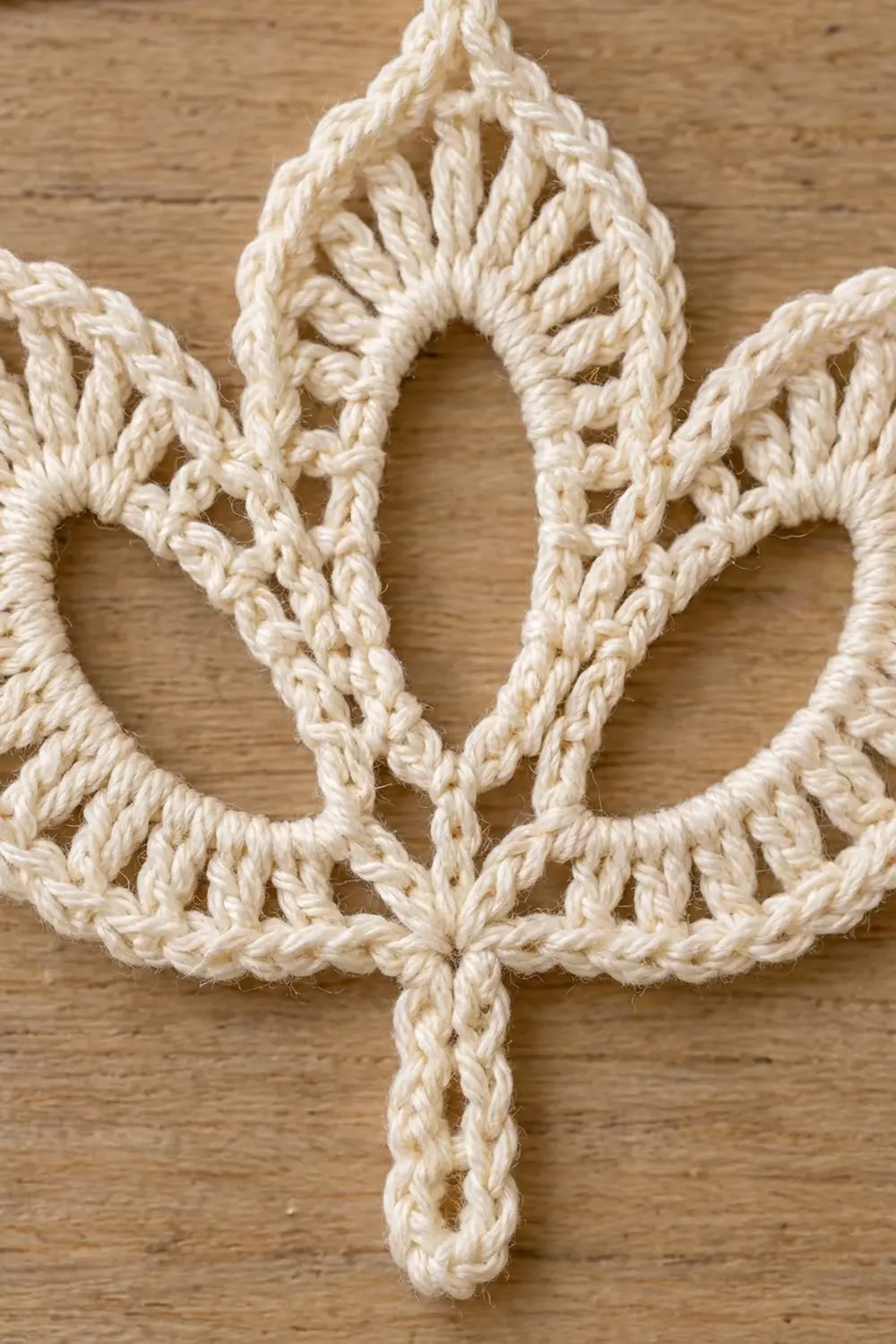
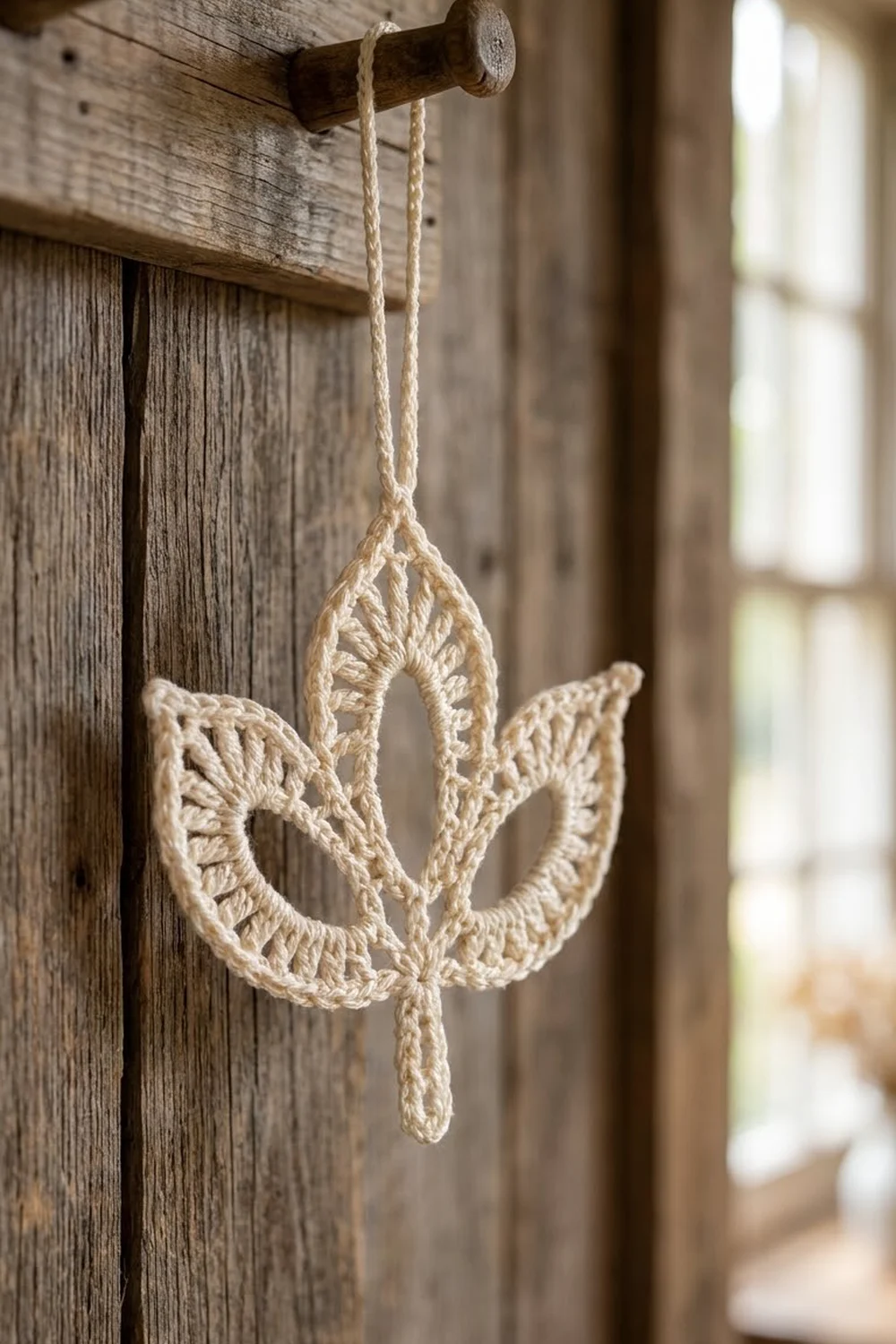
The Ivory Lotus Leaf Motif is a three-petal lace motif with a light, airy look. A tall center petal rises between two smaller side petals, and a slim looped stem hangs from the base. Each petal has an open oval window, a padded inner ring, a fan of spokes and a smooth pointed edge.
It uses one color, a soft creamy ivory cotton, so the texture does all the work. The style falls between Irish crochet and modern boho lace. It works well as an appliqué, a bookmark-style ornament, a sachet topper or a repeat motif for lace.
This pattern uses US crochet terms. The finished motif measures 6 in (15.2 cm) wide by 6.25 in (15.9 cm) tall, including the stem.
The construction is simple once you see it. You chain four loops that all meet at one base point, called the “hub”: stem, left petal, center petal and right petal. Round 1 pads each loop with single crochet. Round 2 adds the spokes. Round 3 is the edging, which forms the pointed petal tips. The whole motif is one continuous piece.
Finished Size and Construction
- Finished size: 6 in (15.2 cm) wide x 6.25 in (15.9 cm) tall, including stem
- Skill level: Intermediate
- Terminology: US crochet terms
- Yarn weight: Sport (#2), mercerized cotton
- Hook: 3.0 mm (US C/2 or D/3)
- Number of pieces: 1
- Layout: Single motif; three petals and a stem radiating from one hub
- Piece size: 6 in x 6.25 in (15.2 cm x 15.9 cm)
- Size before border (after Round 2): 5.5 in x 5.75 in (14.0 cm x 14.6 cm)
- Border depth: about 0.25 in (0.6 cm) per edge
Materials
Yarn. Choose a smooth, tightly plied mercerized cotton in sport weight. Mercerized cotton gives crisp stitch definition and holds the pointed tips after blocking. Avoid fuzzy or loosely spun yarns, because they blur the open windows and spokes.
- Ivory (main and only color): 10 g, about 30 m (33 yd)
These amounts include a margin of roughly 25% for your test motif and tails.
Tools:
- 3.0 mm crochet hook
- Tapestry needle
- Scissors
- Stitch markers (at least 4)
- Blocking mat or folded towel
- Rust-proof pins
- Spray bottle with water
- Ruler or tape measure
Abbreviations (US Terms)
- ch – chain
- sl st – slip stitch
- sc – single crochet
- dc – double crochet
- tr – treble crochet
- st(s) – stitch(es)
- sp – space
- sk – skip
- Rnd – round
Special technique – sc into a loop: Insert the hook into the center of the chain loop, not into individual chains. Yarn over and pull up a loop, then yarn over and draw through both loops. The stitches wrap around the chain and make the smooth, padded ring around each petal window.
Hub: The first chain of the stem loop. All four loops are anchored here with sl sts.
Gauge and Checkpoints
Gauge: 22 sc and 24 rows = 4 in (10.2 cm) in rows of sc with a 3.0 mm hook. Gauge matters less for a single motif, but it does set the final size.
Test first. Make one complete motif before you make a set. It uses very little yarn and tells you more than a swatch.
Checkpoints (measured flat, lightly smoothed, before blocking):
- After the foundation loops: side loops about 1.5 in (3.8 cm) long, center loop about 2 in (5.1 cm) long, stem loop about 1.25 in (3.2 cm) long.
- After Rnd 1: side petals about 1.75 in (4.4 cm) long, center petal about 2.25 in (5.7 cm) long.
- After Rnd 2: motif 5.5 in (14.0 cm) wide x 5.75 in (14.6 cm) tall.
- After Rnd 3 and blocking: 6 in (15.2 cm) wide x 6.25 in (15.9 cm) tall.
If too big: go down 0.25 mm in hook size, or check that your chains aren’t loose. Loose foundation chains are the most common cause of oversized petals.
If too small: go up 0.25 mm, or relax your grip on the chains. Don’t add chains to the loops, because that changes every stitch count that follows.
Foundation Loops
Stem loop: Ch 15, sl st in the first ch made to form a long, narrow loop. The sl st point is the hub. You now have a 14-ch stem loop. Place a marker in the hub.
Left petal loop: Ch 20, sl st in the hub. (20-ch loop.)
Center petal loop: Ch 26, sl st in the hub. (26-ch loop.)
Right petal loop: Ch 20, sl st in the hub. (20-ch loop.)
Arrange the loops like a hand. The stem points down, the left and right loops angle out at about 45 degrees, and the center loop points straight up. Don’t twist any loop.
Round 1 – Padded Rings
You are at the hub, next to the right petal loop. Work every st of this round into the loop (see Special technique).
- Right petal: Ch 1 (does not count), work 28 sc into the right petal loop. Push the sts together so they cover the chain evenly.
- Center petal: Work 36 sc into the center petal loop.
- Left petal: Work 28 sc into the left petal loop.
- Stem: Work 20 sc into the stem loop.
- Sl st in the hub.
Stitch count: 112 sc (28 + 36 + 28 + 20).
Place a marker in the 14th and 15th sc of each side petal and in the 18th and 19th sc of the center petal. These are the tip stitches.
Checkpoint: The windows should be smooth ovals, with the sc tops facing outward around each petal. If a loop ripples, your sc are too crowded. If chain shows between sts, they are too spread out. Shuffle them evenly.
Round 2 – Radiating Spokes
This round works 1 st into every sc of Rnd 1 and adds chain spaces between the spokes. The stitch count stays the same; only the chain spaces are new.
Ch 1 (does not count). Work into the sc tops of Rnd 1, starting with the right petal.
Right petal (28 sts): Sc in each of next 2 sc; dc in next sc, ch 1 11 times; tr in next sc, ch 2, tr in next sc, ch 1; dc in next sc, ch 1 10 times, dc in next sc; sc in each of last 2 sc.
Count: 4 sc + 22 dc + 2 tr = 28 sts; 22 ch-1 sps (11 per side of the petal) and 1 ch-2 tip sp.
Center petal (36 sts): Sc in each of next 2 sc; dc in next sc, ch 1 15 times; tr in next sc, ch 3, tr in next sc, ch 1; dc in next sc, ch 1 14 times, dc in next sc; sc in each of last 2 sc.
Count: 4 sc + 30 dc + 2 tr = 36 sts; 30 ch-1 sps (15 per side of the petal) and 1 ch-3 tip sp.
Left petal (28 sts): Work exactly as for the right petal.
Stem (20 sts): Sc in each of 20 sc.
Sl st in first sc of the round.
Stitch count: 112 sts (28 + 36 + 28 + 20), plus 74 ch-1 sps (22 + 30 + 22), 2 ch-2 sps and 1 ch-3 sp.
The 2 sc at each end of every petal keep the petals snug where they meet at the hub. The dc and tr form the spoke fan, and the taller tr pair lifts each tip into a point.
Checkpoint: 5.5 in (14.0 cm) wide x 5.75 in (14.6 cm) tall. The spokes should fan out evenly without cupping.
Border – Round 3 (Edging)
Border gauge: Each sc in this round covers about 0.11 in (0.3 cm) of edge, so 9 sc span about 1 in (2.5 cm). The border adds about 0.25 in (0.6 cm) per edge.
This is a conversion round: 1 st in every st of Rnd 2, plus extra sts in the chain spaces.
Ch 1 (does not count).
Right petal (54 sc): Sc in each of next 2 sc; sc in next dc, sc in next ch-1 sp 11 times; sc in next tr; (2 sc, ch 2, 2 sc) in ch-2 tip sp; sc in next tr; sc in next ch-1 sp, sc in next dc 11 times; sc in each of next 2 sc.
Count: 28 (1 per st) + 22 (1 per ch-1 sp) + 4 (tip sp) = 54 sc, plus 1 ch-2 point.
Center petal (72 sc): Sc in each of next 2 sc; sc in next dc, sc in next ch-1 sp 15 times; sc in next tr; (3 sc, ch 2, 3 sc) in ch-3 tip sp; sc in next tr; sc in next ch-1 sp, sc in next dc 15 times; sc in each of next 2 sc.
Count: 36 (1 per st) + 30 (1 per ch-1 sp) + 6 (tip sp) = 72 sc, plus 1 ch-2 point.
Left petal (54 sc): Work exactly as for the right petal.
Stem (20 sl sts): Sl st in each of 20 sc. Slip stitches keep the stem slim and cord-like instead of widening it.
Sl st in first sc of the round. Fasten off, leaving a 6 in (15.2 cm) tail.
Stitch count: 200 sts = 112 (1 per existing st) + 88 extra (74 in ch-1 sps + 8 in the two side tips + 6 in the center tip). That is 180 sc + 20 sl st, plus 3 ch-2 points.
Why the math works: The outer edge of each petal is much longer than its padded inner ring. Adding exactly one sc per ch-1 sp roughly doubles the count along each side of the petal. That matches the longer outer curve, so the edge lies flat. The extra sc packed into each tip space, with a ch-2 at the very top, turn the curve into a sharp point without ruffling. Both sides of every petal have the same number of sts, so each petal is symmetrical.
Weave in both tails along the back of the padded rings, where they disappear completely.
Final Blocking
- Wet the motif in cool water and press out the excess in a towel. Don’t wring it.
- Lay it right side up on the blocking mat.
- Pin the hub first. Then pin the stem loop straight down so it hangs about 1.5 in (3.8 cm) below the hub.
- Pin the center tip straight up, so the motif measures 6.25 in (15.9 cm) from the bottom of the stem to the center tip.
- Pin the two side tips out at about 45 degrees, so the widest point measures 6 in (15.2 cm).
- Shape each window into a smooth oval with your fingertips. Pin into the inner ring if needed.
- Pin the outer edge of each petal every 0.5 in (1.3 cm) to open the spokes evenly.
- Mist lightly and let it dry completely before unpinning, usually 6 to 12 hours.
For extra crispness, mist with light spray starch before drying.
Final Quality-Control Checklist
- Rnd 1 has 112 sc: 28, 36, 28 and 20.
- Rnd 2 has 112 sts and 74 ch-1 sps: 11 sps on each side of the side petals and 15 on each side of the center petal.
- Rnd 3 has 54 sc on each side petal, 72 sc on the center petal and 20 sl st on the stem.
- All three tips have a ch-2 point and look symmetrical.
- The windows are open, smooth ovals with no bare chain showing.
- The stem is a narrow closed loop with no twist.
- The blocked size is 6 in (15.2 cm) x 6.25 in (15.9 cm).
- All tails are woven in and can’t be seen from the front.
Troubleshooting
Petals cup or curl inward: Rnd 2 or Rnd 3 is too tight. Go up a hook size for those rounds only, or loosen your dc.
Edges ruffle: Your border sc are too loose, or you added extra sc. Recount against the totals for each petal.
Tips look rounded: Make sure the tr pair sits on the marked tip sts and that the ch-2 point is in the center of the tip space. Pin the tips firmly when blocking.
Bare chain shows inside a window: The Rnd 1 sts are bunched on one side. Slide them around the loop before starting Rnd 2.
A loop twisted in the foundation: Check each loop before Rnd 1. If one is twisted, pull back to the hub and chain it again.
Petals overlap at the base: The 2 sc at each end of the petals were worked as dc. Keep them as sc.
Motif is lopsided: Count the spaces on each side of each petal. The side petals need 11 per side and the center petal needs 15 per side.
Care
Hand wash in cool water with mild soap, press out the water in a towel and dry flat, reshaping the tips. Block again with light starch whenever the motif loses its crispness.
Final Notes
This motif’s size follows one clear chain of measurements. Foundation loops of 20, 26 and 20 ch set the petal windows. Rnd 1 pads them into rings of 28, 36 and 28 sc, plus a 20-sc stem. Rnd 2 keeps those exact counts and adds the spoke spaces, bringing the motif to 5.5 in (14.0 cm) x 5.75 in (14.6 cm). Rnd 3 turns every st and sp into a firm pointed edge of 200 sts. Blocking sets the final 6 in (15.2 cm) x 6.25 in (15.9 cm).
If you later want to link several motifs into a lace panel, the pointed tips and the stem loop make natural joining points. Get one motif right first, though, because every count above depends on it.
Happy crocheting!