

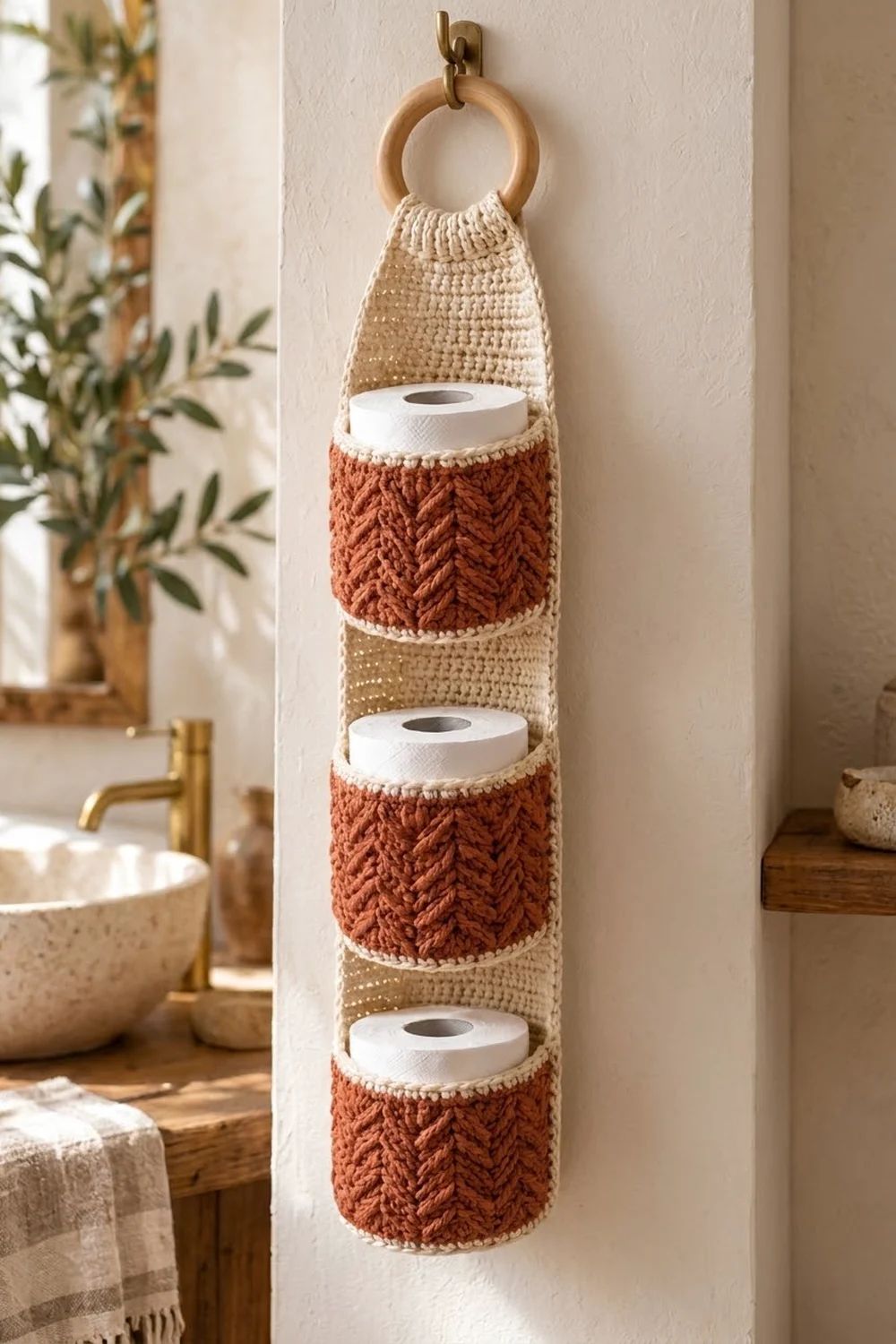
This hanging toilet paper holder is a tall cream panel with three rust-colored pockets stacked down the front. Each pocket is a small round cup that holds one standard roll, with the top of the roll peeking out about 1 in (2.5 cm) above the rim. The panel narrows at the top into a tab that wraps around a natural wooden ring, so the whole piece hangs from a single wall hook.
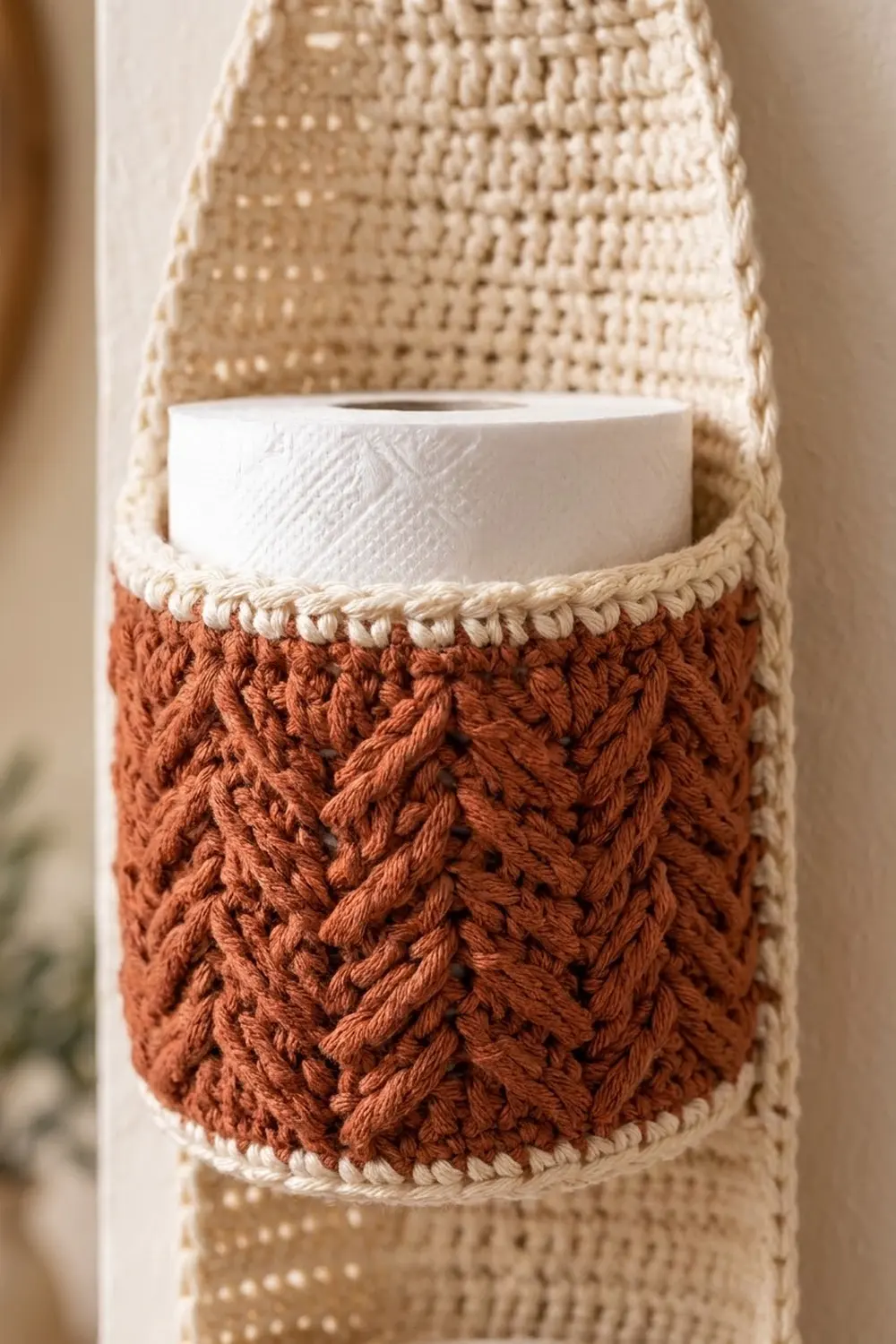
The color scheme is warm and earthy: a soft cream back panel and terracotta pocket walls. Every pocket wall uses herringbone half double crochet in turned rounds, which builds a dense, braided chevron texture. Thin cream bands, finished with crab stitch, trim the top and bottom of each pocket wall.
This pattern uses US crochet terms. The finished panel is 5.5 in (14.0 cm) wide and hangs about 23 in (58.4 cm) from the bottom edge to the top of the tab fold, with the 3 in (7.6 cm) ring above that. Each pocket is about 4.75 in (12.1 cm) across and 3 in (7.6 cm) tall.
You crochet the back panel flat in single crochet rows, starting at the rounded bottom and ending with the tab. Next you make three pockets in the round, sew them onto the panel, add a two-round border, and fold the tab over the ring.
Finished Size and Construction
- Finished size: 5.5 in (14.0 cm) wide x about 23 in (58.4 cm) hanging length, plus ring
- Skill level: Easy-intermediate
- Terminology: US crochet terms
- Yarn weight: Worsted (#4), cotton or cotton blend
- Hook: 5.0 mm (H-8)
- Number of pieces: 4 crocheted pieces (1 back panel, 3 pockets) plus 1 wooden ring
- Layout: 3 pockets stacked vertically, 1 column
- Piece sizes: Panel 5 in (12.7 cm) wide x 24.7 in (62.7 cm) long unfolded; pocket 4.75 in (12.1 cm) diameter x 3 in (7.6 cm) tall
- Panel size before border: 5 in x 24.7 in (12.7 cm x 62.7 cm)
- Border depth: 0.25 in (0.6 cm) on each edge
Materials
Pick a smooth worsted cotton or cotton blend. Cotton keeps its shape when loaded with rolls and copes with bathroom humidity. Pure acrylic tends to stretch over time. The amounts below assume roughly 1.8 m per gram.
- Cream: 200 g (360 m) for the panel, pocket bases, trims, and sewing
- Rust/terracotta: 120 g (216 m) for the pocket walls
The quantities include a margin of about 20% for swatching, tails, and differences in tension.
Tools:
– 5.0 mm (H-8) crochet hook
– Wooden ring, 3 in (7.6 cm) outer diameter
– Tapestry needle
– 4–6 locking stitch markers
– Straight pins
– Tape measure
– Scissors
– Wall hook for hanging
Abbreviations (US Terms)
- ch – chain
- sc – single crochet
- sc2tog – single crochet 2 together
- sl st – slip stitch
- MR – magic ring
- BLO – back loop only
- st(s) – stitch(es)
- yo – yarn over
- inc – 2 sc in the same stitch
- RS / WS – right side / wrong side
Herringbone half double crochet (hbhdc): Yo and insert the hook in the stitch. Yo and pull up a loop, then pull that loop straight through the stitch AND the first loop on the hook in one motion (2 loops remain). Yo and pull through both loops.
Crab stitch (reverse sc): With the RS facing, work single crochet from left to right, inserting the hook in the next stitch to the right. This makes a corded, beaded edge.
Gauge and Checkpoints
- Single crochet: 16 sts x 18 rows = 4 in (10.2 cm), i.e., 4 sts and 4.5 rows per inch
- Herringbone hdc in turned rounds: 16 sts x 12 rounds = 4 in (10.2 cm), i.e., 4 sts and 3 rounds per inch
Make one pocket before you start the panel, because it shows both gauges. Checkpoints:
- After pocket Rnd 10 the base should lie flat and measure 4.75 in (12.1 cm) across.
- The 60-stitch rim should measure 15 in (38.1 cm) around.
- After Rnd 20 the wall should stand 3 in (7.6 cm) tall.
Too big? Drop to a 4.5 mm hook. Too small? Go up to a 5.5 mm hook. Do not change stitch counts, since the panel width and pocket spacing depend on them.
Back Panel (Cream, Make 1)
Work back and forth in rows. Ch 1 at the start of each row does not count as a stitch.
Rounded Bottom
Row 1: Ch 13, sc in 2nd ch from hook and in each ch across, turn. (12 sts)
Row 2: Ch 1, inc in first st, sc in next 10 sts, inc in last st, turn. (14 sts)
Row 3: Ch 1, inc, sc 12, inc, turn. (16 sts)
Row 4: Ch 1, inc, sc 14, inc, turn. (18 sts)
Row 5: Ch 1, inc, sc 16, inc, turn. (20 sts)
Checkpoint: Width is 5 in (12.7 cm).
Straight Body
Rows 6–81: Ch 1, sc in each st across, turn. (20 sts) (76 rows)
Checkpoints: At Row 45 the panel measures 10 in (25.4 cm) long. At Row 81 it measures 18 in (45.7 cm).
Tapered Shoulder
Row 82: Ch 1, sc2tog, sc 14, sc2tog, turn. (18 sts)
Row 83: Ch 1, sc in each st, turn. (18 sts)
Row 84: Ch 1, sc2tog, sc 12, sc2tog, turn. (16 sts)
Row 85: Ch 1, sc across. (16 sts)
Row 86: Ch 1, sc2tog, sc 10, sc2tog. (14 sts)
Row 87: Ch 1, sc across. (14 sts)
Row 88: Ch 1, sc2tog, sc 8, sc2tog. (12 sts)
Row 89: Ch 1, sc across. (12 sts)
Row 90: Ch 1, sc2tog, sc 6, sc2tog. (10 sts)
Row 91: Ch 1, sc across. (10 sts)
Row 92: Ch 1, sc2tog, sc 4, sc2tog. (8 sts)
Row 93: Ch 1, sc across. (8 sts)
Checkpoint: The panel measures 20.7 in (52.6 cm) long. The top is 2 in (5.1 cm) wide.
Hanging Tab
Rows 94–111: Ch 1, sc in each st across, turn. (8 sts) (18 rows)
Checkpoint: The tab is 4 in (10.2 cm) long and the full panel is 24.7 in (62.7 cm). Fasten off and leave a 16 in (40.6 cm) tail for sewing the tab later.
Pocket (Make 3)
Work in joined rounds. Ch 1 or ch 2 at the start of a round does not count as a stitch.
Base (Cream)
Rnd 1: 6 sc in MR, sl st to first sc. (6 sts)
Rnd 2: Ch 1, inc in each st, sl st to first sc. (12 sts)
Rnd 3: Ch 1, (sc 1, inc) 6 times, join. (18 sts)
Rnd 4: Ch 1, (sc 2, inc) 6 times, join. (24 sts)
Rnd 5: Ch 1, (sc 3, inc) 6 times, join. (30 sts)
Rnd 6: Ch 1, (sc 4, inc) 6 times, join. (36 sts)
Rnd 7: Ch 1, (sc 5, inc) 6 times, join. (42 sts)
Rnd 8: Ch 1, (sc 6, inc) 6 times, join. (48 sts)
Rnd 9: Ch 1, (sc 7, inc) 6 times, join. (54 sts)
Rnd 10: Ch 1, (sc 8, inc) 6 times, join. (60 sts)
Checkpoint: The base is 4.75 in (12.1 cm) across and lies flat.
Wall Turn (Cream)
Rnd 11: Ch 1, sc BLO in each st around, join. (60 sts) The unworked front loops make the cream ridge along the bottom edge of the pocket, and the wall begins to rise. Change to rust on the final yo of the join.
Herringbone Wall (Rust)
Rnd 12 (RS): Ch 2, hbhdc in each st around, sl st to first hbhdc. (60 sts)
Rnds 13–18: Ch 2, turn, hbhdc in each st around, sl st to first hbhdc. (60 sts) (6 rounds)
Turning every round reverses the slant of the herringbone loops, which stacks them into the braided chevron columns. Rnd 18 is a RS round. Change to cream on the final yo of the Rnd 18 join.
Checkpoint: The rust band is 2.3 in (5.8 cm) tall.
Top Trim (Cream)
Rnd 19: Ch 1, do not turn, sc in each st around, join. (60 sts)
Rnd 20: Ch 1, crab st in each st around, join. (60 sts)
Fasten off and leave a 30 in (76.2 cm) cream tail for sewing. Weave in the rust ends on the inside.
Checkpoint: The wall is 3 in (7.6 cm) tall and the rim is 15 in (38.1 cm) around.
Make All Pieces
- Back panel: 1, all cream
- Pockets: 3, each with a cream base (Rnds 1–11), rust wall (Rnds 12–18), and cream trim (Rnds 19–20)
Layout, top to bottom (front view):
        [ ring ]
        [ tab  ]
       /  taper \
      |  clear   |   Rows 82–93 + about 2.5 in clearance
      | POCKET 3 |   base on Row 52
      | POCKET 2 |   base on Row 27
      | POCKET 1 |   base on Row 2
       \_bottom_/
Joining
Lay the panel RS up. Place a marker on panel stitch columns 2 and 19 at Rows 2, 27, and 52. The pocket bases sit on these rows, 25 rows apart (about 5.5 in / 14.0 cm). Pocket positions measured from the bottom edge before the border:
- Pocket 1: base 0.5 in (1.3 cm), rim 3.5 in (8.9 cm)
- Pocket 2: base 6 in (15.2 cm), rim 9 in (22.9 cm)
- Pocket 3: base 11.5 in (29.2 cm), rim 14.5 in (36.8 cm)
Stitch-to-stitch logic: Place a marker on the pocket rim. Count 18 sts and place a second marker. Those 18 sts (4.5 in / 11.4 cm) form the back arc. The other 42 sts (10.5 in / 26.7 cm) make the front that bows out around the roll. Panel columns 2 and 19 are 17 sts apart (4.25 in / 10.8 cm), so the back arc is eased in by one stitch and lies snug against the panel.
Method:
1. Pin the pocket so its base sits on the marked row and the two rim markers line up with columns 2 and 19.
2. Whipstitch with the cream tail straight down each marked column, catching the wall edge stitch and the panel stitch on every round (Rnds 11–20 on the pocket, about 13 panel rows).
3. Whipstitch along the base row across the 17 panel sts, going through Rnd 11 front loops.
4. Tack the 18 back rim sts to the panel, one tack per stitch.
Tension: Keep the stitches snug but not tight. Pull each one only until the yarn lies flat. If the seams pucker, the panel will curl around the pockets.
Checkpoint: Measure again after joining. The panel should still be 5 in (12.7 cm) wide and lie flat between the pockets. A roll should drop in easily and stand about 1 in (2.5 cm) above the rim.
Border
The border goes around the panel only. The pockets are sewn one column inside each edge, so they stay clear of it. All counts come from the panel’s own rows and stitches.
Border gauge: One sc per row end gives 4.5 sc per inch along the sides, which matches the row gauge.
Rnd 1 (cream): Attach cream yarn in the first st of Row 1.
– Bottom edge: 3 sc in first st, sc in next 10 sts, 3 sc in last st. (16 sts)
– Side 1: 1 sc in each row end of Rows 2–110. (109 sts)
– Top edge (tab): 3 sc in first st of Row 111, sc in next 6 sts, 3 sc in last st. (12 sts)
– Side 2: 1 sc in each row end of Rows 110–2. (109 sts)
– Sl st to first sc. Total: 246 sts
The 3-sc corner groups are counted in the top and bottom edge totals. They are not counted again in the sides. They wrap around the end stitches of Rows 1 and 111, so those row ends need no separate sc.
Rnd 2: Ch 1, crab st in each st around, sl st to first st. (246 sts) Fasten off.
Why the math works: The sides have 4.5 rows per inch and get 4.5 border sc per inch, so the edges neither ruffle nor pull in. The 3-sc groups add the two extra stitches needed to turn each 90° corner. Crab stitch is worked one-to-one and needs no corner increases. Together the two rounds add 0.25 in (0.6 cm) per edge. The width goes from 5 in (12.7 cm) to 5.5 in (14.0 cm), and the unfolded length from 24.7 in (62.7 cm) to 25.2 in (64.0 cm).
Final Blocking
- Lightly mist the panel and pockets with water. Do not soak them.
- Pin the panel flat at 5.5 in (14.0 cm) wide. Keep the long edges straight and the bottom curve smooth.
- Stuff each pocket with a toilet roll wrapped in a plastic bag so the wall dries round.
- Let everything dry completely, then unpin.
- Pass the tab through the 3 in (7.6 cm) ring from front to back and fold it in half. Sew the top edge of the tab to Row 93 on the back with the tail.
- Hang the holder and check that it measures about 23 in (58.4 cm) from the bottom edge to the top of the fold.
Final Quality-Control Checklist
- Panel is 5.5 in (14.0 cm) wide from bottom to taper
- All three pockets have 60 sts and are 3 in (7.6 cm) tall
- Pocket bases sit on Rows 2, 27, and 52
- Herringbone texture alternates direction on every round
- Border Rnd 1 counts 246 sts
- Tab is sewn securely and the ring turns freely
- All ends woven in on the WS or inside the pockets
Troubleshooting
- Pocket base cups or ruffles: Your tension changed during the base. Rework Rnd 10 more tightly or more loosely so the base lies flat at 4.75 in (12.1 cm).
- Herringbone looks like plain hdc: You are missing the pull-through. The first loop must go through the stitch and the loop on the hook together.
- Seam line wanders in the wall: The join sl st was not worked into the first st. Mark the first st of every round.
- Panel curls at the sides: The border is too tight. Redo Rnd 1 with a hook one size larger.
- Pockets droop forward: Add a second line of tacks between the rim and the panel.
- Roll won’t fit: The pocket is under gauge. Remake it with a larger hook.
Care
Hand wash in cool water, press out the water in a towel, and dry flat with the pockets reshaped around rolls. Do not tumble dry, because the heat can shrink cotton unevenly.
Final Notes
Each measurement depends on the one before it. A 4 in (10.2 cm) gauge of 16 sts gives a 20-st, 5 in (12.7 cm) panel. 111 rows give 24.7 in (62.7 cm). The 60-st pocket rim gives a 4.75 in (12.1 cm) cup. The 246-st border adds 0.25 in (0.6 cm) per edge for a 5.5 in (14.0 cm) finish. Folding the tab over the ring gives a hanging length of about 23 in (58.4 cm). If you check each stage, the three rolls will sit neatly in their pockets.
Happy crocheting!